
ABOUT TRISH CORTES:
Trish Cortes is the executive director of Washtenaw County Community Mental Health. She serves as an organizational representative on the WHI Steering Committee.
ABOUT ANDY LABARRE:
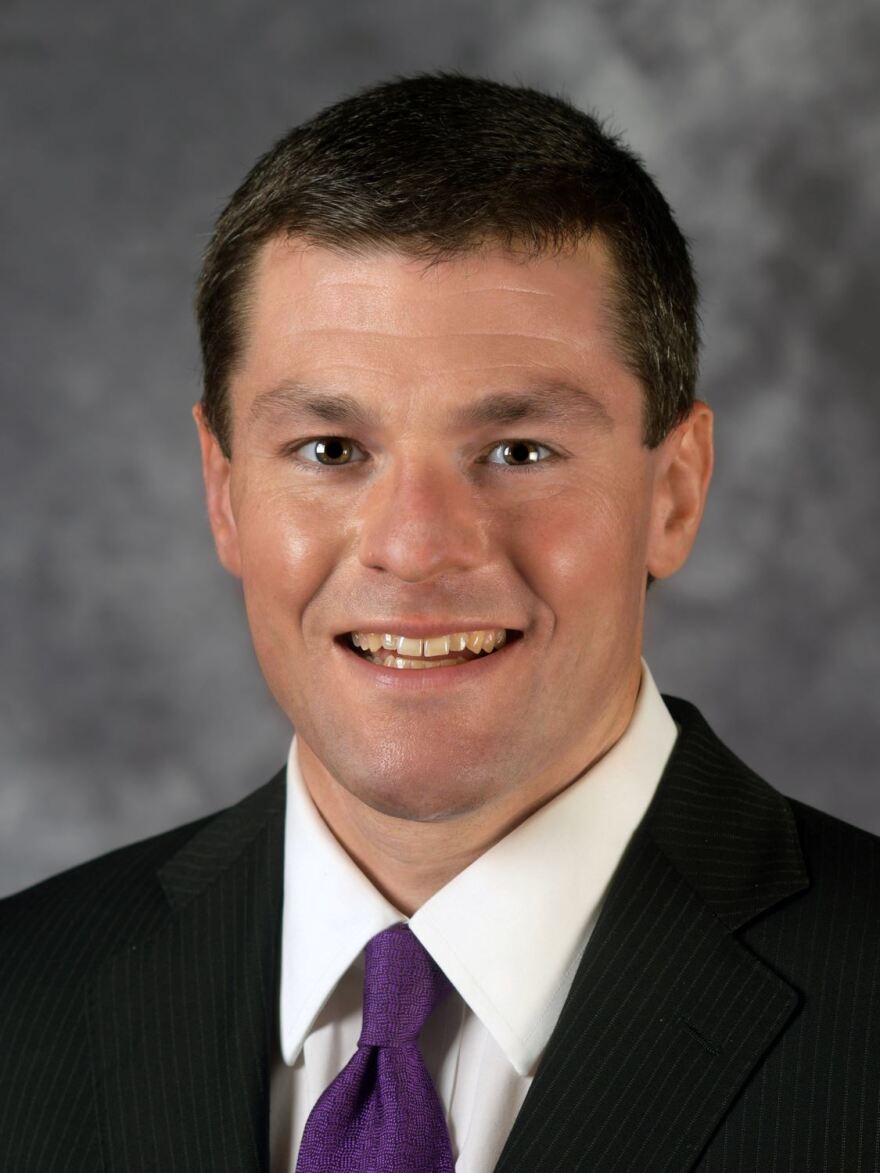
Andy LaBarre
/
andylabarre.com
A2Y Chamber Executive Vice President & Director of Government Relations Andy LaBarre.
Andy LaBarre was first elected to the Washtenaw County Board of Commissioners in 2012, representing District 7, located in the eastern half of the City of Ann Arbor. Andy is a proud Democrat. He served as Vice Chair of the Board of Commissioners and previously served as Chair of the Board (2017-18), Chair of the Ways and Means Committee (2015-16), and Chair of the Working Session Committee (2013-14). Andy lives in northern Ann Arbor with his wife Megan (a teacher at Dexter Community Schools), son Declan, daughter Delaney, and dogs, Monster and Frankie.
Andy now serves as Executive Vice President and Director of Government Relations for the Ann Arbor/Ypsilanti Regional Chamber and is David Fair’s co-host for “Washtenaw Business Lens.”
RESOURCES:
Washtenaw County Community Mental Health
TRANSCRIPTION:
Caroline MacGregor: This is 89.1 WEMU and it’s time for our monthly look at the business community in Washtenaw County. I’m Caroline MacGregor, and welcome to Washtenaw Business Lens. Each month, we partner with the Ann Arbor/Ypsilanti Regional Chamber to look at how the news of the day impacts the local business community. Andy LaBarre is Executive Vice President and Director of Government Relations for the Chamber, and he is a part of each month’s conversation. Thank you for joining us today, Andy!
Andy LaBarre: Caroline, thank you for having me and for facilitating this conversation!
Caroline MacGregor: Today, we are going to take a look at how the City of Ann Arbor is facing rising homelessness and some mental health issues that are affecting downtown businesses. And some of these businesses say they are losing their vibrant State Street District rather rapidly, to quote one business owner. With us today to discuss this is Trish Cortes. She is the Executive Director at Washtenaw County Community Mental Health. Trish, thank you so much for your time today!
Trish Cortes: Good morning, Caroline! And thank you for having me!
Caroline MacGregor: Trish, a meeting was held recently, Tuesday, June 2nd to be specific, with representatives from the Downtown Development Authority, the Ann Arbor Police Department and, of course, the Ann Arbor/Ypsilanti Regional Chamber and yourselves, Washtenaw County Community Mental Health. A lot of business owners were there talking about what they are perceiving as a real impact to their business, and this is due to people exhibiting mental health issues, homeless people on the streets who are deterring customers from coming into their businesses. Can you tell us, first of all, Trish, a little bit about this workshop?
Trish Cortes: So, the intent of the workshop was community mental health. We are trying to do a more aggressive campaign around crisis response for mental health needs in general in the community. So, we have done some town hall meetings. I spoke with Andy LaBarre about an opportunity to talk with some of the DDA and some of the merchants as well as in schools. The audience at this particular venue was the DDA and the merchants to just like, you know, what to expect if you call our crisis line, what you shouldn’t expect when you call the crisis line, to educate folks what we do and how we do it and what the expectation should be.
Caroline MacGregor: What were some of the concerns that you were hearing from local businesses?
Trish Cortes: To be honest with you, the concerns that we hear is really on business owners that are concerned. I really need to say that my staff and I were extremely struck by how compassionate these business owners were about what they were seeing. It was nothing, but how do we help address the issues that these individuals are facing? I can tell you from the community mental health lens, the calls that we’re receiving was “There’s someone here who needs help. What do I do?” And that is really kind of the place where all the phone calls to us come from. But what we heard in the meeting was that there’s individuals are just loitering in front of their businesses, not picking up after themselves, etc. But, really, when we get phone calls, it’s really out of concern for the individual.
Caroline MacGregor: Are the amounts of calls, though, that you are receiving higher, for example, versus last year?
Trish Cortes: You know, I really can’t say that whether the calls have been more. What I can say is that there is an increase in unhoused individuals across all of Washtenaw County and the state and the country. That is definitely a local, state and national trend.
Caroline MacGregor: When your staff are interacting with people in a mental health crisis, I know you obviously can work with the Sheriff’s Department and police, but what is the balance between listening and engaging when trying to meet their needs, while maintaining overall safety and behavioral boundaries?
Trish Cortes: Well, for my staff and for individuals who are experiencing a mental health crisis in our world, we talk about whether an individual has insight into their own mental illness. Untreated mental illness is, many times, individuals just do not have that insight. So, we really talk about engaging individuals and trying to meet their basic needs to then gain trust, to have them want to participate and get them into treatment. Now, when an individual is starting to exhibit aggressive or disruptive behavior, they’re either putting others or themselves in harm, we, number one, first try to de-escalate compassionately or sometimes it does involve law enforcement, and that’s where well-trained law enforcement can do an excellent job of deescalating situations and keeping that individual and others safe.
Caroline MacGregor: I wanted to turn to Andy. Andy, as Executive Vice President and Director of Government Relations for the Chamber, you’re obviously in close touch with many businesses in the downtown area. What are you hearing?
Andy LaBarre: Sure. Generally, Caroline, there’s a balance that folks are trying to strike where they are, as Trish said, trying to respond to the human needs of the individuals who are in either mental health distress or perhaps experiencing homelessness, trying not to be punitive in their response to those individuals, trying to get them the resources they need while also maintaining sort of the overall order, so that they can operate those businesses successfully. I think the biggest takeaway is part of what makes Washtenaw County’s communities vibrant is the influx of human beings. It’s managing those relationships in a way that meets the safety needs and the social needs that takes work. And so, we were really excited to partner with CMH and the DDA to connect our business owners and operators to the resources that do exist in this community and candidly to the expertise that CMH brings to this equation, of meeting mental health needs out in the community.
Caroline MacGregor: We’ve heard reports that these businesses feel, I’ve heard words like besieged all day long by people with mental health issues or homeless people. I believe one restaurant is considering leaving: Real Seafood Company. Is that true?
Andy LaBarre: Caroline, I haven’t seen anything on that, so I can’t speak to it, but I think, generally, operating a business is an intensive process. Right off the bat, there’s a lot of effort that goes into that equation. I think any additional burden on that or additional layer of responsibility can make it harder.
Caroline MacGregor: Trish, what is the relationship between your staff and unhoused persons who are long-term members of the community and how does this impact service options?
Trish Cortes: Well, we actually have a team that is dedicated to doing outreach to individuals who are unhoused. The name of the team is the PATH Team. That is actually their whole focus. I will say that because of the growing number of need across all of Washtenaw County, we’ve had to increase the number of individuals on it. There are master’s level social workers, bachelor’s level of social workers, as well as peer support specialists, who are individuals who have lived experience in homelessness and in mental illness. Those teams actually spend their time doing outreach. Now, our workshop was about crisis response. So, obviously, the crisis team and the PATH team work closely together but yes we have a team that this is what they do.
Caroline MacGregor: With regards to homeless people, people who are interfering with businesses due to mental health concerns, how is your organization engaging with these specific people now to remove this concern for business owners?
Trish Cortes: Well, what the PATH Team does is, it’s actually quite fascinating, every once in a while, I’ll take some elected officials out to go with the PATH Team to actually see what the worker looks like, boots on the ground. Our board members actually do that. I think, Andy LaBarre, you may have gone on that tour if I’m remembering correctly.
Andy LaBarre: Sure have! It’s impactful!
Trish Cortes: Yes, yes! The PATH Team starts early when individuals who are especially like camping are waking up and making their way to many times as to a free breakfast where, here in Ann Arbor, that is St. Andrews, that is a popular place to receive a free breakfast, and they use that opportunity to try to you know engage with with individuals. And again, lots of these individuals are either distrustful of systems or they have no insight into their mental illness and conditions. And so, it’s really about sitting down and having breakfast with them, getting to know them, and they really just try to find these individuals, and we use the term meet them where they’re at literally and figuratively. So, what is it that their needs are that day and where can you find them? And so really, that is where the process is that, wherever it is, they are trying to engage those individuals, see how they can help them, what do you need today, and really build that relationship and that rapport to then have that individual be willing to come in and perhaps see a psychiatrist, see one of our social workers, see a therapist, etc. So, I mean, I think the takeaway is the approach is meet people where they’re at, figuratively and literally.
Caroline MacGregor: So, keep the humanity element intact. In closing, Andy, do you have any general advice for businesses as we head into a busy and probably very hot summer?
Andy LaBarre: I think the first and best advice is to contact CMH now before there are issues, develop a relationship and understand the resources that are on hand through Washtenaw Community Mental Health. It really is a pretty massive resource available to our community, but the more you know ahead of time, the better able you will be to navigate those situations. I also think that, generally, businesses should understand and all of us should, as temperatures increase, people get a little bit more on edge generally. And that is a human reality, but that’s all the more reason to understand the resources that exist in this community and to have a proactive plan to respond.
Caroline MacGregor: Trish, anything you’d like to add to that?
Trish Cortes: No, I think that is very well-said.
Caroline MacGregor: I’ve been speaking with Trish Cortes. She serves as the Executive Director of Washtenaw County Community Mental Health, and she has been our guest on Washtenaw Business Lens. This regular conversation series is brought to you in partnership with the Ann Arbor/Ypsilanti Regional Chamber. And each month, we also hear from the Chamber’s Executive Vice President and Director of Government Relations—that’s Andy LaBarre. Andy, I look forward to seeing you in July.
Andy LaBarre: Caroline, thanks so much! And looking forward to spending the summer with you!
Caroline MacGregor: I’m Caroline MacGregor and for more information on Washtenaw Business Lens and today’s topic stop by our website at WEMU.org. This is your community NPR station, 89.1 WEMU Ypsilanti.

A2Y Chamber
/
a2ychamber.org
Non-commercial, fact based reporting is made possible by your financial support. Make your donation to WEMU today to keep your community NPR station thriving.
Like 89.1 WEMU on Facebook and follow us on X (Twitter)
Contact WEMU News at 734.487.3363 or email us at studio@wemu.org