
 Ypsilanti Community Middle School Principal Charles Davis Jr. says students’ academic performance has improved as a result of a school mentorship program called Young Kings, funded by a mental health mini-grant. Doug Coombe
This article is part of a series about mental health in Washtenaw County. It is made possible with funding from Washtenaw County’s Public Safety and Mental Health Preservation Millage.
Over the last seven years, many Washtenaw County students and their teachers have been empowered to lead mental health-related projects through a series of mini-grants. The mini-grant program is made possible through Washtenaw County’s Public Safety and Mental Health Preservation Millage, and awarded and administered by the Washtenaw Intermediate School District (WISD). For Shannon Novara, program manager of the Bridge Team at WISD, the support is priceless.
“I can’t say enough about how helpful it has been, and how impactful it is for the young people in our community,” she says. “They offer schools the opportunity to spend funds in the way they feel is best. It is really specific to their individual needs in their school building.”
In the beginning, funding was available solely for high schools. Over time, it expanded to middle schools. Following repeated inquiries from educators, Novara opened it to elementary schools as well. Middle and high schools can apply for up to $5,000. Elementary schools, which are usually smaller in size, can apply for up to $2,500. The last round of funding assisted 38 schools, with projects including calm spaces, mindfulness training, and mentorship programs.
While the funding opportunities have historically been referred to as mini-grants, Novara says “there’s not much ‘mini’ about them.” The schools are required to create reports on their projects and she describes their stories of impact as “really, really amazing.”
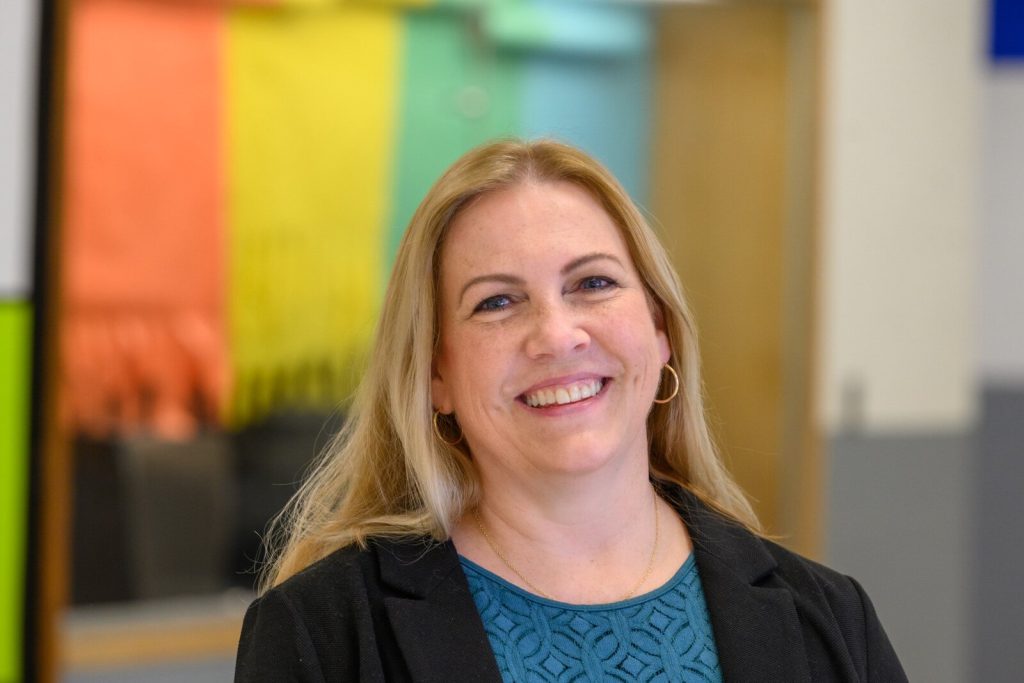 Shannon Novara. Doug Coombe
“I get choked up thinking about them, … every single one,” she says. “Sometimes the project may not seem that original, but then when I hear how much it mattered to a student [and] what a difference it made, it’s so incredible [and] totally worth it.”
For example, Novara says many of the elementary school grantees have chosen to spend the funds on furnishing calm spaces. Sometimes a calm space occupies just one room in the building, and sometimes there’s a calm corner in every classroom. Mini-grants allowed schools to purchase things like fun area rugs, bean bag chairs and alternative furniture, fairy lights, and fidget toys.
“These are often the type of things that they would potentially otherwise purchase on their own,” Novara says. “It’s things that they know that kids need but aren’t going to be funded by the districts’ general funds.”
The power of comfy carpets, bean bags, crash pads, and sensory tools
At Whitmore Lake Public Schools, a mini-grant helped create not one, but two, calm spaces. Amber Masterson, a school social worker, and Amber Stewart, a behavior specialist, both used the funds to create cozy, trauma-informed rooms. The grant paid for rugs, cushions, books, fidget toys, seating, therapeutic lighting, and crash pads (large, padded, bean-bag-like mats for kids to rest or play on). Students use the rooms when they need a break or would like to confide in a safe adult.
“I see big behaviors, right? We give students a body movement break,” Stewart says. “A trampoline and crash pad are things that I got with the mini-grant money and they are utilized daily, multiple times a day.”
Masterson shares that the mini-grant allowed them to buy an Omi the Elephant toy. The stuffed animal has features that include music and meditation prompts. Masterson says Omi helped a student who was having panic attacks every day due to separation anxiety. The student would be hyperventilating when she was dropped off at school.
“She would come in, take off her shoes, get on the carpet, and lean against a bean bag,” Masterson says. “I would cover her up with a soft blanket, and she would hold this elephant and sip her water.”
Together, they did breathing activities over and over. The student would listen to Omi’s prompts.
“We would do that until her body became calm, and then she was ready to go back to class,” Masterson says.
At one point the student saw Masterson in the hall and told her, “I haven’t had a panic attack in a long time.”
“I said, ‘I know. I’ve noticed,’” Masterson says.
Masterson feels that her room “would not be as effective if it was just a table and chairs.”
“I could still walk her through breathing,” she says. “But just having the bean bags, the blanket, the stuffed animal, and the meditation tools, it was effective in helping her a little bit more quickly than what might have happened without it.”
Doorways to helping students get back on track
If a day becomes overwhelming for 10-year-old Ryann Brigham, a student at Mitchell Elementary School in Ann Arbor, she knows that she can head over to her school’s mini-grant funded Green Relax Room. It’s a dedicated space where students can calm down and release stress. An LED color-changing lamp, bean bag chairs, weighted blankets, a pop-up sensory tent, a plush area rug, floor cushions, a rocking chair, fidget toys, and puppets are some of the key features.
Recently, Brigham says she spent five minutes there to regulate her emotions after she got “really mad” at a substitute art teacher.
“She was making me lead the class because I was talking, and I was like, ‘Nah,’” she said. “There were all those kids yelling at me for being a bad teacher. … One time, though, I did yell at everybody to shut up.”
Things took a positive turn after a staff member walked Brigham (and one of her friends) to the calm space. After stepping into the Green Relax Room, Brigham says she felt “a lot better.” She adds that when she returned to class she felt “less likely to yell” at her classmates.
Samantha Cucu, Mitchell Elementary’s principal, says there has been an understanding that the school’s students “were not ready for the challenges or rigor of the classroom with their own dysregulation.” So her and her staff’s goal last year was to create safe spaces that students could enjoy when they wanted to.
“Our students are coming from vast experiences, and trauma and socioeconomic statuses that don’t always support the needs of families or students,” she says. “So we’re always trying to come up with ways that we can find spaces and supports to meet the diverse needs of our students.”
Students were directly involved in creating the Green Relax Room. They helped to pick themes and colors (including nifty neon green walls, the room’s namesake), select items, assist in setting up the room, and co-create the expectations of use.
“They have a lot of cozy stuff to lay down. There’s stuff to make art and coloring books and stuff,” Brigham says. “The lighting is very dim when you turn it off, and so it’s a lot less bright, and there’s a lot of pillows and blankets.”
Cucu says students can self-initiate visits or they might be prompted by a teacher to go to the Green Relax Room. They use the tools for 10 minutes or less to reset and get back on track.
Brigham shares that before the Green Relax Room was made possible, she would “just basically sit in the hallway.” It wasn’t comfortable and other students would often be yelling. She feels that every school should have a similar space.
“Kids like me can get overwhelmed, and they don’t have anywhere to go when they do,” Brigham says. “I feel like at least one person at every school is like me. They should have somewhere to go when they need a break.”
Setting students up for a lifetime
Mini-grant funds have also supported a mentorship program at Ypsilanti Community Middle School called Young Kings. Young Kings fosters social-emotional learning for African-American boys in grades six through eight through mentorship, restorative circles, and hands-on activities. Students learn about topics including financial literacy, how to tie a bowtie, and how to change a car tire.
“Part of it is Manhood 101. A lot of young men in our building unfortunately don’t have a father or a father figure in their lives,” says the school’s principal, Charles Davis Jr.
Davis says his own single mom was unable to teach him certain things, such as how to tie a tie. When he learned how to do so, he taught his younger brothers. He wants students in the Young Kings program to experience the same important rites of passage and gain the same life skills that he gives his own son.
“A lot of the young men that we deal with on a day-to-day basis are all raised by moms, and so some of them are … lacking some of the strategies,” Davis says. “Like, they’re super-emotional and they don’t know how to deescalate. So we’re trying to give them some of those skills.”
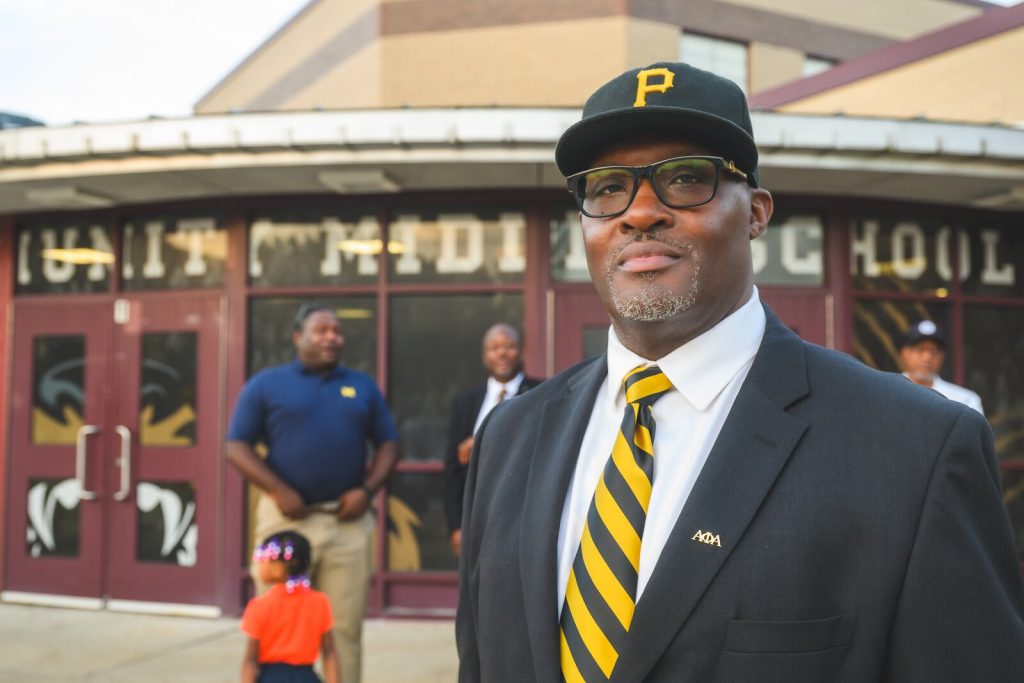 Charles Davis Jr. Doug Coombe
Mini-grant funding has been important in efforts to teach students stress management. The Young Kings program has offered resources including a relaxation class, journaling, fruit-infused water, treadmills, and a massage chair.
“Their grades have gone up. Their attendance is higher. Academics went up, attendance went up, and the number of office referrals have gone down,” Davis says. “We’re just trying to help them have different outlets and strategies to deal with the stress that they deal with on a day-to-day basis.”
He explains that when it comes to social-emotional learning and “having a healthy social- emotional status,” African-American boys are often not encouraged to cry or talk about how they feel. Davis says he’s seen “the depths of the trauma that a lot of the kids have been a part of that they never shared, but they felt safe enough to share” in the restorative circles.
“It was surprising – not that they had it, as much as they felt comfortable enough to share,” he says. “Some of the stuff that the kids say to help each other is really a big, big deal to me.”