
SANTA CRUZ — Santa Cruz County unveiled the Behavioral Health Bridge House, a new temporary housing facility focusing on behavioral health supporting people transitioning out of homelessness, on Soquel Avenue Tuesday.
The facility aims to provide trauma-informed care and behavioral health services through Santa Cruz County’s Integrated Housing and Recovery Team and Housing Matters with 32 beds including individual and shared units.
In addition to bed units, the facility includes shared bathrooms, a shared kitchen, a multipurpose room, internet access, heating and air conditioning, said Santa Cruz County Executive Officer Nicole Coburn.
“It’s going to bring together housing, behavioral health and medical care all in one place so that people can access each of those services,” Coburn said. “This will have the impact of creating a more stable and supportive environment that fosters that long-term recovery.”
The facility, near Capitola Road Extension and across the street from the Harbor High athletic fields, was funded largely by a $10.2 million grant from the California Department of Healthcare Services, according to Santa Cruz County Behavioral Health’s website.
Bridge House, which had been in the works for about three years, is located down the street from Santa Cruz County Psychiatric Health Facility, where District 1 Supervisor Manu Koenig said people often spend 72 hours under intensive care to get stable, but many times end up living back on the street.
Instead, people can spend up to six months at the Bridge House facility, where they work with housing coordinators to find permanent housing, Koenig said.
“Here, people will be able to come just steps away for up to six months, where we can work with them, developing relationships and doing the work so they can truly transform and turn their lives around,” he said.
The facility is expected to serve about 60 to 80 Santa Cruz County residents each year, Coburn said. Residents will receive coordinated services through the county’s integrated housing and recovery team and 24-hour, on-site support from Housing Matters.
Bridge House is a referral-based facility and will prioritize people in the Community Assistance, Recovery, and Empowerment plan, according to Santa Cruz County Behavioral Health’s website.
Santa Cruz County is at a turning point in reducing homelessness, Koenig said, with the rate of homelessness being reduced by 40% since its peak in 2022.
Bridge House is one of several new supportive housing communities in Santa Cruz County. The Watsonville Low Barrier Navigation Center, known as a “tiny village,” is targeted to people who had been living along the Pajaro River levee and was unveiled in September 2025.
The tiny village and Bridge House modular housing were both designed by LifeArk, a company that says it creates “safe, sustainable and affordable homes for people living in low-income, marginalized communities around the world.”
Paul Cho, LifeArk chief financial officer, said the units’ primary load bearing material is made of plastic and includes 30% recycled plastic.
Cho said that despite people’s concerns about plastic being bad for the environment, when used for long-term projects such as their housing, instead of for single-use disposable items, it can be a durable and inexpensive product.
“You’re not going to throw this away,” Cho said. “This is not going to end up in a landfill, so the use of this plastic material is very unique. We’re the first company to have gotten all of the certifications to be able to use it as a load bearing material.”
Robert Ratner, Santa Cruz County Housing 4 Health Partnership director, said that while the name partially came from Behavioral Health Bridge Housing funding from the state, it fit well with the facility’s mission.
“It’s not where people are going to spend the rest of their lives,” Ratner said. “It’s a bridge from coming from a challenging health situation to more stability and getting your own place.”
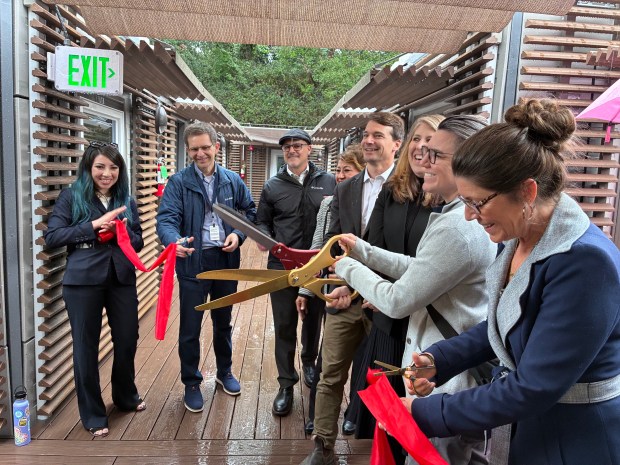 Bridge House project leaders from Santa Cruz County and Housing Matters cut a ribbon to mark the opening of the new transitional housing project. (Gabrielle Gillette – Santa Cruz Sentinel)