
The vast majority of teenagers are “extremely totally all right,” Ross writes in How to Thrive at College. Photo via iStock/FatCamera
Mental Health
Student Health Services psychiatrist discusses the major forces—from trauma and poverty to sex and marijuana—impacting mental health of young people
As the United States was emerging from the COVID-19 pandemic, Mathilde Ross became concerned about what she saw as the media’s counterproductive reporting on the mental health of young people. A senior staff psychiatrist in Boston University’s Student Health Services for nearly 20 years, Ross is well-versed in the factors that lead to mental health issues.
 Ross, a senior psychiatrist at Boston University’s Student Health Services since 2008, says that she set out to write a book that gives teenagers the knowledge and skills to avoid some of the common pitfalls of young adulthood. Photo by Jackie Ricciardi
Particularly vexing to her was the media’s relentless push to ascribe a single explanation to what many were portraying as a mental health crisis on college campuses—especially the preoccupation with cell phones.
“Most of what was being discussed in the public was either inaccurate or unhelpful or both,” Ross says. “To listen to the media, you’d think, oh, if only there were no cell phones, we’d have a generation of everybody being fine. Or maybe global warming was the culprit.
“There were a series of topics going through pop culture that people would talk about and then drop. And the biggest risk factors for serious mental health problems—poverty and trauma—weren’t being discussed at all.”
So Ross decided to address the public confusion herself. Her new book, How to Thrive at College: A Guide to the Ups and Downs of Mental Health on Campus (Diversion Books, 2026), is a practical primer for teenagers and young adults—and their parents—that seeks to demystify mental health, discuss risk factors, and highlight strategies for broaching difficult topics.
BU Today sat down with Ross to talk about the book and some of the pressing issues she’d like to see getting more attention. The interview has been edited for length and clarity.
Q&AWith Mathilde Ross
BU Today: You begin the book with a dose of good news. You write: “The kids are all right. Not every single one, but the vast majority are very extremely totally all right.” Why was that important to stress right up front?
Ross: Because parents are wigging out. Teenagers are moody. They just are. It has ever been thus. I think 15 years ago, if you had a moody teenager, you were like, “Oh, a moody teenager.” But there was something about the climate coming out of the pandemic that made people think every moody teenager was at risk of serious mental health problems, when the reality is most are not. One of the things that’s been driving me bananas about the public conversation about mental health is all the doom and gloom. The reality is that young people are incredibly robust and resourceful. The pandemic was terrible for young people, but they were over it about a year and a half before people stopped talking about it.
BU Today: You offer a lot of guidance for parents about what to say—and what not to say—to their kids. What’s the one thing you want parents to take away from your book?
Ross: One thing I would like parents to understand is that for your kid’s prognosis in adult life, their relationship with you is going to be more important than any particular decision they make. Parents really underestimate how much their teenagers hang on their every word. Kids, especially teenagers, act like they’re not listening, or like they don’t care what you say. But the reality is the opposite. They’re listening to every word and they’re going to remember the thing that you most wish they wouldn’t remember. If you’re going to make a mistake as a parent, make the mistake of erring on the side of always telling them that you accept them no matter what. I see so many instances of parents blowing up their relationship with their kid over something stupid, thinking that it’s going to help their kid in the long run, when really the thing that’s going to help their teenager is being connected to you and being accepted.
You want a kid who is going to call you in a crisis, a kid who, when the sh*t hits the fan, isn’t afraid to pick up the phone and say, “Hey, dad, the sh*t is hitting the fan.”
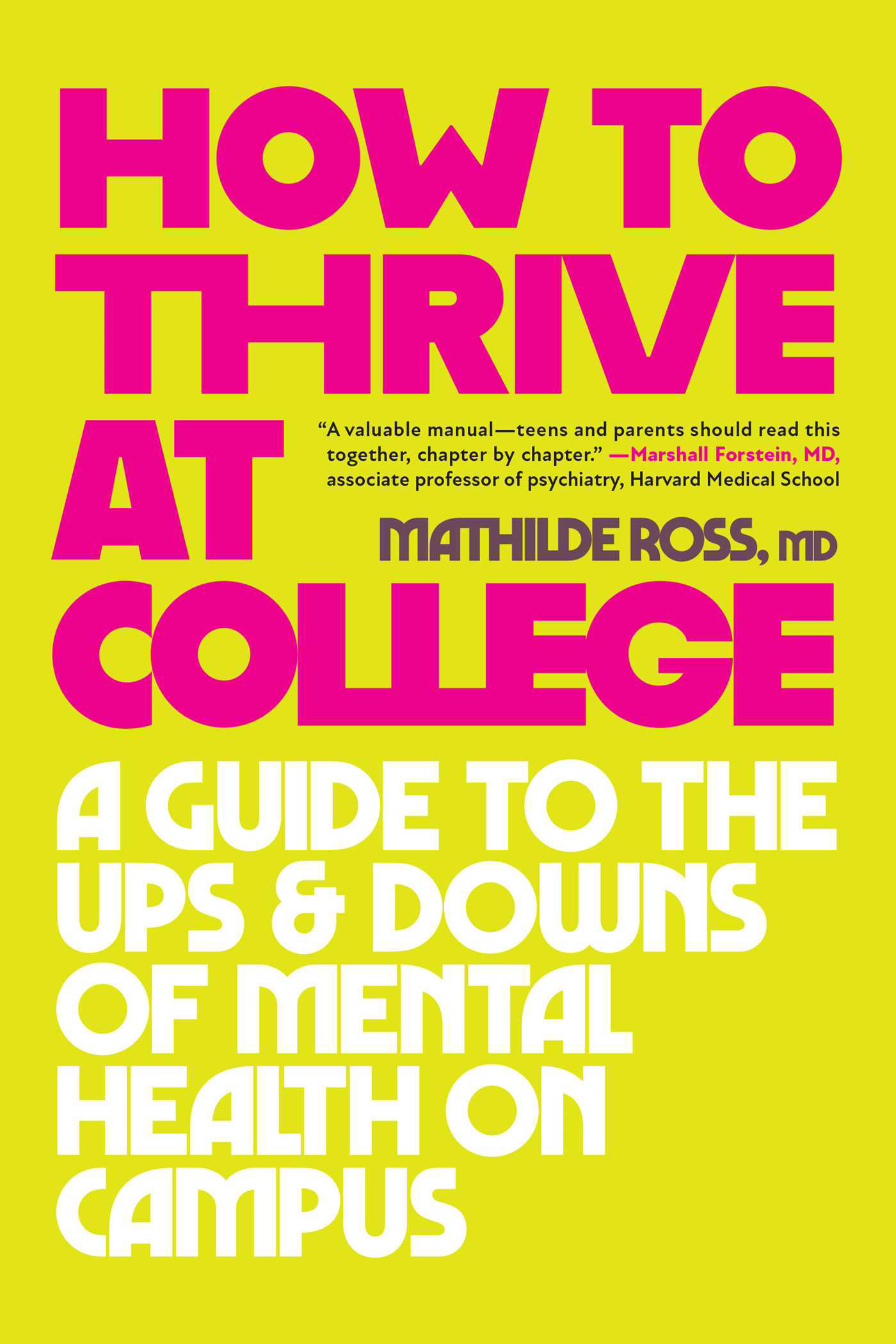 Cover courtesy of Diversion Books
BU Today: You also recommend that when kids are old enough to get a cell phone, their parents help them program in the numbers of some other adults they’re close to. Why is that so important?
Ross: Lots of emergencies are things you don’t want to call your parents for: you’re drunk and you’re somewhere you’re not supposed to be and you need a ride home, or you have a pregnancy scare or an STD. These aren’t things people want to call their parents about, but they are things that can send people down a path of even riskier decisions. A neutral adult can really help keep things from escalating.
BU Today: You write that a lot of mental health issues among college students could be averted if they took better care of themselves—slept eight hours a night, ate regularly, limited caffeine and alcohol. But you also say that, to a surprising degree, college students don’t know how to take care of themselves.
Ross: I spend a lot of time in the book talking about the basics, because in my office, I spend a lot of time talking about the basics. Simple grown-up self-care can seem so pedestrian, but it’s often the biggest issue.
 “Marijuana has been a disaster for young people,” Ross says, noting that while it’s low risk for most people, it’s extremely high risk for others, “and there’s no way to know which group you’re in.” Photo via iStock/KatarzynaBialasiewicz
BU Today: In the book, you flat out state that “marijuana really is bad for young people.” How does it contribute to mental health crises?
Ross: I have often joked that if marijuana didn’t exist, we could function with half our staff. It’s pretty common for a person to come in with symptoms that cluster around the fact they’re not motivated, they’re feeling kind of down, they can’t concentrate. This is pretty commonly due to marijuana use, or at least exacerbated by it. The shift in social attitudes toward marijuana has been a disaster for young people since it became legal. In Massachusetts, there are more and more people using pretty heavily, with a lot of bad consequences, sometimes devastating consequences. It often causes depression or anxiety, as well as poor academic performance, and it can cause devastating psychosis, which sometimes gets better, but not always.
BU Today: You write that you wish teenagers were coming to college better educated about sex. Can you talk about how sex can lead to mental health consequences?
Ross: Sex ed programs are doing a good job of informing young people about STI [sexually transmitted infections] prevention and contraception and even consent—but surely sex is about more than preventing infection or pregnancy. Many young people are unprepared for the emotional complexity of being in a sexual relationship. It’s not really possible to separate physical intimacy from emotional intensity, and trying to do so often comes with an emotional price tag. This is especially true for young people.
 “What is missing in the way we talk about sex is any discussion about how it intensifies relationships,” Ross says. Photo via iStock/portishead1
BU Today: Later in your book you talk about suicide and suicide prevention. What do you hope young people and parents take away from your book regarding this topic?
Ross: Suicidal ideation is typically a transient state, and most people who experience it go on to live completely normal lives. This is why knowing about suicide hotlines like 988 Lifeline is so important. Just holding someone on the phone for 15 minutes can be enough for the moment to pass, and suicide hotlines do so much more than that. All teenagers should have knowledge of and access to suicide hotlines.
Mathilde Ross will discuss her book, How to Thrive at College: A Guide to the Ups and Downs of Mental Health on Campus, on Tuesday, April 28, at Wellesley Books, 82 Central St., Wellesley, Mass. Find more information and purchase tickets here.
BU students seeking support can reach out to Student Health Services, which also offers a 24/7 on-call service for mental health emergencies at 617-353-3569; faculty, staff, and employee family members can contact BU’s Faculty & Staff Assistance Office for help with work and life challenges. The 988 Suicide & Crisis Lifeline has resources to support yourself and help others, as well as a chat service to talk with crisis counselors 24/7.
Explore Related Topics: