
Cynthia Whitaker sat alone on a bench at center stage, her face bathed in a warm glow.
She had just begun to peel back the layers of her mental health journey when a gentle voice came from offstage, encouraging her to lift her gaze and look farther out, so her story could reach every corner of the room.
On Thursday evening, Whitaker joined fellow performers at the Bank of New Hampshire Stage in Concord to rehearse for the National Alliance on Mental Illness’ “This Is My Brave,” a showcase scheduled for May 7, where participants share their personal experiences with mental health.
For Whitaker, the president and chief executive officer of Greater Nashua Mental Health and Weare resident, the decision to bare her story was driven by a message she believes the mental health field itself has been too quiet about: that professionals who dedicate their lives to helping others are not immune to struggling themselves, and that asking for help doesn’t make anyone any less fit to lead.
“People are in recovery and are CEOs all over the world,” she said in an interview after her rehearsal. “But people haven’t talked about it. So the stigma still exists when it is mental health for people in higher positions.”
This year’s show features nine performers. Four are mental health professionals. Two others work on the front lines of care in a different sense: a teacher and an EMT.
Melissa Wieters, the show’s director, said the mental health workers in this year’s cast are showing others in their field that it’s okay not to be okay.
“I think when mental health professionals come forward and share the stories of their struggles and how they reached out for help,” she said. “They’re really opening the doors for other people to do the same thing, not just anybody in the community, but leaders and other professionals, people that are expected to be perfect all the time.”
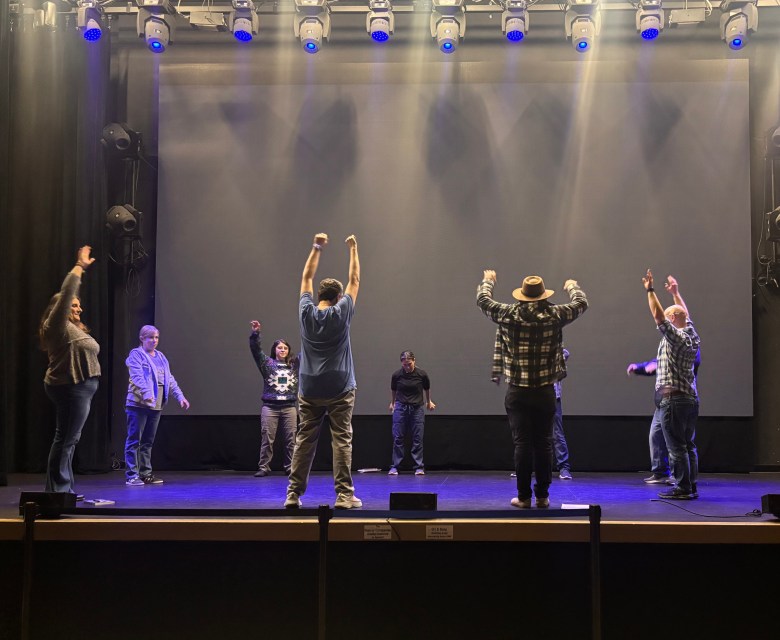 This is My Brave show participants warm up before rehearsing their acts at the BNH Stage on Thursday evening Credit: SRUTHI GOPALAKRISHNAN / Monitor staff
From auditions through rehearsals to the final performance, counselors are available at every step of the process. For some participants, telling their story over and over again can feel like pressing on a bruise that never quite healed.
Whitaker’s path to this stage began with loss and pain accumulated over decades. At 26, she was in a car accident that left her unable to walk for months. At 39, she suffered the loss of twins during her pregnancy.
Each blow carved its own wound — nightmares, hypervigilance, avoidance and the full weight of symptoms that trail unprocessed trauma.
Through all of it, she kept working and leading.
She shared only fragments of what she was carrying, and even then, only rarely.
Next Thursday’s performance will be the first time most of her colleagues learn that their leader, too, has been navigating her own mental health struggles and has been actively seeking help to manage them.
The vulnerability of that revelation is written into her act. One of her lines cuts to the heart of the silence so many leaders maintain: “What if they knew? Don’t let them see you struggle.”
“It’s a little overwhelming,” Whitaker said later. “At the same time, in my brain, I know that the people who do this work, and the people that are my colleagues, and my friends, are not going to think less of me, they’re going to think more.”
The show weaves together narrative and poetry performances, and for most participants, the vulnerability of sharing the stories that broke them is only half the challenge. Many had never set foot on a stage before, or had a microphone clipped to their collar.
Gina Rainone, 33, a nurse at Riverbend Community Mental Health Center, knows firsthand what it looks like when someone hits rock bottom. She has lived it. Her own struggles with substance use and mental illness landed her in emergency rooms, led to involuntary psychiatric admissions, and pulled her through some of the darkest chapters a person can face — homelessness, an abortion, and domestic violence.
She’s turned her life around. Today, she is sober, grounded by therapy and yoga, and has a life she has painstakingly rebuilt.
Rainone said she has been open with those close to her about her mental illness, but at work, she has kept those two lives carefully separated. Next week’s performance is the first time she will let them converge.
“I felt like this would be a good opportunity to finally feel like I can share my story, and I’ll be able to kind of combine those two lives,” she said. “I’m interested to see how my coworkers react, and what their interpretation of it is.”
Most of the performances in the show are about more than just confessions.
The community event seeks to challenge the narrative that mental illness so often carries— that it defines an identity rather than an illness, that it breeds isolation or signals an ending rather than a turning point.
“You can be a doctor. You can be a CEO, be a leader, do whatever,” Whitaker said. “Being a trauma survivor doesn’t disqualify you. It qualifies you differently.”
For more information, go to www.naminh.org/timb.
If you need help
National Suicide and Crisis Lifeline: If you or someone you know needs support now, call or text 988 or chat at 988lifeline.org.
NH Rapid Response Access Point: If you or someone you know is experiencing a mental health and/or substance use crisis, call/text 1-833-710-6477 to speak to trained clinical staff.