
MANSFIELD — The meetings and proclamations occurred in separate meetings on Tuesday morning.
But the link between them was clear.
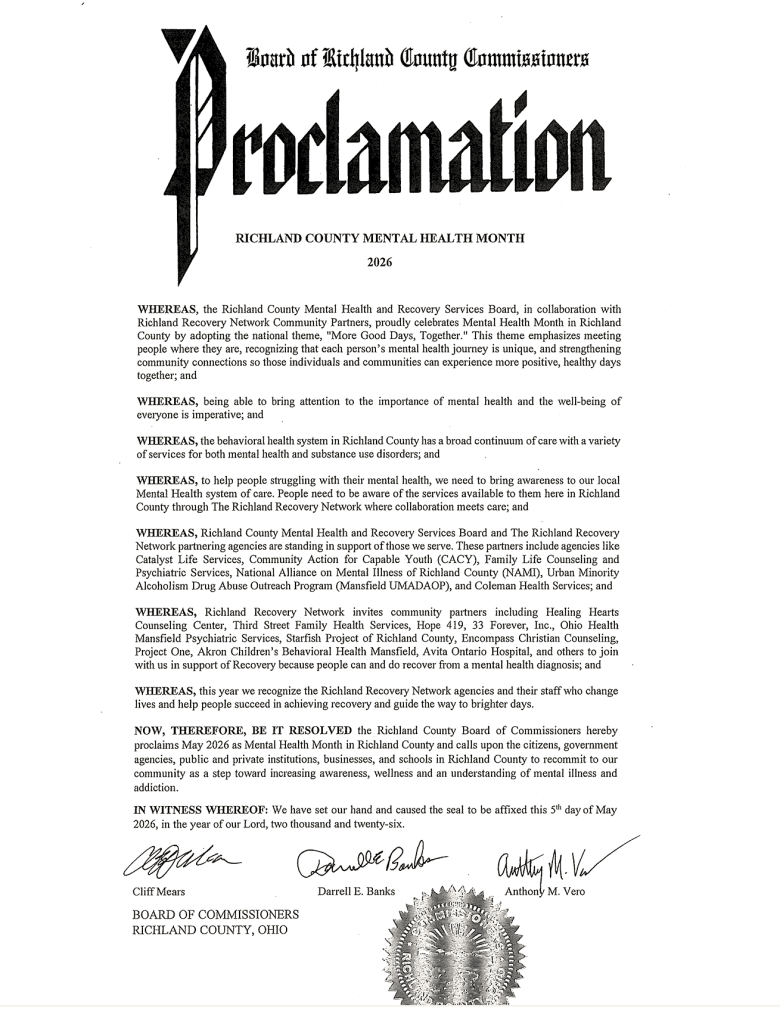
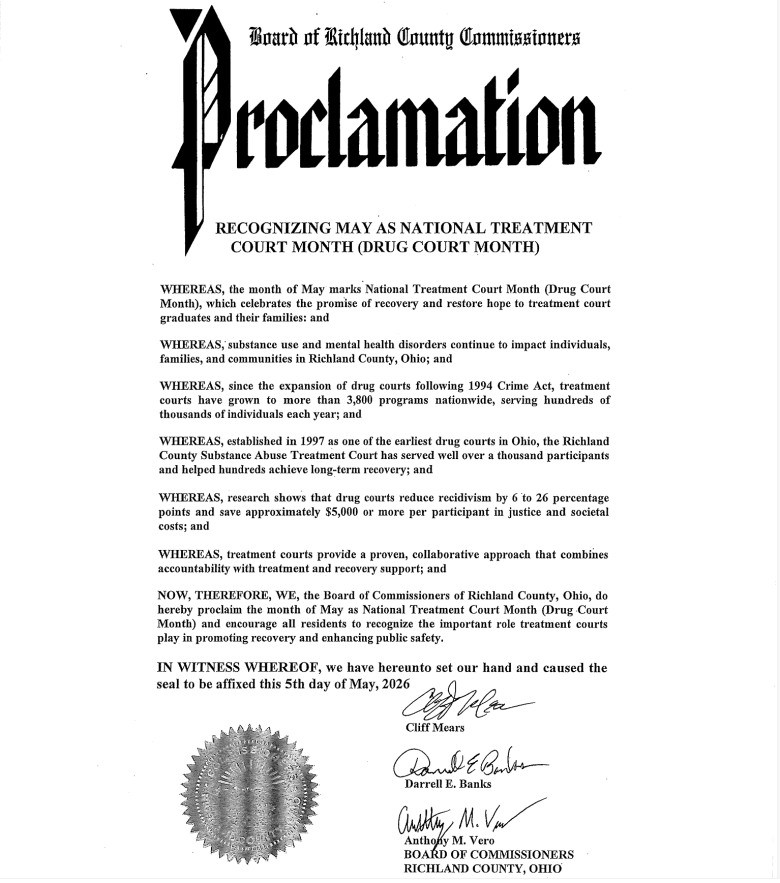
The Richland County Board of Commissioners issued proclamations designating the month of May as Mental Health Month and also Drug Treatment Court Month.
The three-member board took the actions during a meeting with representatives from the Richland County Mental Health & Recovery Services Board and then Richland County Common Pleas Court general division judges Brent Robinson and Phil Naumoff.
The judges, who operate substance-abuse treatment court dockets, both cited an abundance of resources around Richland County for those in need, much of it made possible through local agencies supported by the RCMHRSB.
The two courts have around 140 participants between them and a successful graduation rate of approximately 91 percent. The “Drug Court” was launched in 1997, one of the first in Ohio as a pilot program by late Judge James Henson.
The programs are operated by court staff, including probation officers doing intensive work with participants.
“I’ve been in a lot of counties where maybe there wasn’t this much cooperation or amount of support available. From everything I’ve gathered, Richland County probably has more programming, more funding and facilities available than just about anywhere,” Naumoff said.
“I talk to other judges (around Ohio) that have these types of programs and they’re envious of what we have. I don’t think we lack for anything honestly when it comes to our treatment (programs),” the judge said.
(Below are proclamations issued Tuesday by the Richland County Board of Commissioners designating May as Mental Health Month and also as National Drug Treatment Court Month.)
“It’s something that’s kind of a luxury for us. We do have options here, so that helps us when we’re dealing with our participants within our courts as to what we do with them,” Naumoff said.
“The mental health aspects are the toughest, because most of the people that we see come in front of us are either mental health- or substance abuse-related,” the judge said.
Robinson praised the work of local agencies, among them Catalyst Life Services, Healing Hearts Counseling Center, Third Street Family Health Services, National Alliance on Mental Illness of Richland County, Hope 419, 33 Forever, OhioHealth Mansfield Hospital and Avita Ontario Hospital.
“I always tell people that when I put them on community control, one of the first things we’re going to do is get an assessment to decide if they have mental-health and substance-abuse issues.
“Because if they’re going to come back and see me on a probation violation, it’s almost always related to either substance-abuse or mental-health issues that causes them to get in trouble again,” Robinson said.
“So if we can get those things resolved, we are much more likely to be successful at getting them off community control.
“Mental health is difficult because we have treatment, but it’s just sometimes difficult because those issues, they just don’t go away. If you’re an alcoholic and you don’t drink anymore, that fixes the problem.
“If you’re schizophrenic, it’s hard to fix that problem. There are medications, but it’s still a little bit harder to resolve that,” Robinson said.
Prior to meeting with the two judges, commissioners met with Carey Vogt, interim director of RCMHRSB, program director Scott Basilone and Aubrey Hall, executive director of NAMI Richland County.
Commissioner Cliff Mears paraphrased the resolution, noting the national theme of “More Good Days Together.”
“This theme emphasizes meeting people where they are, recognizing that each person’s mental health journey is unique, and strengthening community connections so those individuals and communities can experience more positive, healthy days together,” according to the resolution.
Vogt said the local cooperation is essential.
“Our providers come together and plan events throughout the month of May to bring awareness to the community and let them know about services available to anyone in need,” she said.
One of the myriad of services she cited is a 24/7 behavioral health crisis hotline at 419-522-HELP.
“If anyone is ever in crisis and they need someone to talk to or get advice on what they should do, that hotline is available,” Vogt said.
She urged local residents to visit the agency website at www.richlandmentalhealth.com for information about partner agencies and also a list of events scheduled during May, including the Drug Treatment Court Graduation ceremony May 20 at 3 p.m. in Naumoff’s courtroom.
She also cited a PDF on the website offering information on the Richland Recovery Network.
“It gives residents essential information that they need to know about the behavioral health providers in our county. It’s a very quick concise way of searching if they’re looking for a specific service for a specific age group and that type of thing,” Vogt said.
“We have a great continuum of care in Richland County for our behavioral health services system and we offer several services education, advocacy and much more,” she said.