
Rondale Moore’s passing was a tragic flashpoint, but the deeper story is football’s culture—from youth leagues to the NFL—and what it teaches men to hide.
Key Takeaways
Football culture pressures athletes to hide mental health struggles, risking isolation and tragedy.
Injuries and identity loss contribute to loneliness and increased suicide risks in players.
Changing the definition of toughness and enhancing mental health support is critical.
The recent death of former NFL wide receiver Rondale Moore at just 25-years-old has reopened a conversation that football culture has historically struggled to sustain. Moore’s passing, believed to be the result of a self-inflicted gunshot wound, stunned teammates and fans alike. Conversations quickly turned to injuries, rehabilitation, and the emotional toll that accompanies a career defined by physical punishment and public scrutiny.
Moore had spent two seasons sidelined by knee injuries, a circumstance that can breed isolation from the life they once knew. According to reporting surrounding his death, players navigating long injury recoveries often describe the process as mentally exhausting and profoundly lonely.
But this conversation cannot end with Rondale Moore, because this is bigger than a single incident.
When Tragedy Stops Feeling Isolated
In recent years, multiple young football players connected to the sport’s pipeline have died by suicide or suspected suicide.
LSU wide receiver Kyren Lacy was 24. Dallas Cowboys defensive lineman Marshawn Kneeland was also 24. Years earlier, University of Utah running back Ty Jordan died at just 21.
Each story carries different circumstances, but together they raise a difficult question.
How many tragedies must occur before we acknowledge that the culture surrounding football may be enabling pressures that young men are not always equipped to carry?
From high school stadiums to Division I programs to the NFL, football operates as a relentless ladder of competition. At every stage, the stakes escalate, and the pressure becomes ubiquitous.
Former NFL wide receiver Sinorice Moss, who played for the New York Giants, says that pressure is constant.
“It’s pressure every day,” Moss explained. “Every day you wake up, you have to perform. At your best, at your weakest, at your lowest, you still have to show up and perform.”
For many athletes, the sport becomes the center of their identity. Years of sacrifice and expectation create a life defined by performance. When injuries happen or opportunities disappear, that identity can collapse.
What the Research Shows
For years, conversations about football and mental health centered largely on concussions and chronic traumatic brain dysfunction.
According to Harvard University, research conducted through the Football Players Health Study, suicide rates among NFL players historically were not significantly higher than those of athletes in sports like baseball or basketball.
Still, researchers identified a troubling shift.
According to the study, after 2010, former NFL players experienced more than twice the suicide rate compared with athletes in the NBA and Major League Baseball.
Scientists caution that suicide rarely stems from a single cause. Depression, chronic pain, sleep disruption, career instability, and neurological trauma can intersect. Repetitive head injuries in football have been strongly associated with depression and other neuropsychiatric symptoms linked to suicidal behavior.
Yet biology alone does not explain the emotional reality many athletes face. The culture surrounding the game is an active player in the conversation.
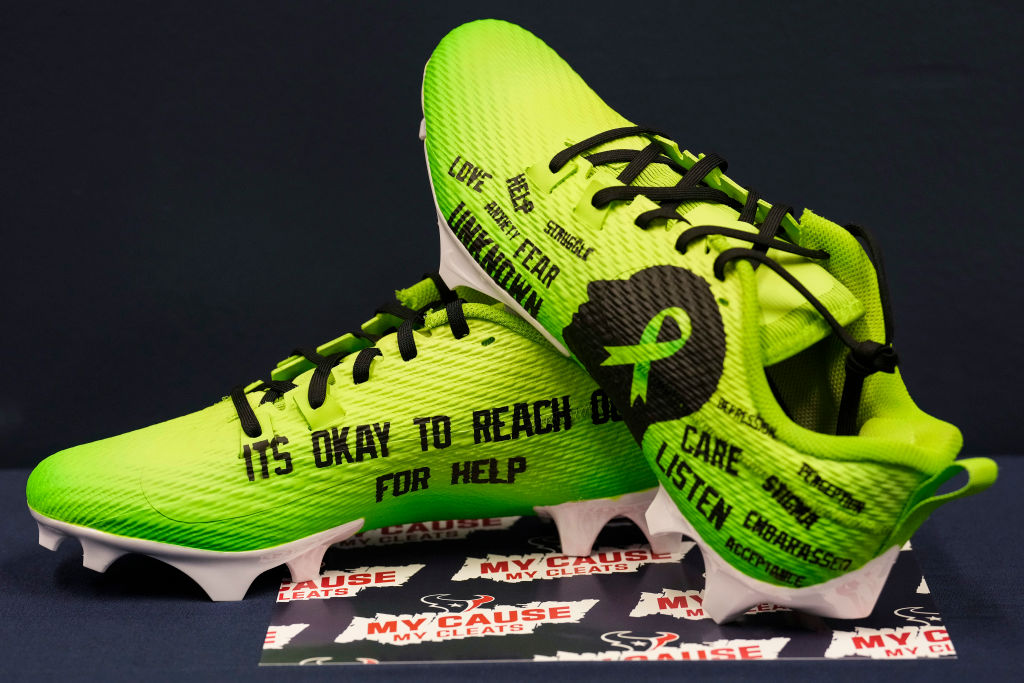 Houston Texans wide receiver Tank Dells cleats. Image: Brett Coomer/Houston Chronicle via Getty Images
The Myth of the Indestructible Athlete
Football culture has long celebrated toughness. Playing through pain becomes proof of character, and emotional restraint becomes evidence of strength. The athlete who refuses to show vulnerability is often praised as the ideal competitor.
But toughness, when distorted, becomes silence.
Moss says many players internalize the idea that asking for help is a form of weakness.
“For so long we’ve been taught to be tough and figure it out ourselves,” he said. “A lot of guys don’t want to say they’re hurting because they don’t want to seem weak.”
But this leads us to a glaring contradiction. The athlete capable of absorbing violent collisions may still struggle privately with loneliness, fear, and pressure.
Duality is a thing, so strength and suffering often coexist.
What One Memphis Family Is Seeing
For families watching young athletes move through football’s pipeline, the tension between opportunity and pressure can appear long before college recruiters or NFL scouts arrive.
One Memphis couple agreed to speak about raising a talented high school football player but asked to remain anonymous, concerned that speaking publicly could create backlash that might affect their son’s emerging football career.
“We’re proud of him,” the boy’s mother said. “He works hard, and the coaches see his talent. But sometimes I watch how much pressure they put on these boys, and I wonder if anybody is asking whether they’re okay mentally.”
Her husband described how expectations escalate when a player begins to stand out.
“When your child is good, the whole system starts pushing on him,” he said. “Coaches want wins. Schools want attention. Everybody sees potential. But not everybody sees the kid.”
The mother said the family constantly weighs the emotional cost of chasing opportunity.
“We support his dreams because that’s what parents do. But sometimes I think about how much weight these kids are carrying before they’re even adults.”
The Conversation Football Must Have
The realities surrounding football culture should force a broader reckoning.
Not only within the NFL. Within college athletics, high school programs, and even Little League organizations.
Moss noted that the NFL and the players’ association have increased players’ access to resources since he was in the league. However, he believes the sport must continue creating space for athletes to speak honestly about what they are experiencing.
“We’re human beings before anything,” he said. “Creating spaces where players can say, ‘Coach, I can’t go today. Mentally I’m not there,’ that’s important.”
The NFL now requires teams to employ licensed mental health clinicians and provide mental health education programs for players. But resources alone cannot solve a cultural problem. The definition of strength must evolve.
Football has spent decades teaching players how to endure physical pain. Now sports must learn how to protect the people who carry it.
Because until that conversation becomes normal in locker rooms, homes, and stadiums across the country, the silence surrounding mental health in football will continue to carry consequences.
And those consequences are far too costly to ignore.