
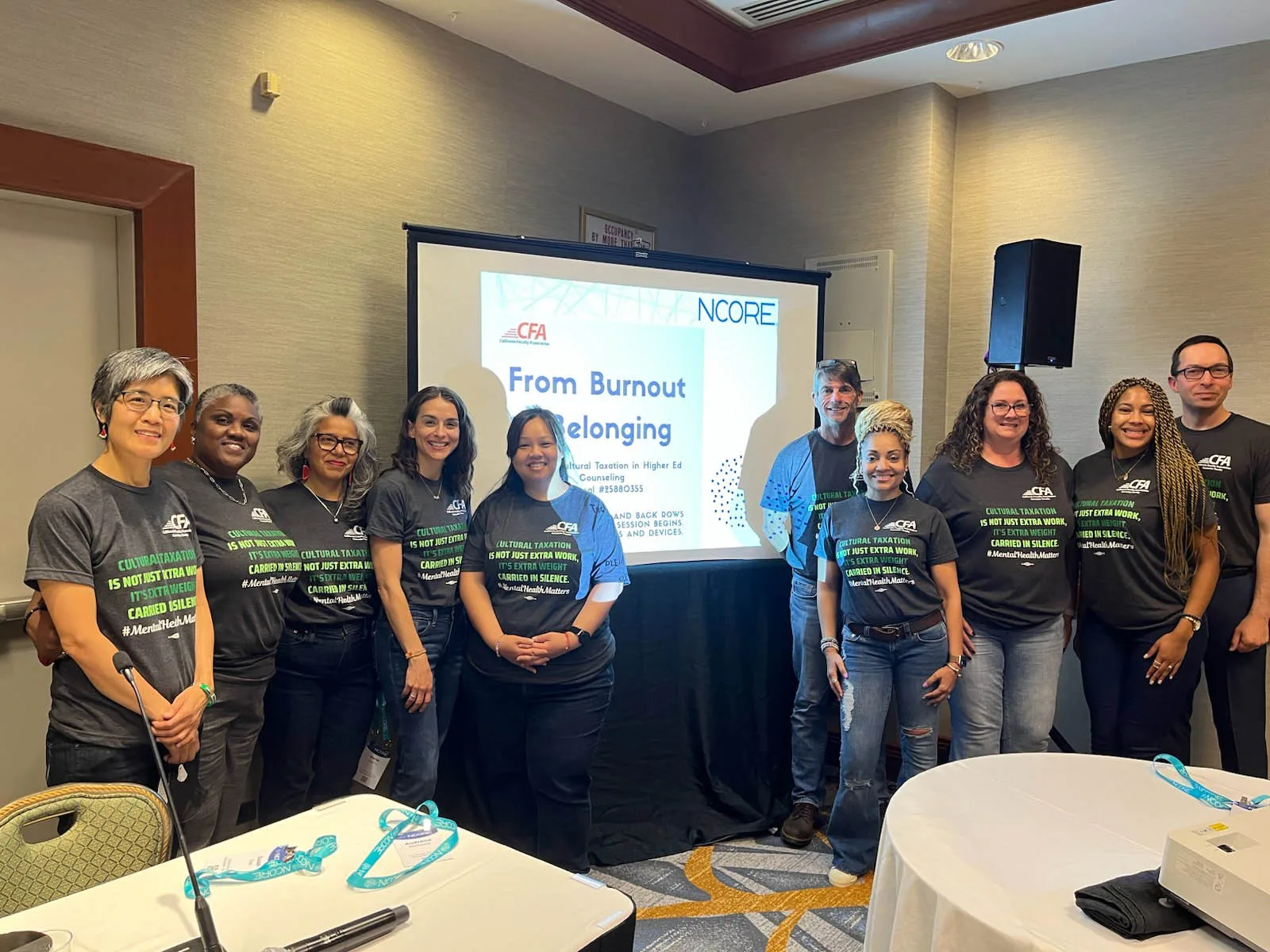
The CFA Counselors Committee sent the following letter to the members of the CSU Board of Trustees last week:
Dear Members of the CSU Board of Trustees,
As a committee of mental health professionals with more than 100 years of collective experience working in the CSU, we write to express our serious concerns regarding misinformation from the CSU Chancellor’s Office on student mental health and to provide accurate figures to correct the record. We hope you receive this letter with curiosity, openness, and responsibility.
At the CSU Board of Trustees meeting on March 11, 2026, Drs. Dilcie Perez and Carolyn O’Keefe presented on “CSU Student Wellness and Basic Needs” for the Committee on Educational Policy. During the presentation they asserted CSU students have suicidal ideation rates that are “double the national average.” On the presentation slide titled “Urgent Needs,” they reported that 28.3% of CSU students experienced suicidal ideation while the national average was 10-15%. They further emphasized, “This is a system-level crisis.”
Let us be clear, this comparison is grossly inaccurate and misleading, not only to each of you Trustees, but to all who care deeply about CSU students, their safety, and their mental health. The truth is that according to results from the Spring 2024 National College Health Assessment survey, CSU students reported screening positive for suicidal ideation at a lower rate than the national average, 24.2% (NCHA-CSU, 2024) compared to 25.9% (NCHA, 2024). Drs. Perez and O’Keefe misled us when they did not compare apples to apples. Instead, not only did they compare entirely different metrics of suicidal ideation, but used metrics from different surveys, the NCHA and the Healthy Minds Study (DiPierro, 2026).
As leaders of student mental health in the CSU, Drs. Perez and O’Keefe had ample and convenient access to the national and CSU-specific NCHA data on suicidal ideation. Yet, they chose not to present results that would demonstrate a fair and accurate comparison. Therefore, questions remain – Why did they not present comparable results on suicidal ideation? Do they believe that CSU students have suicidal ideation twice the national average? Furthermore, for what purpose were they stoking the mental health crisis narrative (Glass, 2024) and characterizing CSU students as so mentally troubled? We encourage you to ask these questions of Drs. Perez and O’Keefe as well as of CSU Chancellor, Dr. Mildred Garcia.
From not only the vantage point of professionals in the field with decades of experience, but from a reasonable person standard, the presentation of misinformation to your Board appears to have been done in the service of creating a rationale for the systemwide TimelyCare contract being pursued.
This is a reasonable conclusion, because, following the crisis narrative, the presentation immediately pivoted to advocating for after hours care with TimelyCare. By invoking the words “mandate” and “duty”, Drs. Perez and O’Keefe appeared to pressure and frighten others into compliance with their recommendation of TimelyCare. They also implied that the campuses are not providing adequate after hours support for student mental health, which is also inaccurate. Most, if not all campuses, currently provide after hours support that meets the standard of care in university counseling centers. That is, ProtoCall by Welltrack is highly utilized across the CSU and the nation for after hours care. With over 30 years of experience and providing services comparable to TimelyCare, they are not only the industry standard, but they are more affordable, an important consideration in these tight budget times. Although beyond the scope of this letter, we also encourage you to investigate the under-utilization of TimelyCare at select CSU campuses as well as the exponential increase in cost for an unproven, for-profit company.
An additional example of misinformation on mental health that deserves your attention and investigation is the Student Mental Health and Basic Needs Initiatives Report – 2024-25 (Lenz, 2026). This report “provides an overview of each university’s spending on basic needs and mental health resources for students, as well as a summation of the expanded offerings that were made possible by these appropriations” (Lenz, p. 1).
Based on our Committee’s review, there are multiple examples of individual campus summaries that do not align with our knowledge and experience at the center. For example, reports of adding counselors because of these funds do not account for counselors leaving during this time or appear to inflate the number of counselors on staff. Additionally, there is evidence to suggest that the “additional” appropriated funds for mental health support were not added to the existing mental health budgets at some campuses. This is a serious concern given that $15.8 million dollars was appropriated for “additional” support to the mental health needs of students and not to offset the university or division budget at the expense of student mental health.
In conclusion, as counselors in the CSU who are dedicated to supporting student mental health, we raise our concerns in the ethical spirit of beneficence and veracity. As we know you do as well, we care deeply about the wellbeing of students and work tirelessly to ensure they have equal opportunity to thrive and succeed as students and beyond. As a governing body accountable to students and the public, we expect you to ensure that future efforts from the CSU to support student mental health are free of misinformation, communicated transparently, and rooted in evidence.
Respectfully Submitted,
CFA Counselors Committee