
Three local Girl Scouts are providing mental health resources to other kids in the community, installing homemade little free libraries with books on various mental health topics around the Snyderville Basin as their latest service project.
The middle school-aged Girl Scouts, who were anxious about being named because of their own experiences with bullying, said they’ve noticed teens will feel embarrassed to seek support if it means they need to tell their parents or trusted adults about an issue. They said the little free libraries are intended to give those in need a starting point to access information without feeling judged or anxious checking out a book from the library or confiding in an adult.
The troop installed three libraries in the Snyderville Basin: one at the Egyptian Theatre, one at the Summit County Library branch in Kimball Junction and one across the street from Ecker Hill Middle School near the bus stop. The group then stocked each library with books on a variety of mental health topics, including depression, anxiety and eating disorders.
The Girl Scouts also interviewed mental health professionals, including therapists, doctors and crisis hotline workers. Community members contributed construction materials to the girls, and the Live Like Sam Foundation, a local nonprofit organization, donated the books now adorning the little free libraries.
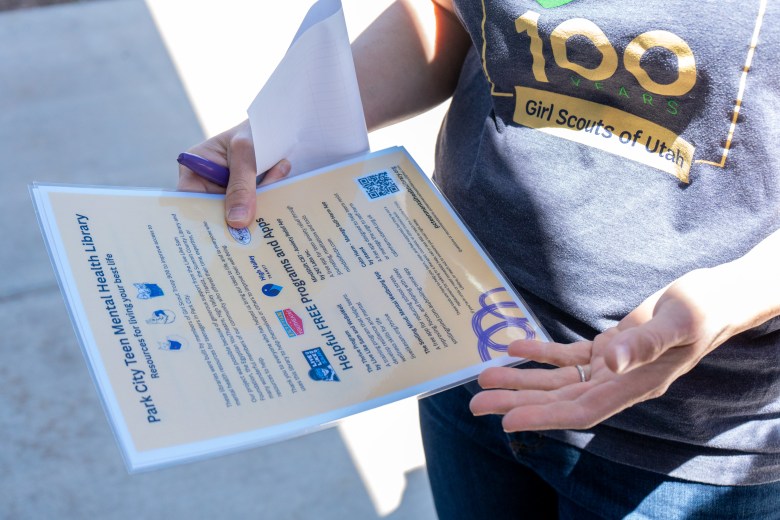 The parent of one Girl Scout holds the laminated sign attached to each little free library. The signs direct patrons to a website with a list of mental health resources, including hotlines and recommended readings. Credit: Jonathan Herrera/Park Record
“Let’s say you don’t have a device to access things from or your parents monitor what you do, and you don’t want them knowing about the issue because they wouldn’t take it super well,” one of the Girl Scouts said. “You’d want to be able to access stuff without it being this whole thing, so now you can get it here.”
The girls took on the project to earn the Silver Award, which requires 50 hours of work from each troop member. It’s the highest honor a Girl Scout can earn as a middle school student.
Signs attached to the libraries have information about the project, as well as a QR code to link to other mental health resources in case someone needs immediate help or requires another form of assistance.
“I think what the kids noticed was that there was no great, single place to go to for support like this,” said the parent of one of the Girl Scouts. “There’s either a flyer here or a phone number there, so it was surprisingly hard for them to get this list together. … We’ve been doing this (project) for six months, so it’s been a long time coming. It’s amazing to see it in the real world, and it looks great.”
The Girl Scouts said their goal was to help teenagers “learn, cope and feel supported,” but they also reiterated that the libraries shouldn’t replace talking to a therapist, counselor or other trusted adult. Instead, they said the resources should be used as supplemental or educational materials, establishing a baseline so readers have some knowledge if they need to pursue more care.
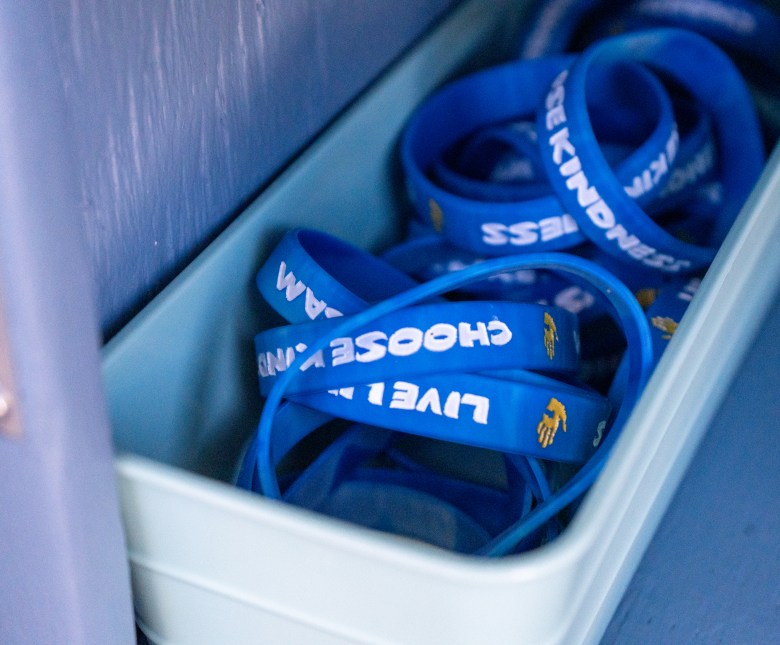 The little free libraries also have free bracelets from the Live Like Sam Foundation for readers to take. Credit: Jonathan Herrera/Park Record
The Summit County Health Department and Utah Department of Health and Human Services track mental health information among local schoolchildren every two years through the Utah Student Health and Risk Prevention, or SHARP, survey.
The latest survey, conducted in 2025, indicated Summit County students are struggling with depression and anxiety at a lower rate than previous years — approximately 45% of kids reported they had no signs of depression in 2025 compared to 28% of kids in 2023 — but health officials said there’s still room for improvement.
Summit County Behavioral Health Prevention Director Pamella Bello previously said the SHARP survey results showed encouraging trends, with the number of local students experimenting with alcohol or marijuana decreasing since 2023, in addition to lower rates of depression and anxiety.
Bello said the survey results were positive overall because the change in mental health and substance use rates likely indicated the county’s preventative and educational measures are working. She said it was difficult to attribute the shift to any specific program, but the continuous push for community engagement from the Summit County Health Department and other health partners has brought mental health issues to the forefront of parents’ minds.
“Prevention works, progress is possible and community engagement matters,” Bello said. “We need these parents engaged and working with us, toward the same goals for our kids and for our community. The choices we make today as a community shape the outcomes of our next generation.”
Information on the Girl Scouts’ project, including a list of hotlines and recommended readings, is available at pcteenmentalhealthlibrary.org.
Related Stories