
Editor’s note: If you or someone you know is struggling with suicidal thoughts, call or text 988 (National Suicide Prevention Lifeline), chat 988lifeline.org or text anonymously with a crisis counselor at 741741.
Sarah Jackson often overhears her 14-year-old twins discussing struggles affecting their friends and classmates. That’s why she brought them to the MayDay for Mental Health Suicide Prevention Symposium in Akron.
Jackson said she hopes her children gain a better understanding of how to recognize when someone may be struggling — including themselves.
“I want them to know how to recognize signs if somebody’s in trouble,” said Jackson, 48, who lives in Louisville. “Or if they themselves are in trouble.”
That message resonated throughout the event, where families, students and mental health professionals gathered at the Akron-Summit County Public Library’s downtown branch to discuss youth mental health, suicide prevention and warning signs adults should not ignore.
Connection, conversation and early intervention can become lifesaving during moments of crisis, said Ciara Dennis-Morgan, chief clinical and wellness officer for the Minority Behavioral Health Group.
“We want to break that stigma of people not being able to talk about it,” said Sherry Blair, youth suicide prevention supervisor at Akron Children’s. “If a child is struggling, they should feel like they can go to their parents instead of feeling like they’d get in trouble.”
The symposium was organized through a partnership between Summit County Court of Common Pleas Judge Kani H. Hightower, NAMI Summit County and the Alcohol, Drug Addiction and Mental Health Services Board of Summit County.
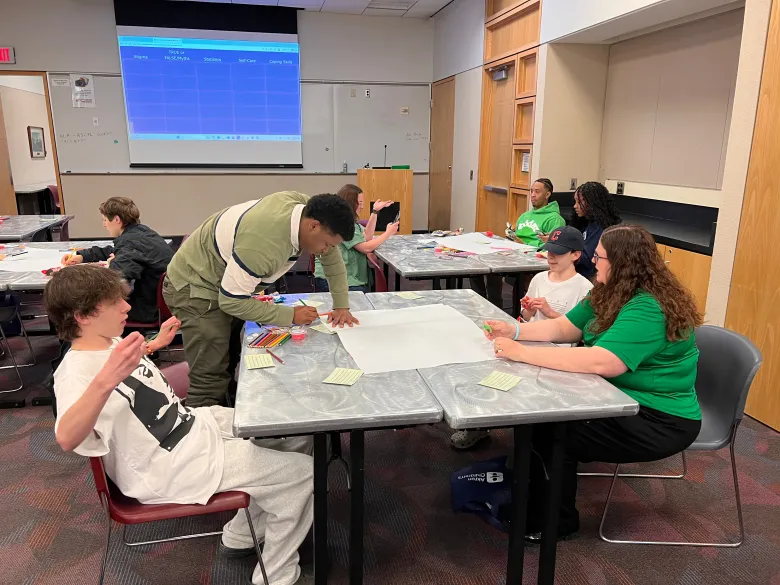 The MayDay for Mental Health Suicide Prevention Symposium in Akron was divided into two separate sessions. Parents attended a panel where doctors discussed how to open conversations with their children about mental health, while students (pictured) participated in youth-led discussions facilitated by NAMI Summit County. (Shams Mustafa / Signal Akron)
What does mental health really mean?
“Mental health deals largely with mental stress,” Blair said. “It can include mental illness, but it doesn’t mean somebody is ill. Sometimes we’re distressed, and people just need a little grace and understanding.”
How can Akron residents help reduce stigma around mental health?
Blair said reducing stigma is key to opening more conversations about mental health.
“The more we can break the stigma around mental health,” she said, “the more we can open conversations about it.”
How are coaches reducing mental health stigma in sports?
Jamie Messenger of NAMI Summit County said some coaches are allowing students to take mental health days without jeopardizing their positions on sports teams, a shift she said stood out to her.
“A lot of times in the high school space there’s pressure to perform and not miss practice because you could lose your starting spot,” Messenger said. “But coaches are actually checking in on their mental health and wellness and making sure things are going well for them outside of the sports space.”

Young people speak openly about mental health struggles: ‘You’re not alone’
Depression and anxiety among young people increased during the COVID-19 pandemic. The CDC stated that 44 percent of high school students reported feeling persistently sad or hopeless in 2021.
Among them was Phoebe Boyd, 22, a Missouri native who moved to Cuyahoga Falls about 10 years ago. Boyd took the stage May 1 at the symposium and spoke about her experience with depression.
“I didn’t really want to be here anymore,” Boyd told Signal Akron after the event. “I felt like everything my family was going through was more important than what I was going through.”
After nearly a year in therapy, Boyd said she learned how to better understand her emotions and navigate difficult moments.
“It really helps having someone talk to you and help you through everything you’re going through and help you understand different angles,” she said.
Youth discussions highlight bullying, warning signs and barriers to care
The symposium was divided into two separate sessions. Parents attended a panel where doctors discussed how to open conversations with their children about mental health, while students participated in youth-led discussions facilitated by NAMI Summit County.
Several local mental health organizations also set up resource tables for attendees, including Portage Path Behavioral Health and Greenleaf Family Center. Materials included information on warning signs of mental health concerns and hotline numbers for immediate support.
In the youth breakout sessions, Messenger said students raised concerns about bullying and the lack of mental health support in schools.
“Bullying is a problem,” she said. “They don’t think the schools are handling bullying well, so that would definitely be a space that we want to try to address.”
Mental health warning signs can include changes in behavior
Messenger said changes in behavior are among the most important warning signs adults can look for in children.
Students who are typically punctual but suddenly struggle to get out of bed or attend school can be showing early signs of distress, she said. More serious warning signs include talking about hopelessness, feeling unheard or making statements about not wanting to be alive.
Early conversations matter because some youth feel their struggles are not being recognized by adults in their lives.
“Just having the courage to say, ‘Hey, I noticed a change here. Is there anything I can do?’” she said.
Cost and access are ongoing barriers to mental health care. The changes in federal health care tax credits have increased insurance costs for some families enrolled in the marketplace, causing some people to delay or go without care, Messenger said.
Akron police officers trained to respond to mental health emergencies
Akron Police Officer Melanie Bailey said the department has expanded its response to mental health crises through specialized programs and training.
One of those programs is the department’s Crisis Intervention Team, or CIT, which responds to calls involving people experiencing mental health crises. Officers assigned to the team receive training focused on de-escalation, communication and connecting individuals with medical care.
Bailey also highlighted the department’s SCOUT team, which pairs police officers with social workers, paramedics and nurses to follow up on nonviolent mental health-related calls.
“A lot of times they just want someone to hear them,” Bailey said. “You just sit there and let them talk.”
She said officers regularly encounter residents struggling with mental health issues, with some voluntarily asking to be transported to a hospital for evaluation while others may require emergency intervention.
“If you see someone in a mental health crisis, call and try to get someone to help them as quick as possible,” she said, encouraging community members to provide dispatchers with as much information as possible during emergency calls.