
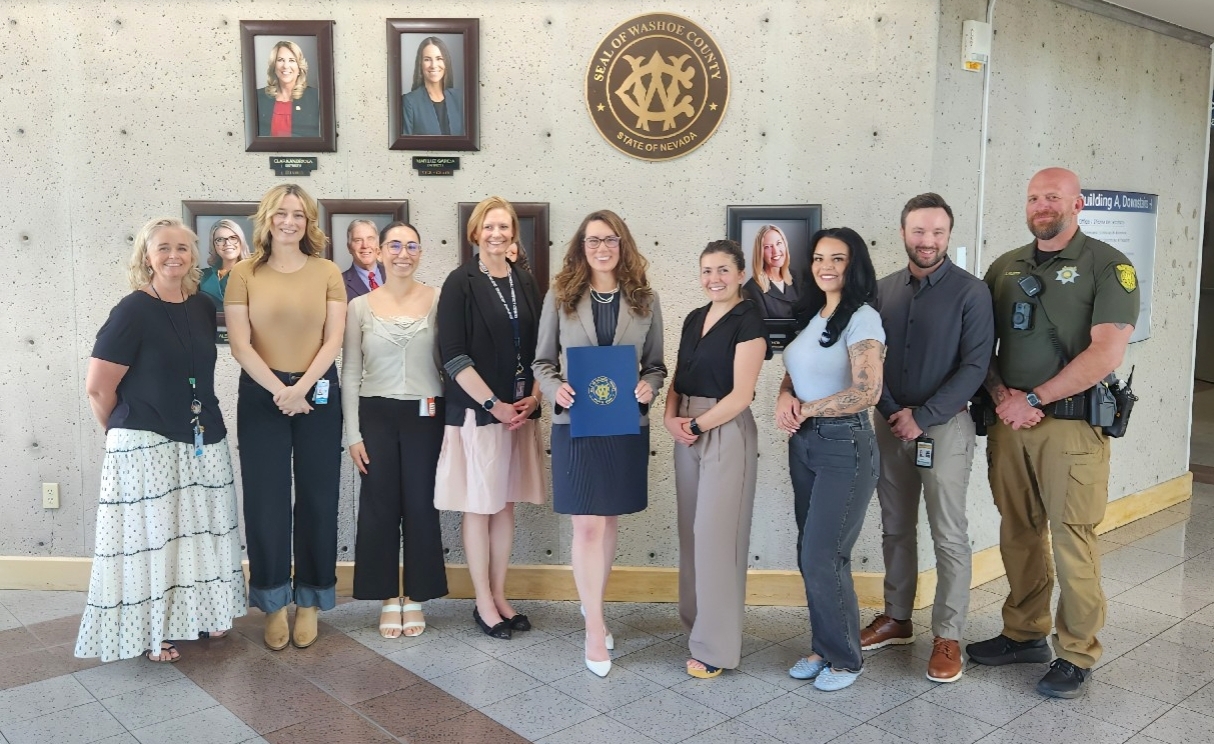
Courts and justice system partners across Washoe County are joining together this May to recognize National Treatment Court Month, highlighting the impact of therapeutic courts in promoting recovery, accountability, and public safety throughout the community.
In recognition of National Treatment Court Month, the Washoe County Board of County Commissioners joined local therapeutic court programs in issuing a joint proclamation recognizing the important role treatment courts play in supporting individuals with substance use disorders, mental health conditions, and trauma-related needs and establishing the month of May as National Treatment Court Month.
Therapeutic courts provide structured, court-supervised treatment programs for eligible individuals whose involvement in the justice system is connected to behavioral health challenges. These programs combine accountability, treatment, supervision, and recovery support while connecting participants to community resources and services.
Washoe County’s therapeutic courts are also part of a broader collaborative effort aligned with the Sequential Intercept Model (SIM), a national framework developed by the Substance Abuse and Mental Health Services Administration (SAMHSA) that focuses on improving coordination between the justice and behavioral health systems and reducing unnecessary justice-system involvement. The goal of the SIM is to divert those with mental illness or substance use disorders from the justice system and into treatment.
Programs across Washoe County include Reno Justice Court’s Court Assistance Program (CAP Court), DUI Court, Hope, Empowerment, Recovery (HER) Court, and Support in Treatment, Accountability and Recovery (STAR Court); the Second Judicial District Court’s Adult Drug Court, Mental Health Court, Veterans Treatment Court, Felony DUI Court, and Youth Offender Court; Sparks Justice Court’s Sparks Recovery Court; and Reno Municipal Court programs including Court Assisting Military Offenders (CAMO-RNO Court), Fresh Start DUI Court, Co-Occurring Disorders Court, and Young Adult Recovery Court.
Reno Justice Court served 104 participants during the last fiscal year and celebrated 38 successful graduations, including 5 Community Court graduates, 21 Court Assistance Program graduates, and 12 DUI Court graduates. Second Judicial District Court therapeutic court programs celebrated 230 graduations in 2025, while Sparks Recovery Court reported 18 new admissions and 9 graduations during the year.
Research consistently demonstrates that therapeutic courts reduce recidivism, improve long-term recovery outcomes, and reduce costs associated with incarceration, emergency services, and repeat justice-system involvement. According to All Rise, treatment courts save an average of more than $6,000 per participant served through reduced criminal justice and social service costs.
“Therapeutic courts recognize that many individuals entering the justice system are struggling with addiction, trauma, mental health challenges, and instability,” said Judge Kendra Bertschy of Reno Justice Court. “By combining accountability with treatment and support, treatment courts address the root causes of justice involvement. They reduce crime, save lives, strengthen families, and make our communities safer.”
According to All Rise, the national training and advocacy organization for treatment courts, more than 4,000 treatment courts now operate nationwide, connecting over 150,000 individuals annually to treatment and recovery support services.
For more information about therapeutic courts in Washoe County, visit:
Reno Municipal Court Therapeutic Courts: www.reno.gov/government/municipal-court/specialty-courts-and-programs
Second Judicial District Court Specialty Courts: www.washoecourts.com/SpecialtyCourts
Sparks Recovery Court: www.washoecounty.gov/sjc/sparksrecoverycourt.php
Reno Justice Court Therapeutic Courts: www.washoecounty.gov/rjc/therapeutic_courts/index.php