
The independent monitor overseeing court-ordered reforms to the Aurora Police Department on Wednesday called for the city to conduct a broad review of three recent police shootings in which officers killed people who were in the midst of mental health crises.
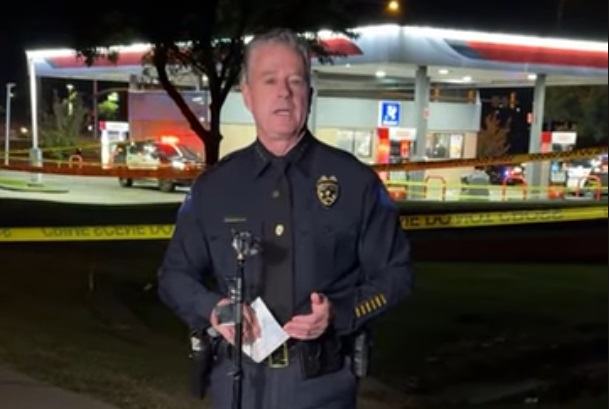 Aurora police Chief Todd Chamberlain updates the media on Sept. 18, 2025, about a fatal police shooting that happened earlier that night near South Havana Street and East Alameda Avenue in Aurora. (Screenshot of Aurora Police Department livestream)
Independent monitor Jeff Schlanger, in a special 12-page report, requested that Aurora officials investigate the broader circumstances surrounding each fatal shooting, including considering each victim’s mental health history, prior warning signs, attempted interventions and prior interactions with the public safety system.
The review should examine systemic gaps and shortcomings in the incidents, and how both Aurora police and other professionals can work to fill those gaps, Schlanger told The Denver Post.
“It is a call for the city to really examine this entire system,” he said.
The special report was prompted by the April 9 shooting of Amare Garlington, Schlanger said. The 23-year-old man was suicidal and held a butcher’s knife to his own throat before charging at officers and stabbing both Officer Mark Moore and a police dog at an Aurora apartment complex. Moore shot and killed Garlington.
“This was not, on its face, a conventional criminal enforcement encounter. It was a crisis response that became a violent confrontation,” the report reads. “That distinction is important because it directs attention to the broader question of whether the public system surrounding behavioral health intervention is sufficiently robust to reduce the likelihood that such crises culminate in sudden close-range violence.”
That shooting raised the urgency of issues already on the independent monitor’s radar and convinced the oversight group they could not wait until the next regular report in the fall to address them, Schlanger said.
The report also outlines two other fatal Aurora police shootings that warrant further review; in both cases, the victims were unarmed.
Officer Derek Paulson shot and killed 17-year-old Blaze Balle-Mason on Sept. 18 after the boy called 911, claimed to be armed, threatened to start shooting inside a gas station and then ran at officers.
Officer Brandon Mills killed 32-year-old Rashaud Johnson on May 12, 2025, as he trespassed in a parking lot near Denver International Airport. That officer shot Johnson as the man walked toward him with his hands at his side about 45 seconds after the end of a physical altercation in which he and the officer tussled on the ground.
Schlanger called for Aurora to launch a task force with representatives from the police and fire departments, the city and mental health service providers to identify gaps in the city’s behavioral health safety net and consider how to fix those problems. The review should also involve state and federal systems, he said.
“Breaking down the silos is important, and then understanding, as well as we possibly can, what can be done differently to achieve a better outcome in these situations,” he said.
Ryan Luby, a spokesman for the city, said in a statement Wednesday that Aurora officials agree with the monitor’s recommendations “and welcome deeper conversations about this topic with all community stakeholders.”
The report emphasizes efforts Aurora and the police department have already made to improve their processes and resources, but concludes that more work needs to be done.
The Aurora Police Department has been under a court-monitored consent decree since 2021, following the death of Elijah McClain. The department agreed to change its use-of-force, hiring and training policies as part of the decree, and submit to outside oversight.
Qusair Mohamedbhai, whose Denver law firm brought a lawsuit against Aurora police over Johnson’s killing, said Thursday that the monitor’s report carries little substance.
“Rashaud has been dead for over one year. Aurora continues to stand by its officer and its monitor only now says, ‘Convene a task force,’” he said. “‘Do not call the police in Aurora if your loved one is in acute mental health crisis’ should have been the recommendation of the monitor.”
Sign up to get crime news sent straight to your inbox each day.