
For young men of color, particularly young Black men, the barbershop can be a place where sensitive issues are discussed.
That is something Southern Connecticut State University’s Owl Flight to Excellence program Assistant Director Bernard Macklin knows well. The barbershop, he says, represents far more than a simple haircut.
“It gives you a sense of peace, where you can go into a place, get your hair cut, look good, as well as have very comical conversations, very political conversations, very religious conversations. I mean, we have them all in a barbershop,” said Macklin.
Two years ago, Macklin had been looking for a way to get young men of color on campus together to discuss issues impacting their lives and receive mentorship. The barbershop seemed like a good starting point, and he began to have conversations with local barbers about offering free haircuts on campus to students in an environment where they could be open and vulnerable if needed.
“I was thinking of ways to have them be able to come to a place where they can just have serious conversations, very laid back conversations, and creating, fostering and building relationships, because that’s one of the biggest things that I found that was a lack for men of color on this campus. It’s a lot of us, but we have no way of building relationships with each other.” said Macklin. “Barbershop Talks kind of fuse that. They bring everything into one place where we can actually have those conversations.”
That is when Barbershop Talks was born. Now, Macklin and the University Access Program at SCSU offer six sessions throughout the semester when students can receive a haircut while being in a supportive environment. The program is funded by grants from the university’s Office of Diversity and Inclusion, and students do not pay for haircuts.
It is a model that Macklin says other schools of varying sizes across the country and state use. At Southern, each event attracts 30 to 60 customers, and three barbers attend each session.
Student Justin Dawkins is a barber outside of school, and is one of those participating in the Barbershop Talks events.
“When it comes to getting your hair cut, it’s very important, because a lot of Black men come together to just enjoy to be together in the barbershop. It’s a time for them to wind down and just be able to talk about things we don’t normally talk about around [other] people,” said Dawkins.
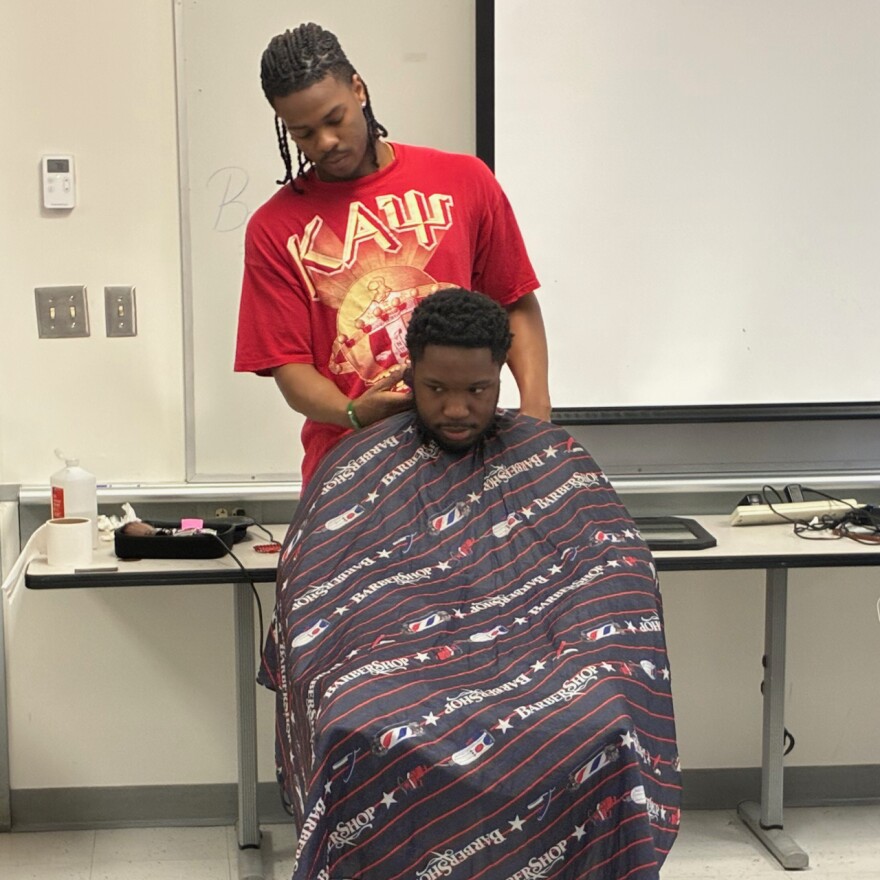
Justin Dawkins cuts a student’s hair at the Barbershop Talk event on April 14.
While not all of the Barbershop Talk customers are young Black men, or even students, most are. Pressures from school and outside activities affect all students but, for many of those at the Barbershop Talk, these stressors are compounded by racism and the lack of a listening ear from someone who looks like them.
While Southern is a diverse campus, with around 55% of students being people of color, only 20% of the student body identifies as Black.
“I think it’s very important,” said SCSU student Kyntrel Witherspoon-Dessources, who was attending the April 14 Barbershop Talk session. “It’s a safe space for men of color who can be themselves, truly be who they are, and not try to pretend to be someone who they’re not. It’s a chance for them to be vulnerable to other people who won’t judge or won’t feel like they’re being judged.”
A wide variety of subjects from sports to politics are discussed over food and haircuts, but Macklin makes sure to check in on how the students are doing mentally.
A listening ear in the barbershop from someone who can offer assistance connecting with mental health support is vital, says Justin Gelzhiser, assistant professor of psychology at VinUniversity in Hanoi, Vietnam. In 2023, Gelzhiser partnered with Lorenzo Lewis, the founder of The Confess Project, which trains barbers across the United States to deal with mental health concerns, to study the impact of the barber and client relationship in relation to mental health.
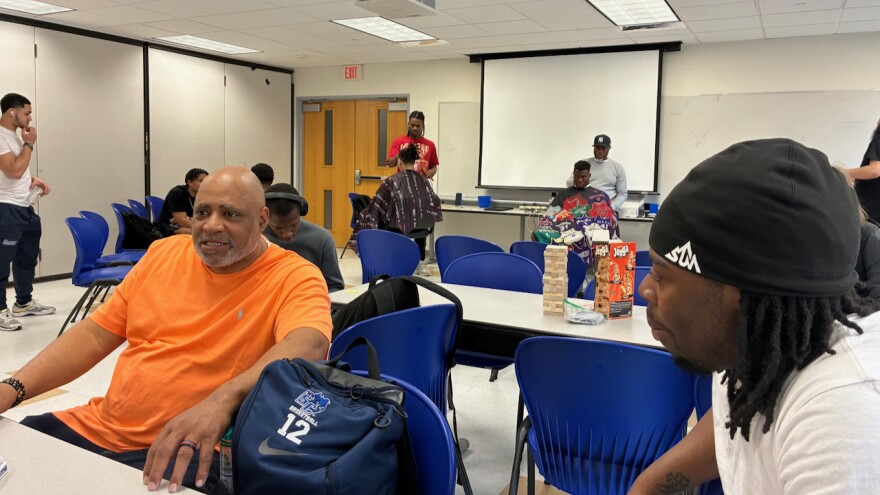
Bernard Macklin, left, talks with student Kyntrel Witherspoon-Dessources at the Barbershop Talk event on April 14.
Their study interviewed 23 men and 9 women of color from communities around the U.S., all of whom were licensed barbers. The barbers worked with communities of color in rural, suburban, and urban locations in Arkansas, Colorado, Illinois, Indiana, Kentucky, Mississippi, North Carolina, Ohio, and Tennessee. Of the 32 barbers, 29 had completed additional training as mental health advocates.
Gelzhiser says his research shows that, in Black communities, barbers are often some of the first or only people that clients open up to about mental health concerns. The qualitative study identified several common themes in the barber interviews, including their role in identifying suicidal ideation in customers, in preventing community violence and in breaking stigmas around mental health.
“There’s a very tight relationship between the barber and their customer. Some of these barbers work with the same customer from when they’re born, their first haircut, throughout their entire lives, and so they’re in a position to be able to recognize any behavioral changes that they see.” Said Gelzhiser. “They see this person once a week or twice a month their whole life, a lot of times, or if they’re a college student, they’ll see them over four years regularly. They’re able to recognize, with training, any changes in behavior, and be able to know how to ask questions of their customers, to be able to intervene, provide support if they find that they need it.”
At Southern, Macklin knows how critical this mental health support is. If concerns are expressed about a student’s welfare, connections to mental health professionals are available.
“If somebody is in real dire straits, we’re going to make that referral.” Said Macklin. “Then I know that they can look at outside outlets, mental health services and facilities that are right here in New Haven that can serve our students if they want to take it on.”
This kind of support can yield results and save lives. Through the course of his research, Gelzhiser learned the story of a young person whose barber provided crucial help when they had suicidal thoughts. The barber may have saved their customer’s life.
“They were depressed, and that person ended up recovering from this incident; they did not harm themselves, and they were able to go back to their life. That barber acted as the last line of defense for that person. That’s kind of an extreme story, but it’s a true story. It highlights how that person was in a position to help in a way that really no one else was there for,” said Gelzhiser.
This support is especially crucial for young men of color. A 2019 study published by the American Academy of Pediatrics, and referenced by Gelzhiser, shows young Black men are more likely than their white peers to keep suicidal thoughts private and avoid seeking help.
The barbershop can be the only safe space for these men to open up and take the first steps to receiving help.
“What may seem like a 45-minute, 30-minute, not-important relationship actually becomes a huge lifeline for people, particularly who are at risk, and also communities of color who are at risk due to stigma and due to societal problems. That allows those people, who are in a position to provide a unique relationship, to support the mental health of those students, and even in a campus like [Southern], that’s a very, very vital thing,” said Gelzhiser.
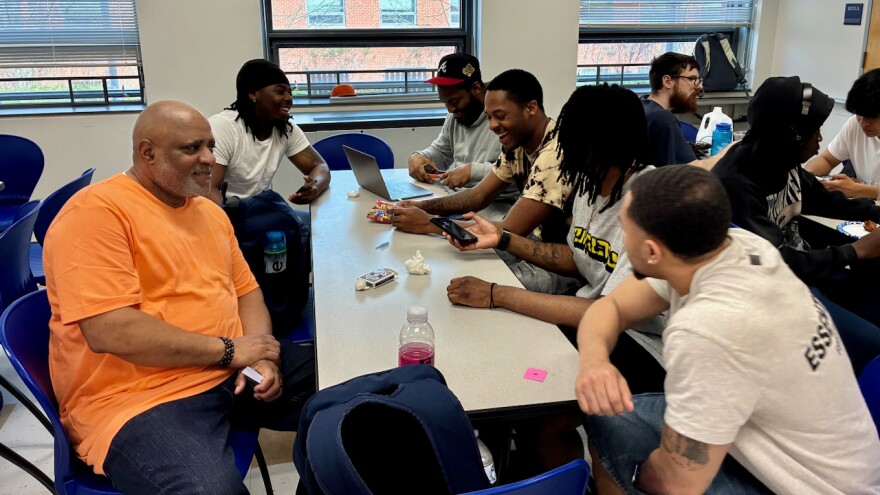
Bernard Macklin, left, with student customers at the Barbershop Talk event on April 14.
Barbershop Talks at SCSU are offered throughout the semester, and students can request the same barber each time. The six sessions serve as many students as they can, but with a population of more than 500 young Black men on campus in recent semesters, not everyone can get a place in the chair.
Outside of school, students may still be facing the same societal and social pressures and concerns they brought to the barber chair. But when they are on campus, Macklin says, he hopes the Barbershop Talks customers know they have a place to talk openly.
“It’s just one of those things that we want our students to know that we are here on campus.” Said Macklin. “We’re not going anywhere, as long as we’re able to fund the program, and be able to do the things that we’ve been doing. But it’s open to every student, no matter what color.”
This story is republished via CT Community News, a service of the Connecticut Student Journalism Collaborative, an organization sponsored by journalism departments at college and university campuses across the state.
This story is supported by a grant from the Solutions Journalism Network. CT Community News is proud be to a member of the Solutions Journalism Network Student Media Challenge cohort for 2025-26.