
Meeting the growing need for mental health care starts with understanding what providers are seeing, and according to a local counselor there’s an increase in demand for services.
TOMAH, Wis. (WXOW) – As more Wisconsinites seek mental health support, providers say the need for services is growing while communities across the state continue to face challenges accessing care.
Dr. Amanda Falkers, owner of AJ Falkers Counseling and Consulting Services, said demand has increased in recent years, particularly among younger patients.
“I would definitely say there’s an increase in demand for services, particularly with children,” Falkers said. “I think COVID has had an impact on socialization. Technology has impacted kids and how they interact with each other. So, we’ve definitely seen an increase with life transitions, grief, anxiety, depression, suicidal ideation.”


Data from the Wisconsin Interagency Council on Mental Health (WICMH) reflects Falkers’ thoughts.
The council’s recently released Mental Health Action Plan reports that 59% of Wisconsin high school students experienced at least one mental health challenge within the past year.
The report also found nearly 9% of Wisconsin’s youth have attempted suicide, and 19% have seriously considered suicide.
The WICMH was created to develop recommendations aimed at improving mental health outcomes and access to care throughout the state.

The action plan identifies workforce shortages as one of the most significant challenges facing Wisconsin’s behavioral health system, particularly in rural communities.
According to the plan, workforce shortages can lead to longer wait times, fewer treatment options and increased travel distances for patients seeking care. The report notes that 40 of Wisconsin’s 72 counties are federally designated mental health professional shortage areas.
Falkers explained how the issues can compound due to the nature of rural areas.
“You have to travel sometimes an hour to get the services that you need,” she said. “Whether that’s dental, medical, behavioral health.”
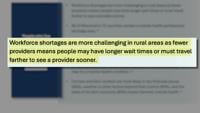
Beyond distance, Falkers said transportation, internet access and concerns about privacy in smaller communities can create additional barriers for patients seeking care.
The action plan points to several factors contributing to workforce shortages, including low insurance reimbursement rates, limited clinical training opportunities and workloads that can contribute to provider burnout.
Falkers said addressing those shortages requires looking beyond traditional roles and creating multiple pathways into behavioral health careers.
“We definitely need more—especially well-qualified—individuals,” Falkers said. “The mental health field isn’t just for counselors, right? You can be a case manager, a peer specialist; somehow, you can impact someone’s life. We need other individuals within the behavioral health field to help support the whole system.”

Preparing those future professionals takes years of education and supervised training. Falkers said most counselors enter the field with a master’s degree before completing supervised practice hours and licensing requirements.
At AJ Falkers Counseling and Consulting Services, training the next generation of providers is part of addressing long-term workforce needs. The practice regularly works with interns from a variety of educational backgrounds and specialties.
“They’re able to work alongside someone that’s seasoned in the field to be able to learn how to do counseling in various ways,” Falkers said. “Whether that’s with trauma, grief, anxiety, depression, learning how to screen for suicide and manage those suicidal ideations—who do we contact if they can’t be managed? So, learning some of those systems that impact our clients.”
Falkers said mentorship extends beyond clinical skills. Interns also gain experience with documentation, insurance requirements and administrative responsibilities that are often part of behavioral health careers.

Retention is another challenge identified in the state’s action plan.
Supporting providers is critical in a profession where burnout remains a concern, Falkers said.
“You have to have a self-care plan in place, and that is something that we are actually ethically responsible for in this field—making sure that you’re taking care of yourself so that way you can be there for your clients,” she said. “We’re expecting them to do the work, we’re expecting them to take care of themselves. We need to be able to do the same thing.”
WICMH’s action plan includes recommendations aimed at strengthening Wisconsin’s behavioral health workforce and improving access to care.
Proposed strategies include expanding telehealth services, supporting clinician wellness initiatives, increasing training opportunities, pursuing interstate licensing compacts and expanding peer support services.

Falkers said improving access to mental health care will require collaboration among providers, schools and community organizations.
She pointed to partnerships with local school districts, where counselors provide services directly within schools. Falkers said one district in the area also helps transport students to appointments during the summer, reducing a barrier for families who may struggle to get children to services on their own.
As demand for services continues to grow, both providers and state officials agree that expanding access to care will require a combination of workforce development, community partnerships and continued investment in mental health resources across Wisconsin.
Read the full WICMH Action Plan below:
Wisconsin Interagency Council on Mental Health
More resources:
WXOW wants you to know that you are not alone. There are community resources you can turn to for help.
Have a story idea? Let us know here
Watch more on WXOW wherever you are
There are plenty of ways to get the latest content from WXOW. You can find us on Roku, Fire TV, Apple TV and other smart TV platforms so you can watch us anytime! Enjoy livestreaming newscasts or replays of our latest news along with some of our signature content such as Tools for Schools plus the latest weather and local sports.
Find WXOW on Roku here or by searching for WXOW in the Roku Channel Store.
Find WXOW for Fire TV here or searching for WXOW in the Amazon App Store.
Add the WXOW app for Apple TV through the Apple App Store.
Use this link to find out more about all the WXOW apps available.