

Novel care model developed at Cincinnati Children’s cuts emergency visits by 25% and hospital admissions by 58%
The best way to keep teens from spending days, weeks or even months in unwanted psychiatric hospital stays is to consistently provide support before problems escalate into emergencies.
Establishing the coordinated, team-based care model that achieves this goal was complex and took years, but the Teen Health Center at Cincinnati Children’s has documented impressive progress, according to a recent study published in the journal Pediatrics.
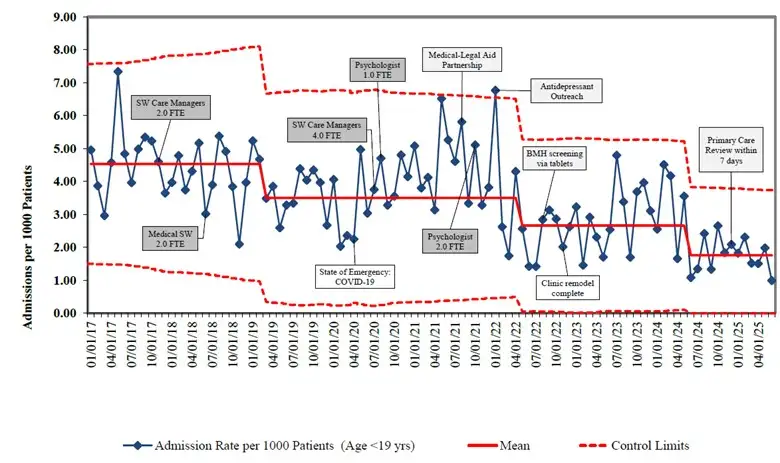
Their work across six years has resulted in earlier mental health screenings, faster triage during emergency visits, stronger follow-up services, and expanded community support for teens in need. Overall, the effort has reduced behavioral and mental health emergency department visits by 25% and hospital admissions by 58%.
“This study shows what can happen when primary care teams have the people, processes and partnerships needed to respond early to behavioral and mental health concerns,” says corresponding author Alex Nyquist, PhD, a faculty psychologist with Division of Behavioral Medicine and Clinical Psychology. “By building a more coordinated system around teens and families, we were able to help more patients get the right support before they reached a crisis point.”
The Teen Health Center at Cincinnati Children’s serves more than 5,000 teens a year, with many of its patients underinsured or covered by limited Medicaid benefits. For many years, this population was more likely than others to have under-treated conditions escalate into crisis situations.
The newly published findings show that the gains came not from a single intervention, but from a years-long effort to identify and respond to behavioral and mental health concerns during visits to primary care clinics, where many teens already receive routine services.
Since 2019, the Teen Health Center expanded its care team by adding more social work care managers, medical social workers, pediatric psychologists and community health workers. Those specialists worked alongside adolescent medicine physicians, nurses and quality improvement leaders to redesign care processes.
Among the most important changes:
Standardized suicide- and depression-screening tools
A more reliable triage process for crisis calls
Faster review of emergency visits and admissions
And structured outreach after new antidepressant prescriptions.
By 2025, the time between an acute behavioral health encounter and primary care review had dropped from 37 days to seven days. ED visits decreased from 7.9 per 1000 per month to 5.9 (25% reduction). Admissions decreased from 4.5 per 1000 per month to 1.9 (58% reduction).
The team created dedicated clinic space better suited for behavioral health care. They also built stronger community connections, including deeper partnerships with schools and legal aid services.
“Together, those changes helped the Teen Health Center shift more support upstream—before families reached the point of needing emergency or inpatient psychiatric care,” says study co-author Emmanuel Chandler, MD, Director of the Division of Adolescent and Young Adult Medicine. “This study shows that sustained investment in collaborative primary care can help reduce crisis-level behavioral health use among adolescents while improving access to timely, coordinated support.”
About the study
Cincinnati Children’s co-authors on this study also include Melissa Young, PsyD, Andrew Beck, MD, MPH, La Donna Morales, MSW, LISW, and Jessica Kahn, MD, MPH (now at Albert Einstein College of Medicine). Funding for the study was supported by the Division of Adolescent and Young Adult Medicine and the Health Equity Network at Cincinnati Children’s via the Office of Population Health and Michael Fisher Child Health Equity Center.
Don’t Miss a Post: