
Galveston County has seen an increase in mental health providers, including psychologists, counselors and therapists, but access to care remains complex.
The overview
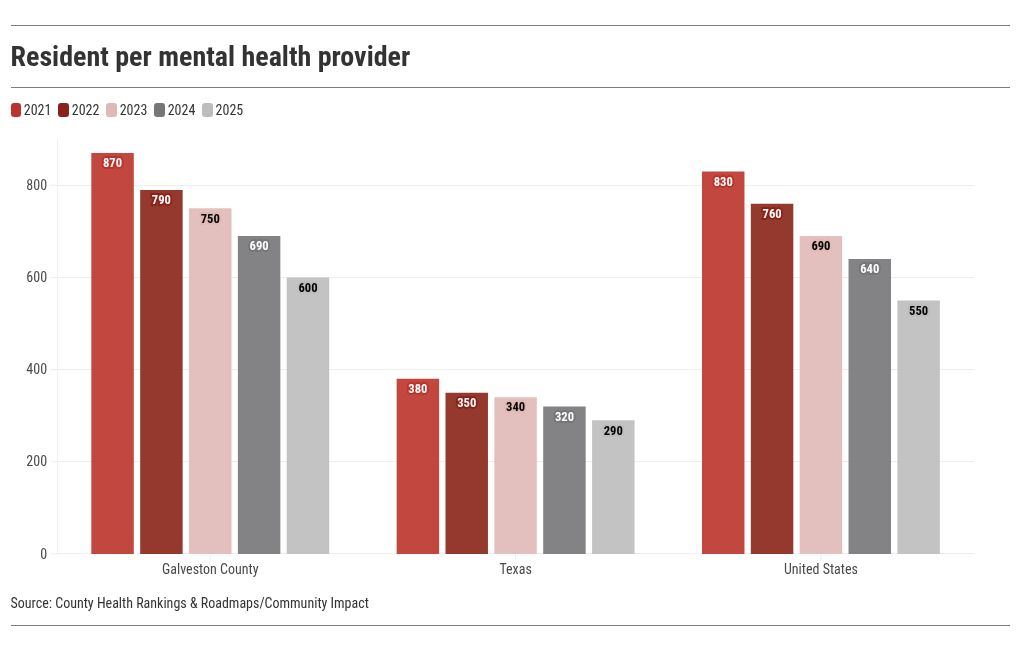
Access to mental health care providers, measured by the ratio of residents per provider, has improved in Galveston County since 2021, reflecting statewide and national trends, data shows.
However, access to care is also influenced, and can be limited, by factors including insurance coverage, cost and scheduling, said Andrea Usanga, chief strategy and innovation officer for Mental Health America of Greater Houston.
“If there are 100 providers and none of them take your insurance or are unaffordable, that’s not access,” Usanga said.
If left untreated, mental health conditions can develop into more serious disorders, said Lane Baker, chief operating officer at Coastal Health and Wellness, the county’s federally qualified health center.
“The next epidemic that we’re experiencing is mental health,” Baker said.
The approach
For residents seeking outpatient therapy, entry typically begins with an intake process used to match individuals with a provider based on patient concerns, availability and insurance coverage.
At Innovative Alternatives’ Clear Lake office, Clinical Director Sarah Lute said the goal is to schedule an initial appointment within a week, though that timeline can very based on need for high-demand appointment times. Once matched, treatment length can vary depending on the level of care.
“Sometimes people want a quick approach and we focus on solutions, while others may be coming in due to complex issues from their past, so it may take time for them to open up and process those experiences,” Lute said.
While some patients continue until they meet their goals, others discontinue care due to private pay costs, scheduling conflicts, transportation barriers or lack of child care, Lute said.
Michelle Chevallier, a psychiatric social worker at Houston Methodist Clear Lake, said gaps in access can leave people discouraged, leading some to seek alternative methods.
“We don’t want somebody who has gotten to a point of wanting to improve themselves to feel like it’s not an option,” she said. “We’ve seen people turning to [artificial intelligence] chatbots for instant feedback, and sometimes that can have harmful consequences. The chatbots are more programmed to affirm what somebody inputs rather than challenging distorted thoughts or provide clinical judgment in the way a trained provider would.”
The cost
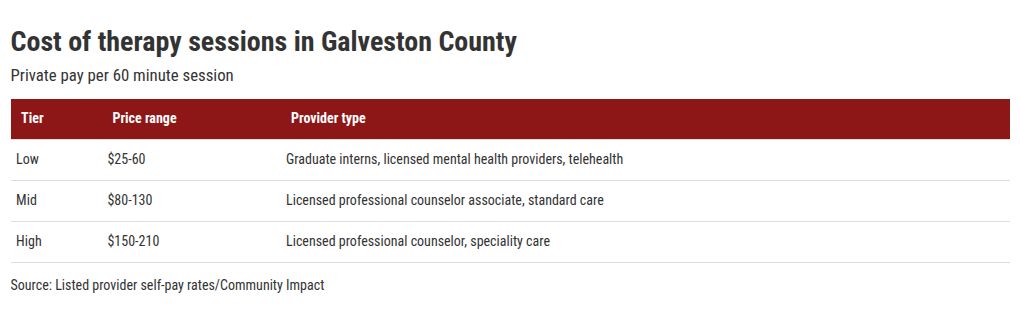
Therapy costs in Galveston County vary by provider and treatment type, from lower-cost telehealth or intern services to higher rates for experienced clinicians.
Most patients attend weekly or biweekly sessions, with more intensive care requiring multiple visits per week, Usanga said.
At a $110 average per session, biweekly therapy costs around $2,700 annually.
In the classroom
Kristina Ford, Clear Creek ISD’s director of counseling and student services, said counseling services help students manage academic and personal challenges while connecting families with outside support when needed.
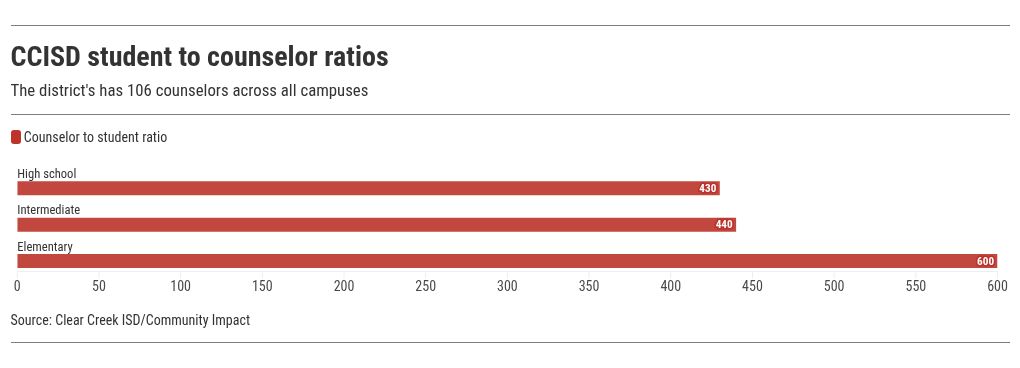
Elementary had the highest student-to-counselor ratios for the 2025-26 school year, reflecting a higher overall enrollment than intermediate and high school.
“Service availability in the community can fluctuate, which may affect how quickly students can be matched with the right level of support,” Ford said.
Something to know
In addition to high private pay costs, Usanga said many behavioral health professionals no longer accept insurance because reimbursement rates are often too low to cover operating expenses.
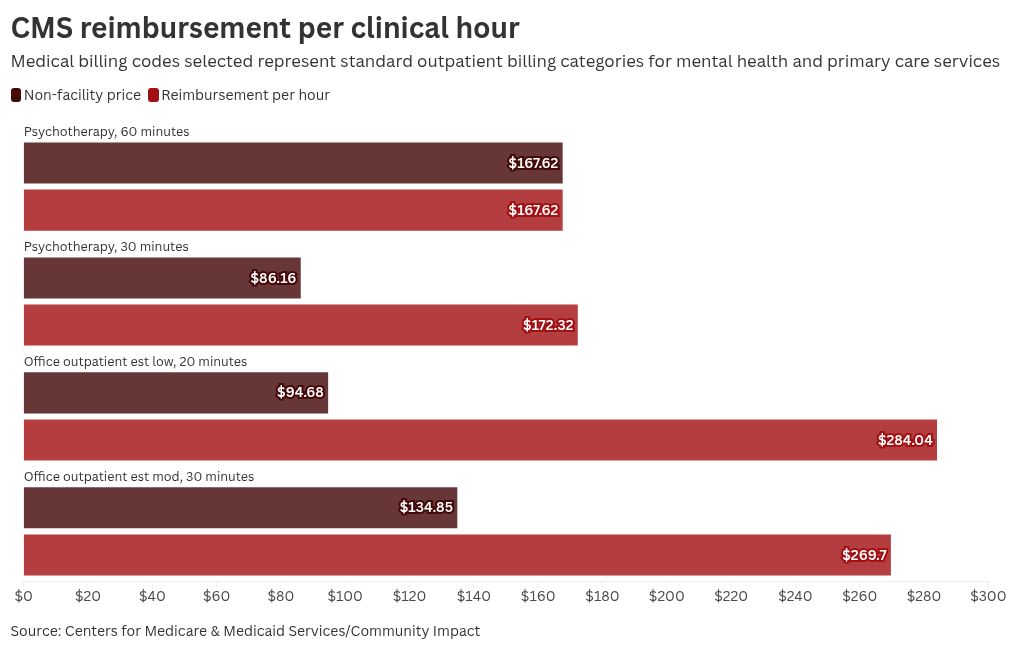
The Centers for Medicare and Medicaid Services, or CMS, publishes standard Medicare outpatient payment rates that private insurers often use as benchmarks for reimbursement rates.
Psychotherapy is billed in fixed time-based sessions, while outpatient medical visits are billed based on the type of care provided, including low-, moderate- and high-complexity visits.
Outpatient medical visits are reimbursed at a higher rate per unit of clinician time than psychotherapy sessions, CMS data shows.
Reimbursement rates also don’t take into account the unpaid time therapists spend on care coordination outside appointments, Usanga said.
The bottom line
Improving access to mental health care requires earlier intervention and stronger integration with primary health care systems, Usanga said.
“The reason we have mammograms and other screening is so we’re not at a point where there’s very little that can be done,” she said. “The same exact thing goes for behavioral health care.”
At Coastal Health and Wellness, Baker said behavioral health services are integrated alongside primary medical, pediatric and dental care through federal funding.
Additionally, Chevallier pointed to Houston Methodist’s virtual collaborative care program, which allows primary care physicians to refer patients directly to licensed clinical social workers within the same health care network.
“Behavioral health integration with primary care has become increasingly important because many patients first present concerns during routine medical exams,” Baker said.
Despite ongoing barriers involving cost, insurance and provider availability, Usanga said awareness of mental health has continued to improve, supporting more integration and preventative care.
“[Millennials and Gen. Z] are much more aware of the impact of mental illness and challenges that they are facing,” Usanga said. “They are willing to express when they need help. I feel optimistic about the future of behavioral health.”