
Over 100 community members, including Sentara Albermarle Medical Center executives and staff, law enforcement, court personnel, local mental health providers and others from around the First Judicial District came together recently for a symposium focused on the issues facing the local court system and jails in dealing with people who are incarcerated and suffering from mental illnesses.
“About 45 percent of the state’s prison inmates have a history of mental health problems, and at any one time about 25 percent of the prison population has a mental health diagnosis that requires treatment,” said Chief District Court Judge Robert P. Trivette.
Trivette, along with Trillium Health and Sentara, organized and sponsored the symposium, which took place at the Pasquotank County Courthouse on May 27.
“We are dealing with folks suffering mentally in many ways every day in our courts and in our jails,” Trivette added. “Historically, courts have not been set up to deal with the level of mental health issues we are facing today. We need help because we are not mental health specialists.”
Five presenters spoke at the event.
Elizabeth Arnette is an Assistant Attorney General with the N.C. Department of Justice. She represents Cherry Hospital, the state psychiatric hospital that serves 36 counties in eastern North Carolina. She has significant experience in cases where criminal law and mental health intersect.
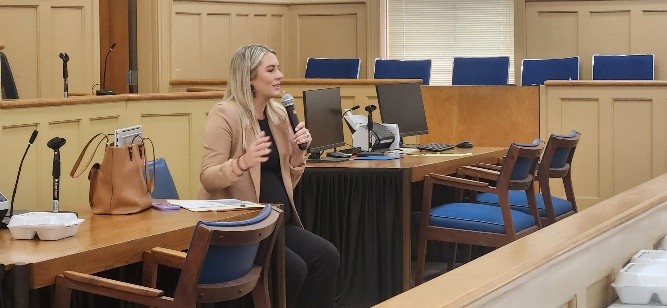 Assistant state Attorney General Elizabeth Arnette. [submitted photo]
One focus of the symposium was to educate court system personnel and local mental health providers on the process of dealing with people who are “Incapable to Proceed” or may need to be “Involuntarily Committed” and have fallen into the criminal justice system.
Arnette explained that a judge must sign two court orders to have an inmate sent to Cherry Hospital when local authorities determine the person is incapable of proceeding — that is when the defendant’s mental health has deteriorated to the point that the individual does not understand the criminal justice process enough for the case to legally proceed.
In such a case, Ms. Arnette explained, the person may be sent to Cherry Hospital to receive treatment in hopes that their capacity is restored, and the court case can proceed.
Unfortunately, because of chronic understaffing, there is often a waiting period of several months for admission to Cherry Hospital, leaving offenders stuck in local county jails, where mental health treatment options are limited or nonexistent.
Cherry Hospital has 300 beds but can utilize only 170 beds because of the lack of nurses and other staff, Arnette stated.
In her presentation, Dr. Holly Manely, the Director of Psychology at Cherry Hospital, stated the average stay at the hospital is four months – two months below the national average. Patients are also offered services other than restoring capacity, she noted, which can often help them if they are released back into the community. Patients can be forced to take medications if needed to prevent them from becoming violent.
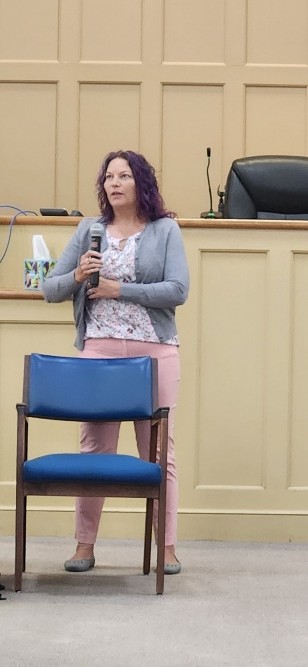 Cherry Hospital Director of Psychology Dr. Holly Manley. [submitted photo]
Because of the backlog at Cherry Hospital, in 2023 the North Carolina legislature created a pilot project at Pitt County Regional Jail in Greenville, designed to offer an alternative capacity restoration program for counties in eastern North Carolina.
Dr. Anna Abate is the director of this program called NC Rise, and she spoke at the symposium. The program is modeled after Cherry Hospital’s restoration program. About 80 percent of the inmates who go through the NC Rise program have been determined to be capable of proceeding after completing the program, Abate stated. The program has limits, however. There are only 10 beds available, only males are admitted at this time, and the program cannot take any violent offenders.
Trivette stated that he learned of the NC Rise program last year and has already used it several times.
Wayne Jones, Assistant Administrator at the Albermarle District Jail (ADJ) in Elizabeth City, noted there has been a steep increase over the years in the number of jail inmates with serious mental health issues.
“This has had a significant impact in our jail, affecting safety, operations and costs,” Jones said in a statement after the symposium. Jones has been at ADJ for 38 years. “More and more we are required to do mental health assessments, counseling, medication management, crisis interventions and provide specialized housing.”
“In addition,” Jones added, “our staff must receive specialized training to know how to de-escalate situations and safely respond to psychiatric emergencies.”
Dr. Betsy Dixon, a Licensed Professional Counselor and Ms. Victoria Gray, a Licensed Clinical Social Worker, work as mental health specialists at Sentara Albermarle Hospital in Elizabeth City, and often focus on involuntary commitments. They both spoke at the symposium.
Dr. Dixon and Ms. Gray have been working closely with the local court system and jail on streamlining the involuntary commitment process.
An involuntary commitment (IVC) can be sought by anyone who believes an individual is a danger to his/herself or to others.
Often these cases arise after a person has been arrested and is in custody at ADJ. The involuntary commitment process starts at the magistrate’s office but ultimately a medical professional decides whether a person should be committed and for how long.
Dr. Dixon stated that the process is a balancing act. “Of course, safety is critically important when discussing IVCs. There are absolutely times when IVCs have saved lives,” Dixon stated. “But it’s also important to acknowledge the real impact that the IVC process can have on a patient’s wellness.”
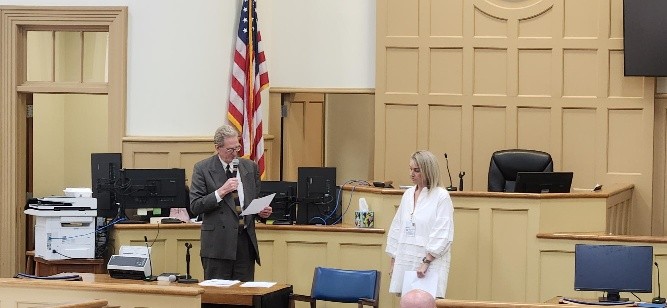 Chief District Court Judge Robert P. Trivette (left) introduces Dr. Betsy Dixon of Sentara Albemarle Medical Center. [submitted photo]
“For many patients it is one of the most frightening and disempowering experiences of their lives. Our approach matters,” Dixon added. “We cannot always avoid IVCs, but we can influence how a patient experiences it.”
Ms. Gray focused on the two main criteria for possibly finding that an IVC is warranted – when a person is a danger to themselves or when a person is a danger to other people. The finding must involve more than someone verbalizing suicidal thoughts, she explained. There must be behaviors indicating a “substantial risk,” such as a recent suicidal attempt, or continuous behaviors such as a person repeatedly cutting themselves or making overdose attempts or making repeated threats to obtain a firearm.
The other criteria — a danger to others – can be indicated by credible threats of violence toward others, especially when accompanied by assaultive or aggressive behavior, Gray explained. People who cannot be redirected after destroying property or making homicidal threats may meet the criteria for commitment.
“It is clear we will be dealing more and more with prisoners and detainees in our jails and courts who are suffering from serious behavioral health issues,” Trivette said after the symposium. “This is a very tough problem, and we must work on it together — courts, jails, law enforcement, mental health providers, and the community.”
Chief District Court Judge, Robert P. Trivette introduces Dr. Betsy Dixon of Sentara Albemarle Medical Center at a recent symposium at the Pasquotank County Courthouse related to mental health issues and defendants incarcerated in the criminal justice system. Dr. Dixon spoke on the involuntary commitment process.
Elizabeth Arnette is an Assistant Attorney General with the NC Department of Justice who represents the State of NC at Cherry Hospital, the state psychiatric facility in Goldsboro serving 36 counties in eastern North Carolina. Ms. Arnette spoke at the symposium on issues related to defendants who are determined to be incapable of proceeding with their court cases and are ordered to go to Cherry Hospital to have their capacity restored. Ms. Arnette explained the backlog of several months to be admitted to Cherry Hospital is because of chronic staffing shortages at the hospital.
Dr. Holly Manley is the Chief Forensic Evaluator and the head of the Department of Psychology at Cherry Hospital. She spoke at the symposium on treatment services provided at Cherry Hospital for patients.
Approximately 100 people who work in the local court system as well as local medical care providers attended a symposium on May 27, 2026, on issues related to incarcerated people who have serious mental health issues. The symposium was organized by Chief District Court Robert P. Trivette (pictured far left) and sponsored by Trillium Health and Sentara Albemarle Medical Center.