

In this issue of the Daily, we bring you some good news: A large-scale review and meta analysis reveals the healing power of nature. Psychologist Dr. Barbara Greenberg weighs in on The Golden Bachelor reality TV show. And just in time for Pride Month, the American Foundation for Suicide Prevention launches new suicide prevention resources.
But first: Let’s pause for a moment of “impossible joy” for New Yorkers, with their beloved Knicks winning the NBA championship for the first time in 53 years! You can hear it in a video from The Guardian, the New York Times’ account of a unifying night of wild celebration, and a television interview with Mayor Zohran Mamdani, who said watching the victory with fellow New Yorkers in a section of affordable seats the City created was “one of the best moments of my life.”
New study reinforces the healing power of nature
 Photo: ShutterTim82/Shutterstock
Some academic studies have titles that are hard to parse, but this Nature Human Behavior briefing headline could not be more clear: “The healing power of nature reduces stress, anxiety and depression.”
In the accompanying study, researchers led by Esmaeel Saedy Robat, a professor at the Islamic Azad University in Iran found that being in nature “reduces symptoms of anxiety and depression while promoting relaxation” by doing a global analysis of more than 3,800 studies involving more than 10 million people.
According to recent studies, around 350 million people in the world suffer from depression. Statistics about anxiety disorders – which afflicted an estimated 264 million people – “are similarly concerning,” the researchers wrote. The prevalence of the two mental disorders has risen over recent years, with depression increasing by 18.4% from 2005 to 2015 and anxiety disorders rising by 14.9% in the same period. The researchers predicted that depression and anxiety would account for the world’s “largest disease burden” by 2030 and will continue to rise through 2050, in part due to global demographic aging and population growth.
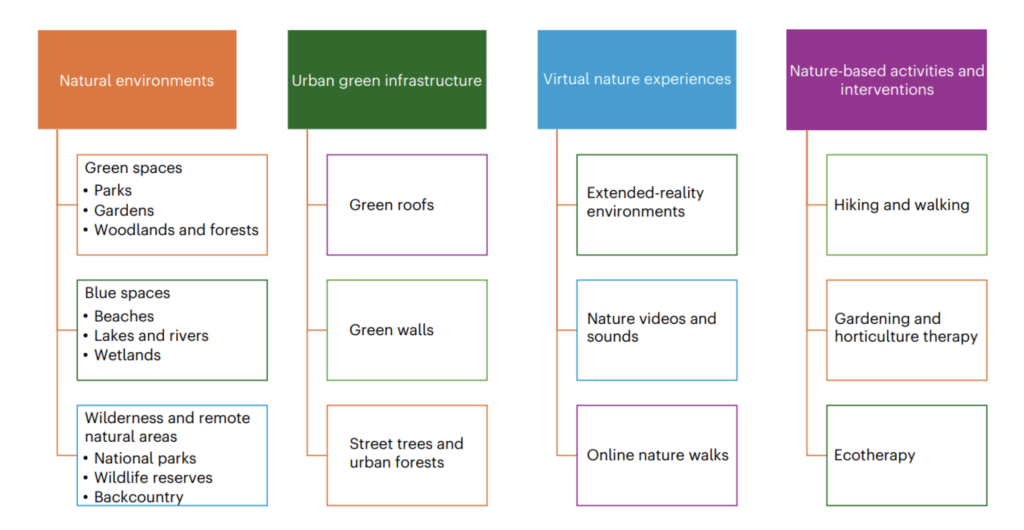
However, nature itself can help heal these twin ills as well as help people cope with overwhelming stress, the study found. “Nature-based interventions,” known to specialists as NBIs, offer relatively inexpensive treatment. These include spending time in natural environments like parks, forests, lakes, oceans and wilderness areas and urban forests; enjoying virtual nature experiences; and doing nature-based activities such as gardening, walking, hiking and ecotherapy (see chart below).
The researchers point to three established theories for the benefits of nature: those derived from social cognitive theory, stress reduction theory, and attention restoration theory. “These theories collectively highlight the multifaceted ways in which interaction with natural environments can enhance well-being and promote psychological health,” they write.
For instance, stress reduction theory, suggests that, “since humans evolved in natural habitats, their love of nature is innate and instinctive…Natural environments can reduce stress by lowering heart rates, reducing muscle tension, reducing sympathetic nervous system activity and decreasing levels of stress hormones, such as cortisol…Natural settings have an inherently restorative quality that contrasts with the demands of urban or artificial environments. Exposure to green spaces may thus promote mental relaxation and alleviate stress.”
The paper, published in February of this year, concludes that nature-based interventions “benefit mental health, reducing key negative outcomes associated with stress, anxiety and depression, and enhancing positive states such as affect and relaxation…High-quality, standardized research with active comparators is now needed to fully harness and integrate these strategies into mental health care.”
Dr. Barbara Greenberg on The Golden Bachelor and Gray Dating
Teen and family psychologist Barbara Greenberg, PhD, of Fairfield, Connecticut recently wrote about the popular reality show “The Golden Bachelor” in Psychology Today. “Both friends and clients were buzzing about this show, so as a lover of what is going on in our culture, I naturally tuned in,” wrote Greenberg, a MindSite News advisory board member. She found that the show’s second season star, Mel Owens, was an amiable, divorced 66-year-old lawyer and former football player. He had recently stated on a podcast that he preferred women ages 40 to 60 “who do not have artificial hips or wigs.” Instead, the reality show assigned him 23 women ages 58 to 77 to date.
Well! As Dr. Greenberg said, “ABC cleverly flipped the script on Mel (in terms of the women’s ages) and this has made the show that much more interesting.” The goal is for him to pick a life partner, and perhaps not surprisingly he began by apologizing for his podcast remarks. Greenberg reports that The Golden Bachelor is extremely popular with gray daters over 50, who enjoyed comparing themselves with the contestants in terms of accomplishments and self-care.
“The 50-plus-year-olds that I have spoken with report that the show has given them hope that you can be desirable and find companionship and romance after age 50,” she said, adding that some have even started dating again as a result.
But Dr. Greenberg noticed one issue that concerned her: The 23 contestants “all clearly idealized Mel,” a man they hardly knew. “My concern is that this is what happens in real life,” she says. “Simply because a man of a certain age is attractive and available does not mean that he is a man of solid character. Go on and enjoy this show. Have fun dating, but please stay away from idealizing potential partners…The takeaway from the show should be that self-care and socializing may be exciting and complicated, but chasing after a stranger is the stuff of reality TV.”