
Author’s Note: Recent trends in language use within the autism community reflect differing preferences regarding identity-first language (e.g., “autistic person”) and person-first language (e.g., “person with autism”). In this article, both styles are used to reflect the diverse preferences of autistic individuals, families, professionals, and advocates.
Research suggests that children with neurodevelopmental disorders may be at increased risk for oral health problems compared to their typically developing peers (Frank et al., 2019; Obeidat et al., 2022; Uliana et al., 2024). Oral health concerns have been linked to pain, sleep disruption, reduced quality of life, school absences, and poorer academic performance (Guarnizo-Herreño et al., 2019; Jackson et al., 2011; Rebelo et al., 2019; Watt et al., 2024). For children with autism and ADHD, these effects may be particularly important because oral discomfort can influence many of the same areas commonly associated with neurodevelopmental conditions, including attention, behavior, sleep, and emotional regulation.
Why Are Children with Autism and ADHD at Greater Risk?
Children with autism and ADHD may face unique barriers to maintaining oral health. For autistic children, sensory sensitivities, food selectivity, and communication differences may make toothbrushing, dental visits, and recognition of oral discomfort more challenging (Hasell et al., 2022; Prynda et al., 2025; Sarnat et al., 2016; Uliana et al., 2024). Children with ADHD may experience difficulties with executive functioning, routine adherence, self-monitoring, and oral hygiene habits (Chau et al., 2020; Mota-Veloso et al., 2018).
Additionally, motor coordination difficulties may influence the effectiveness of daily oral hygiene routines (Konstantinova et al., 2023; Mafla et al., 2022). Feeding difficulties, food selectivity, and oral sensory sensitivities are also common among autistic children and often require support from speech-language pathologists and other developmental specialists (Sharp et al., 2013; Marshall et al., 2015). These challenges may increase vulnerability to oral health problems while making oral discomfort more difficult to recognize and address.
What Did Our Study Find?
To better understand the relationship between neurodevelopmental disorders and oral health, we analyzed data from the 2022–2023 National Survey of Children’s Health, a nationally representative survey including more than 66,000 children ages 6 to 17. Children were grouped based on parent-reported diagnoses of autism, ADHD, co-occurring autism and ADHD, or neither condition. Oral health problems included parent-reported concerns such as cavities, toothaches, bleeding gums, or other ongoing dental issues.
Several important findings emerged:
Children with autism were significantly more likely to experience oral health problems than typically developing peers.
Children with ADHD were also significantly more likely to experience oral health problems than typically developing peers.
Children with co-occurring autism and ADHD demonstrated the highest rates of oral health concerns.
Children with ADHD experienced oral health problems at rates comparable to children with autism.
This final finding was particularly noteworthy. While oral health challenges among autistic children have received increasing attention in recent years (Hasell et al., 2022; Prynda et al., 2025; Uliana et al., 2024), children with ADHD may represent an underrecognized group at elevated risk for oral health difficulties (Chau et al., 2020).
Could It Be Oral Pain?
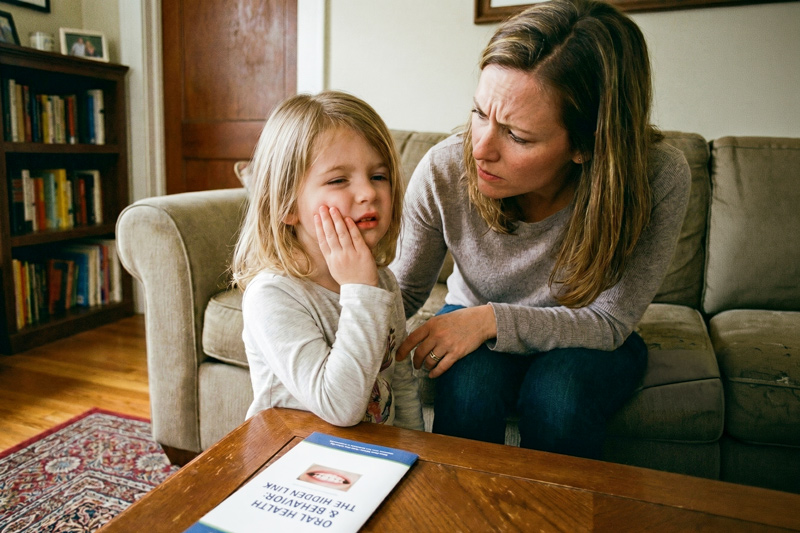
One of the most important implications of this research is that oral health problems may sometimes masquerade as, or even exacerbate, symptoms commonly associated with autism and ADHD. Oral pain can affect sleep, mood, attention, behavior, and overall functioning (Metwally et al., 2024; Watt et al., 2024). For children who have difficulty recognizing or communicating discomfort, pain may be expressed behaviorally rather than verbally. As a result, symptoms commonly attributed to autism or ADHD may sometimes be influenced by untreated oral discomfort.
Possible signs include:
Increased irritability
Emotional outbursts
Behavioral dysregulation
Sleep disruption
Difficulty concentrating
Reduced frustration tolerance
Food refusal or changes in eating habits
Increased sensory sensitivities
This issue may be particularly relevant for children with communication differences who may have difficulty expressing physical discomfort. In these situations, behavior may become the primary way a child communicates pain (Hasell et al., 2022; Prynda et al., 2025). Oral discomfort may also affect feeding and eating behaviors. Children experiencing dental pain may avoid chewing, refuse previously accepted foods, become more selective, or demonstrate increased distress during mealtimes. Because feeding challenges are already common among children with autism, changes in eating behaviors may not immediately raise concerns about oral health (Sharp et al., 2013; Marshall et al., 2015). Emerging research also suggests that poor oral health may influence broader developmental outcomes by affecting pain, sleep, stress, and overall health (Foláyan et al., 2023; Metwally et al., 2024).
Oral Health and School Success
Oral health concerns affect other aspects of a child’s daily functioning outside of the home. Research has consistently linked poor oral health with increased school absences, reduced classroom participation, and poorer academic performance (Guarnizo-Herreño et al., 2019; Jackson et al., 2011; Rebelo et al., 2019). For children with autism and ADHD, who may already experience challenges related to attention, executive functioning, sensory processing, or emotional regulation, untreated oral health problems may create additional barriers to learning and school success.
What Can Families Do?
If you are a parent or caregiver, there are several steps you can take to support your child’s oral health:
Watch for changes in behavior – Sudden increases in irritability, emotional outbursts, sleep difficulties, or food refusal may warrant consideration of possible oral discomfort.
Monitor eating habits – Changes in chewing, food preferences, or willingness to eat certain textures may sometimes signal oral pain.
Prioritize routine dental care – Regular dental visits can help identify concerns before they become more serious. Seek dental professionals who have advanced training and certifications in working with neurodivergent children.
Share sensory concerns with providers – Many dental professionals can adapt procedures to better support children with sensory sensitivities.
Consider the whole child – When new behavioral or emotional challenges emerge, consider whether physical health factors, including oral health, may be contributing.
What Can Professionals Do?
Mental health professionals, educators, pediatricians, dentists, speech-language pathologists, occupational therapists, and other providers all play a role in supporting children’s oral health.
Professionals can:
Include oral health in screening and assessment efforts.
Consider oral health when behaviors change – Irritability, sleep disruption, feeding concerns, and behavioral dysregulation may warrant exploration of possible physical discomfort.
Promote interdisciplinary collaboration – Partnerships among healthcare, educational, and behavioral health professionals can help ensure comprehensive care.
Support family-centered care – Research suggests that coordinated, family-centered approaches may improve health outcomes for children with special healthcare needs (Chakraborty et al., 2025).
In Summary
Children with autism, ADHD, and co-occurring autism and ADHD experience elevated rates of oral health problems compared to their typically developing peers. Importantly, children with ADHD may represent an underrecognized group at risk for oral health difficulties. Oral discomfort can influence behavior, sleep, feeding, attention, learning, and quality of life in ways that are not always recognized. By considering oral health as part of a child’s overall well-being, families and professionals may gain a more complete understanding of the factors influencing development and daily functioning. Sometimes an overlooked piece of the puzzle is not another diagnosis or intervention; it may be recognizing and addressing a source of physical discomfort that has been there all along.
For more information, email abertsch@fielding.edu.
References
Chakraborty, B., Wilson, F. A., Wehbi, N. K., Chen, L. W., & Tak, H. J. (2025). The impact of family-centered care on oral health for children with special health care needs. Special Care in Dentistry, 45(5), e70095. https://doi.org/10.1111/scd.70095
Chau, Y. C. Y., Peng, S. M., McGrath, C. P. J., & Yiu, C. K. Y. (2020). Oral health of children with attention deficit hyperactivity disorder: Systematic review and meta-analysis. Journal of Attention Disorders, 24(7), 947–962. https://doi.org/10.1177/1087054717743331
Foláyan, M. O., Femi-Akinlosotu, O. M., Adeoti, B., & Olorunmoteni, O. E. (2023). Untreated early childhood caries and possible links with brain development. Biomed, 3(4), 431–439. https://doi.org/10.3390/biomed3040035
Frank, M., Keels, M. A., Quiñonez, R., Roberts, M., & Divaris, K. (2019). Dental caries risk varies among subgroups of children with special health care needs. Pediatric Dentistry, 41(5), 378–384.
Guarnizo-Herreño, C. C., Lyu, W., & Wehby, G. L. (2019). Children’s oral health and academic performance: Evidence of a persisting relationship over the last decade in the United States. The Journal of Pediatrics, 209, 183–189.e2. https://doi.org/10.1016/j.jpeds.2019.01.045
Hasell, S., Hussain, A., & Da Silva, K. (2022). The oral health status and treatment needs of pediatric patients living with autism spectrum disorder: A retrospective study. Dentistry Journal, 10(12), 224. https://doi.org/10.3390/dj10120224
Jackson, S. L., Vann, W. F., Kotch, J. B., Pahel, B. T., & Lee, J. Y. (2011). Impact of poor oral health on children’s school attendance and performance. American Journal of Public Health, 101(10), 1900–1906. https://doi.org/10.2105/AJPH.2010.200915
Konstantinova, D. A., Dimitorov, L. G., Angelova, A. N., & Pancheva, R. Z. (2023). Components of oral health related to motor impairment in children with neuropsychiatric disorders. Cureus, 15(9), e46093. https://doi.org/10.7759/cureus.46093
Mafla, A. C., Benavides, R. J., Meyer, P., Giraudeau, N., & Schwendicke, F. (2022). Association of children’s toothbrushing and fine motor skills: A cross-sectional study. Brazilian Oral Research, 36, e103. https://doi.org/10.1590/1807-3107bor-2022.vol36.0103
Marshall, J., Ware, R., Ziviani, J., Hill, R. J., & Dodrill, P. (2015). Efficacy of interventions to improve feeding difficulties in children with autism spectrum disorders: A systematic review and meta-analysis. Child: Care, Health and Development, 41(2), 278–302. https://doi.org/10.1111/cch.12157
Metwally, N. M., Ragab, O. A. A., Kandil, M. S. H., & Elghareb, L. A. (2024). Pain assessment, cognitive and cortical changes with full mouth rehabilitation in a group of children. BMC Oral Health, 24(1), 599–611. https://doi.org/10.1186/s12903-024-04356-w
Mota-Veloso, I., Ramos-Jorge, M. L., Homem, M. A., Pordeus, I. A., Paiva, S. M., & Oliveira-Ferreira, F. (2018). Dental caries in schoolchildren: Influence of inattention, hyperactivity and executive functions. Brazilian Oral Research, 32, e52. https://doi.org/10.1590/1807-3107bor-2018.vol32.0052
Obeidat, R., Noureldin, A., Bitouni, A., et al. (2022). Oral health needs of U.S. children with developmental disorders: A population-based study. BMC Public Health, 22, 861. https://doi.org/10.1186/s12889-022-13237-2
Prynda, M., Pawlik, A. A., Emich-Widera, E., Kazek, B., Mazur, M., Niemczyk, W., & Wiench, R. (2025). Oral hygiene status in children on the autism spectrum disorder. Journal of Clinical Medicine, 14, 1868. https://doi.org/10.3390/jcm14061868
Rebelo, M. A. B., Rebelo Vieira, J. M., Pereira, J. V., Quadros, L. N., & Vettore, M. V. (2019). Does oral health influence school performance and school attendance? A systematic review and meta-analysis. International Journal of Paediatric Dentistry, 29(2), 138–148. https://doi.org/10.1111/ipd.12441
Sarnat, H., Samuel, E., Ashkenazi-Alfasi, N., & Peretz, B. (2016). Oral health characteristics of preschool children with autistic syndrome disorder. The Journal of Clinical Pediatric Dentistry, 40(1), 21–25.
Sharp, W. G., Berry, R. C., McCracken, C., Nuhu, N. N., Marvel, E., Saulnier, C. A., Klin, A., Jones, W., & Jaquess, D. L. (2013). Feeding problems and nutrient intake in children with autism spectrum disorders: A meta-analysis and comprehensive review of the literature. Journal of Autism and Developmental Disorders, 43(9), 2159–2173. https://doi.org/10.1007/s10803-013-1771-5
Uliana, J. C., Del’ Agnese, C. C., Antoniazzi, R. P., & Kantorski, K. Z. (2024). Autistic individuals have worse oral status than neurotypical controls: A systematic review and meta-analysis of observational studies. Clinical Oral Investigations, 28(2), 137. https://doi.org/10.1007/s00784-024-05500-0
Watt, S., Dyer, T., Marshman, Z., & Jones, K. (2024). Does poor oral health impact on young children’s development? A rapid review. British Dental Journal, 237, 255–260. https://doi.org/10.1038/s41415-024-7738-4