
Lifer!’ ‘LiiFER!’ ‘LIIIFFEEEER!’ That’s the common call of the greater spotted Reiser brothers, Owen and Quentin. It’s what they say when they see a species of bird in the flesh for the first time. And they’ve seen a lot: 579 different varieties during 2024, when the pair from St Louis, Missouri, decided to drive all over the lower 48 states of the US to attempt a ‘big year’.
If that sounds impossibly nerdy to readers who would no sooner walk down the street clutching a pair of binoculars than they would a pair of knitting needles, let’s reassure you right at the top. This is extreme birdwatching. It takes hardship, dedication, long journeys into the wilderness and more nights sleeping in a 2010 Kia Sedona than most would be willing to endure. It’s not a new thing – the idea was documented in Mark Obmascik’s 2004 book The Big Year and fictionalised in 2011 for a comedy film of the same name starring Jack Black, Steve Martin and Owen Wilson. Even before that, people (okay, mostly men) have been competing to see the greatest variety of birds in a calendar year, especially in North America, since around the 1940s.
What the Reiser brothers have managed to do is make it cool. In August 2025 they released a two-hour documentary about their big year attempt on YouTube. Listers: A Glimpse Into Extreme Birdwatching has now been watched more than 3m times, an extraordinary figure for a long movie about a specialist outpost of a specialist hobby. With Owen, a nature cinematographer, mostly behind the camera, and Quentin, a dryly funny hipster app designer, usually in front, they’ve made a hilarious piece of gonzo journalism; a kind of Bill & Ted’s Excellent Birding Adventure complete with goofy animations, fancy dress and lots of swearing. Quentin admits that the idea came about because he got stoned and found himself filled with wonder while browsing the old family copy of Birds Of North America: A Guide To Field Identification. The pair arrive at their subject with piss-taking irreverence, but the film’s irresistible charm comes from the fact that, very quickly, they find themselves falling in love with the creatures they spot. On seeing a Montezuma quail for the first time, with its black and white markings like a French mime artist, Quentin says, ‘I’d run through a brick wall for that bird.’
The birding community is all aflutter about it but hasn’t taken offence, despite footage of vomiting, fart jokes and Quentin going on a boat trip to spot marine birds while on magic mushrooms. ‘Immediately you had birders from all over the place saying, “This is the movie we’ve always wanted about birding,”’ says Alvaro Jaramillo, co-host of the bird podcast Life List. ‘I’ve yet to see anyone that I respect say that it was not a great film.’
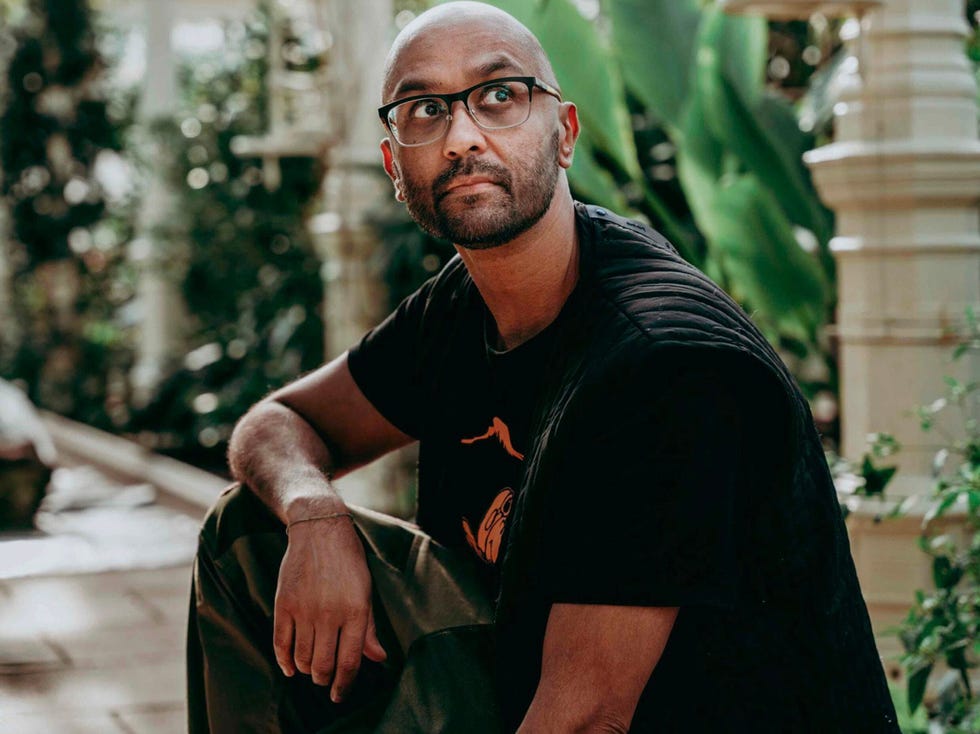 Underhill Creatives
Sound artist Jason Singh describes himself as a ’bird listener’
Nature’s Beatboxer
Listers is a cultural crossover moment for a pastime with a poor rep that is often unfairly lumped in with trainspotting, possibly because both require anoraks. Unlike trains, birds are punks and fashionistas, fighter pilots, acrobats and sex-mad fight-pickers who are usually shouting one of two things: ‘Fuck me!’ or ‘Fuck you!’
Many of us will have enjoyed some of the language of the birdspotting world, with its bearded tits and blue-footed boobies, and perhaps mocked it as ‘twitching’. Two unintentionally funny British documentaries, Encounters: Twitchers on Channel 4 in 1996 and Twitchers: A Very British Obsession on BBC Four in 2010, did little for its cool credentials. Another word to add to your vocabulary is ‘jizz’, meaning the knowledge you get from a combination of vague impressions. Glimpsing the size, shape, movement and so on is the jizz of a bird – explained for those still giggling at the back in Rob Hume’s book Birds By Character: The Fieldguide To Jizz Identification.
Today, a relaunched British podcast, Get Birding, is reaching beyond the traditional audience by employing none other than Sean Bean, Lord Eddard Stark of Winterfell himself, as its host. In one episode, guest Amir Khan – TV doctor and president of the RSPB – tries to make this world more relatable by saying, ‘The garden is like a kebab shop at two in the morning – every animal is trying to feed, shag or fight.’ Also featuring regularly on the show is Dr Mya-Rose Craig, a 23-year-old ornithologist and author of Birdgirl, who featured in the BBC Twitchers doc aged seven and is one of a number of people bringing youth and diversity to birding on social media.
Then there’s Jason Singh, who is surely in a class of one as a ‘nature beatboxer’. ‘I’m not a birdwatcher. I’m a bird listener,’ he tells me. More broadly, he’s a sound artist and music producer who began his career playing the drums and has followed an idiosyncratic path that includes impersonating the dawn chorus on Countryfile. You’re in a unique position to engage younger people with the natural world if you can use your mouth to sound like both a rave horn and a chaffinch.
Birds are punks, fashionistas, fighter pilots and sex-mad fight-pickers
Even growing up near Brick Lane in the east-London borough of Tower Hamlets, Singh had the small park Allen Gardens and Spitalfields City Farm on his doorstep. ‘I started listening to birds during a traumatic period of my life,’ says Singh. For him, the sound of the birds, and the wind in the trees, wasn’t just a hobby – it was a way of tuning out the turmoil in his life.
As a sound artist, he creates music using ‘biosonification’, converting the electrical impulses generated by plantS, trees and even mushrooms into musical notation. ‘It’s almost like Google Translate,’ he says. For six months in 2012, he was the sound artist in residence at the V&A Museum in London, with a focus on its Middle Eastern collections, where he developed a soundscape inspired by the 12th-century Sufi poem The Conference Of The Birds. A bird specialist at the National Trust heard it and was astonished to learn that all these sounds were made by one person, which led to him being commissioned to produce a short album for them. It’s called Tweet Music and is still available on his Bandcamp page. Since then, his unique talents have made him a nature programme regular, and he also leads deep listening sound walks from his current base in Devon. ‘It’s about getting people engaged with their environment and their landscapes through sound – getting people to think about that sound as music.’
Mal Troon of the University of Sussex agrees that we are tapping into something deep within ourselves when we tune in to birdsong. In his work in the field of sound studies, he explores how sounds can be as permanent an element of a specific place as the things we can see. He has written about navigating in the dark on a Scottish clifftop using the sounds of thousands of Manx shearwaters returning to their underground burrows. ‘It’s a kind of sonic mapping. The sound of birds can place us somewhere in particular,’ he says, the most obvious one being the way that the screech of a herring gull makes us visualise the seaside. He’s a birder himself, going out regularly with a handful of friends, and thinks it’s the social aspect that provides the greatest enjoyment. ‘The wellbeing element is built on top of the birdwatching, from the by-products of spending time together with a common interest and having time to chat.’
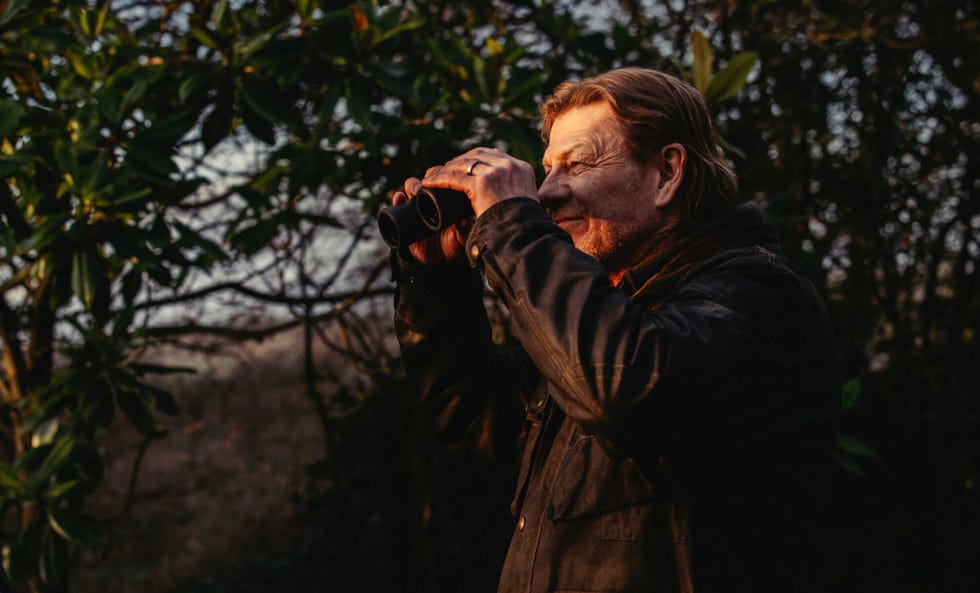 James Turner
Actor Sean Bean is a presenter on the recently relaunched podcast Get Birding, which is reaching beyond the traditional birdspotting audience
Birder’s High
It’s not a revelation to point out that spending more time outdoors in nature is great for your mental health. A study in the journal Frontiers In Psychology in 2023 found that bird walks offered ‘psychological restoration’ – provided the walkers paid deliberate attention to the sights and sounds. Another, in Landscape And Urban Planning last November, tried to measure this by taking readings for blood pressure, heart rate and the stress hormone cortisol in 233 people who took a bird walk in Germany. Some of the group listened to the natural song around them, some to additional birdsong played through speakers placed along the route, and a control group heard nothing using noise-cancellation headphones. The researchers found that stress markers decreased universally after taking the walk, even for those who walked in silence, but that those who were asked specifically to ‘pay attention, not only had a better nature experience but also presented with more positive emotions after the walk’.
Scientists have found that being in the natural environment reduces feelings of aggression and can even make us less selfish. A 2023 experiment in the Journal Of Environmental Psychology, meanwhile, found that compared with walking around an indoor shopping centre, people who visited a nature conservatory were ‘less likely to think about themselves, felt closer to people nearby and around the world and felt higher connectedness to their social and physical environment’.
This plays into the concept of biophilia, which suggests that human beings have an inbuilt affinity with nature and other living things. Ornitherapy is a growing practice, too, a type of mindful birdwatching for wellbeing purposes. In 2021, the UK government spent £5.77m on a ‘green social prescribing’ programme, whereby health professionals were encouraged to prescribe nature-based activities to patients with mental health difficulties as part of a holistic care plan.
When Jason Singh takes people on his deep listening walks, or works with groups of young people, he’s hoping to draw out that affinity with nature that is already inside all of us. ‘I’m trying to show that actually, wildlife and nature and birdsong is what we are. It’s not something we have to experience – we are it,’ he says. ‘And the more that we’re around it, the more we feel that oneness of it.’
If more of the population could be encouraged to feel this connection, we might also grow more aware of the importance of preserving spaces for wild birds to live. The most recent statistics from the Department for Environment, Food & Rural Affairs show that wild bird populations in the UK and England have shrunk by almost a fifth since 1970, mainly due to intensive farming, including a 7% decline in England in the five years since 2019. The government has a stated target to stop that decline by 2030 and begin increasing biodiversity again after that.
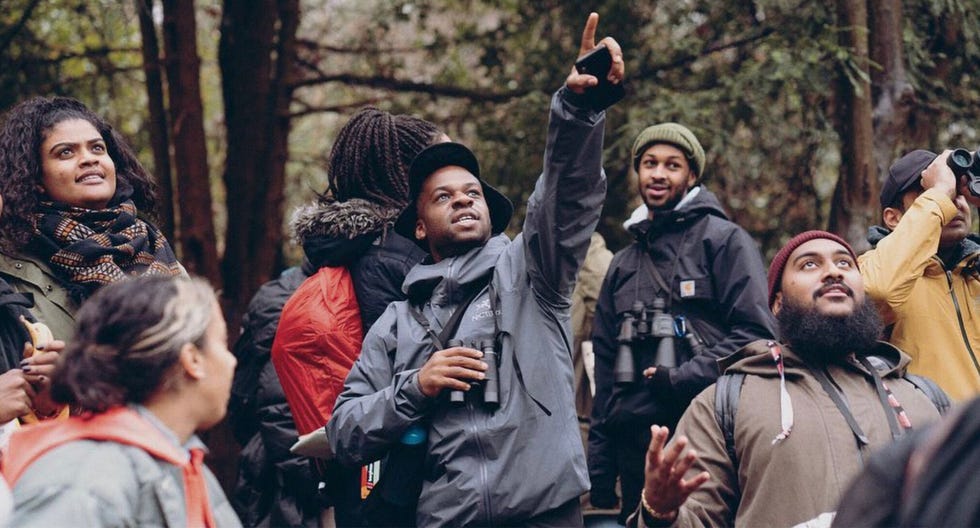 Will Carr
Collective gasp: Ollie Olanipekun (centre) is co-founder of Flock Together, a birding group for people of colour launched during the pandemic
Speed Birding
As for myself, I’m more of a speed birdwatcher, going out for a run on the trails and finding that I get more satisfaction not from setting a new PB, but when I come home having glimpsed a kestrel levitating miraculously, or the elegant whiteness of a little egret. This low-level twitchery happens naturally as soon as you remove headphones and start taking a bit more notice of the sounds around you. Without trying too hard, these days I can identify the mocking laughter of a green woodpecker as it undulates, Flappy Bird-style, between trees. Thanks to a bush below my bedroom window, I’m far too familiar with the rowdy chaos of the house sparrow, like an invisible primary school playground at 5am. Most of us should be able to tell the warning cry of a blackbird as it goes, ‘Shit, shit, shit! Someone’s coming!’ across the back fence. And I’m always glad when the skylarks return to spring singing on the South Downs, their silvery dial-up-internet notes impossibly high above.
Because, to be honest, birding at its base level is easy. You would certainly also get wellbeing benefits from looking at badgers, otters or hedgehogs, but you’re not going to spot one if you look out of your nearest window for the next 30 seconds. I can see two jackdaws pottering in the guttering across the road as I write this sentence. You can recognise a robin if you’ve ever received a Christmas card, and even the common pigeon has its fans. A particularly fine homing pigeon named Cher Ami is taxidermied and on display at the Smithsonian’s National Museum of American History in Washington, DC. He saved the US Army’s 77th Division, trapped under bombardment in the Argonne Forest in 1918, by delivering a message to a base 25 miles away despite being shot in the chest and losing a leg. The French later awarded him the Croix de Guerre medal for his instinctive heroism.
Stepping up to the next level and identifying the ones that aren’t swans or ducks is easy now, too, thanks to a couple of phone apps. A new one, Birdex, is a kind of Strava for birding, giving users points for every bird they spot. But two more established ones are more practical and less gamified. I’ve been using Merlin and it works like magic, recording the sounds around you and telling you which birds you can hear and what they look like. Then there’s eBird, a listing app that tells you what others have seen in your area and allows you to create lists of your own sightings.
‘Locking in on a bird in a tree – there’s no better way to silence my brain’
This is where it can get serious, if you let it. In their film Listers, Owen and Quentin Reiser become listing obsessives, rising up the US national leaderboard for most species spotted to almost touch the top 20, but falling foul of those they term ‘the eBird cops’ when they misname one creature. In 2024, another young man with time to spare, Ezekiel Dobson, drove more than 140,000 miles through 47 US states, spotting 758 different species to set a new lower 48 record.
Things can be a bit nasty at the sharp end, however. ‘The only negative side of birding I’ve encountered directly is people that are hyper-competitive,’ says naturalist and bird guide Alex Patia in the documentary. ‘When I’ve been doing a big year, they’ll keep not telling me about bird sightings.’
Even Chris Howard, a producer/director who has filmed a million starlings for David Attenborough and worked his way up through every role on the BBC’s Springwatch and its sister programmes, from runner to series producer, has found that walking into a busy bird hide can feel a bit like entering an indie record store and asking for the latest Lionel Richie. ‘If you’re not dressed head-to-toe in camo with a massive lens, it can be quite intimidating,’ he tells me. ‘I’m a beardy middle-aged white guy in khaki, so I’m 90% there and I can still feel unwelcome. The best thing about what is happening now, via things like Listers and social media influencers, is the breaking down of some of those barriers and the building of new, helpful, supportive and fun communities around it.’
Flock Together
But while younger white men might feel a bit awkward, at least they won’t have a gun pulled on them. About 10 years ago, Jason Singh was walking in the George Washington National Forest in Virginia, recording bird sounds for a project exploring migration patterns, when he was threatened with firearms on multiple occasions. ‘It boils down to looking the way that I do,’ he says resignedly. ‘I was creating this project about the movement of birds, and while people are comfortable with nature moving around, they’re not so comfortable with people moving around.’
There’s an unhelpful misconception in the UK and elsewhere that people of colour belong in the cities, even reflected in the fact that for a long time, music made by Black people was euphemistically termed ‘urban’. ‘My people, going way back, were forest dwellers. My great-grandmother was a plant healer,’ says Singh. ‘They’ve only been forced into cities to work.’
When I meet Ollie Olanipekun for a Sunday afternoon bird walk in Richmond Park, west London, he’s the only Black man around wearing binoculars. ‘For us, especially when you go to nature reserves outside London, this device is the sign that says, “I’m not a threat,” which is sad,’ he says. ‘There’s an assumption that anyone can just come here and feel peace, but a lot of people find it intimidating because historically, it’s been presented as a space that is not for them.’ He’s the co-founder of Flock Together, a birding group for people of colour that was launched during the pandemic period, when more and more people were rediscovering the natural world on their doorsteps. With around 30,000 followers on Instagram, they’ve played a major role in the new coolness of this pastime, even making a short fashion film to bring to life a colourful collaboration between The North Face and Gucci.
Olanipekun’s background is in big brand advertising, so he knows his way around a product activation and how to manage social media appeal. Flock Together is a creative space, with a shared lunch break on its walks that could well include spoken word poetry or music. Olanipekun has also been working with the RSPB and the National Trust on increasing the diversity of their appeal.
While his work is a great fit, he was birding long before he went public with it. When he was diagnosed with ADHD in 2020, he realised how much it had been helping him mentally. ‘My parents are both academics and I could never understand why I struggled so much in school. I was distracted constantly,’ he says. ‘But going birdwatching, looking through a pair of binoculars and locking in on a bird in a tree – there is no better way to silence my brain. It feels like a different dimension.’
As we stroll through the park, green parakeets jostling noisily overhead, there’s no urgency to find anything in particular, though he says he quite fancies a green woodpecker. I get the impression he’s no more bothered about knowing everything’s name than I am, and it takes an internet search upon getting back home for us to agree that the cute little black thing we saw on the water was a tufted duck.
It means we can just enjoy an easy-going chat outside, with nesting herons as a delightful unexpected bonus. That’s what he wants first-timers to take from the Flock Together walks, too. ‘People can come and call a pigeon a crow and that’s totally fine. But when there’s 50 or 60 of us and we spot something great, there’s something incredibly powerful about that collective gasp, this moment of awe and wonder that we share.’
Singh agrees that something truly special happens when we strike a connection with other living things collectively. ‘It’s my belief that everything exists within us, and we have these senses for us to experience the world,’ he says. ‘If you give yourself the permission, you can experience the whole breadth of what is happening on this planet.’ And it starts by putting this magazine down and looking out of the window.
6 Bird Species to Look Out for in British Parks and Woodland 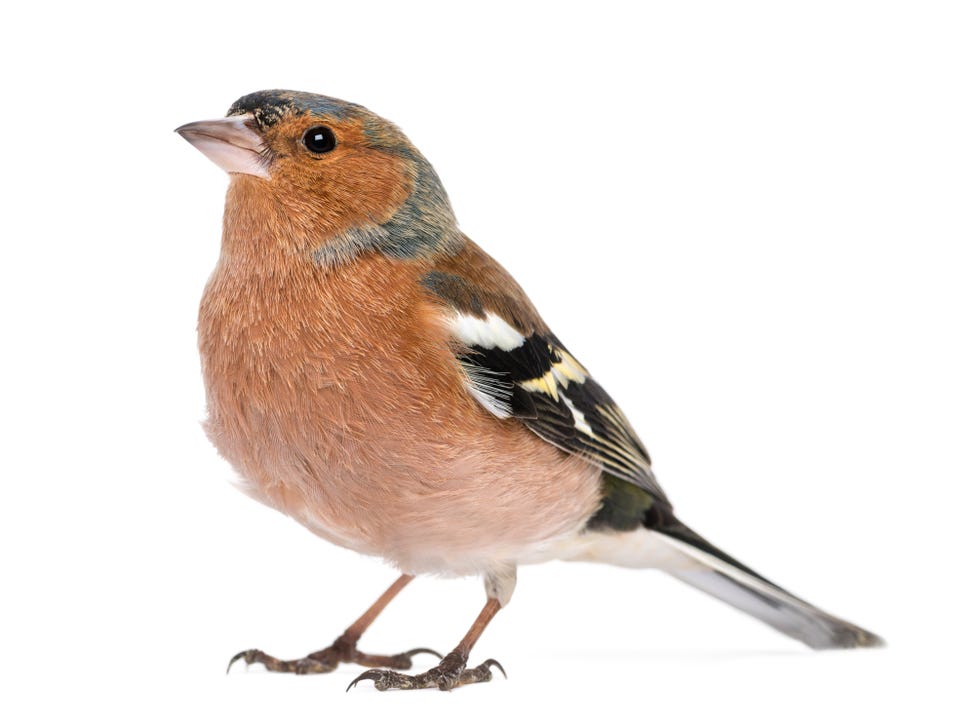
GlobalP
Chaffinch
A great looker with his grey head and pinky-brown chest, you’ll hear this guy before you see him. His loud, easily recognisable call has the descending rhythm of a ball bouncing down the stairs.
GlobalP
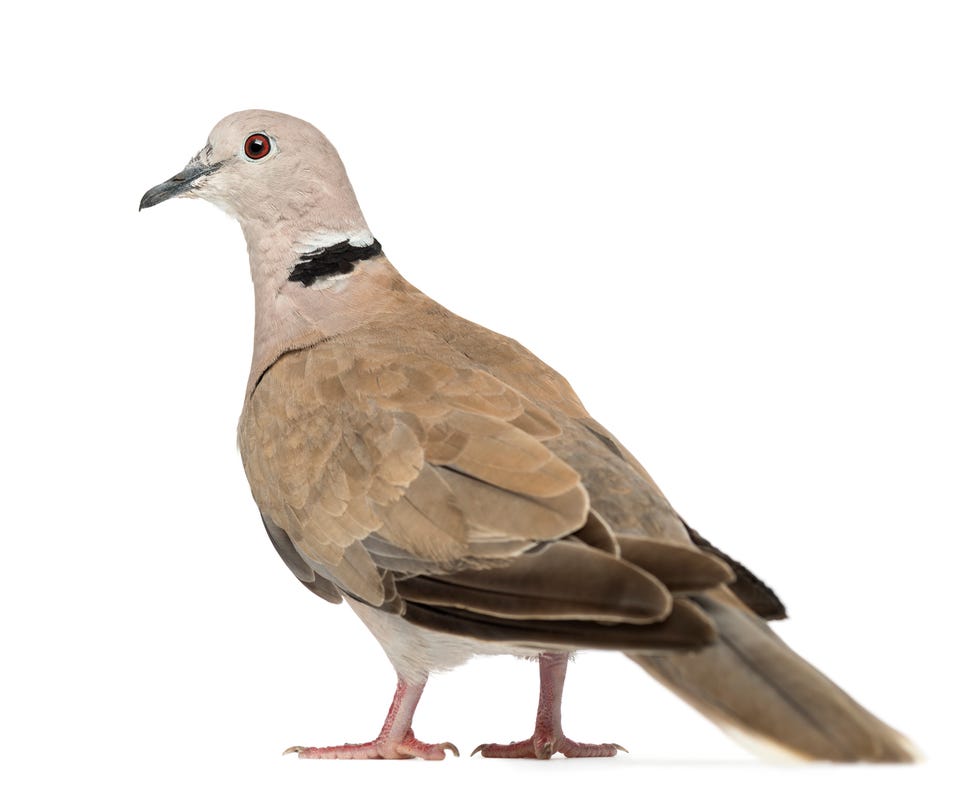
Collared Dove
Like a smaller, more elegant pigeon, with lighter grey-beige feathers and a thin black line around the back of its neck. Its three-syllable cooing sounds very similar to the fatter woodpigeon.
Andrew_Howe
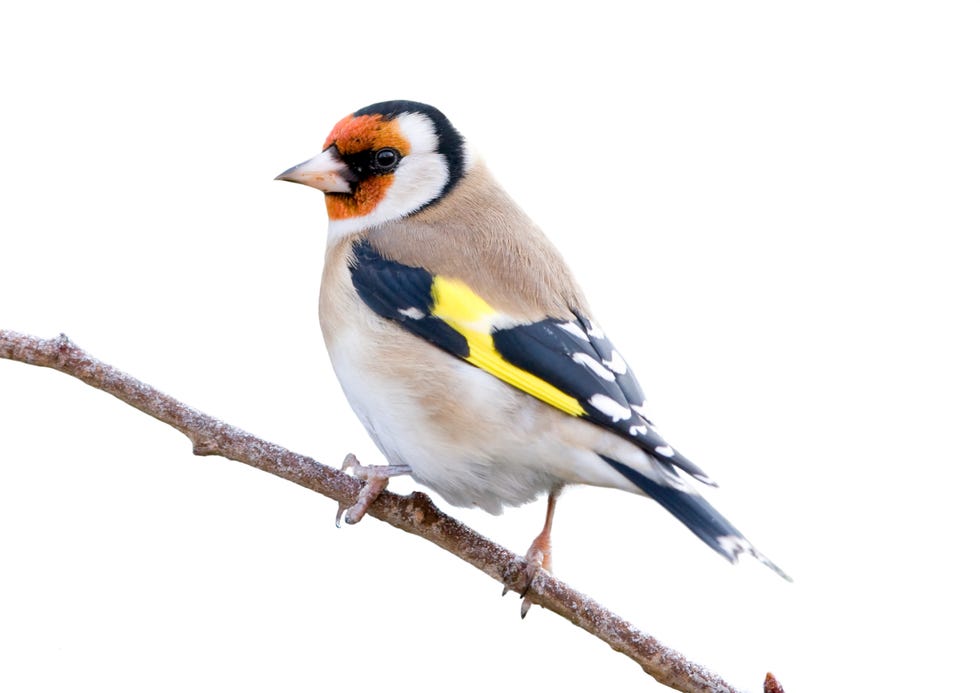
Goldfinch
With their red faces and yellow wings, these small birds are some of our prettiest, earning the collective noun ‘a charm of goldfinches’. A yellow-coloured birdfeeder containing niger seeds is meant to attract them to your garden.
GlobalP
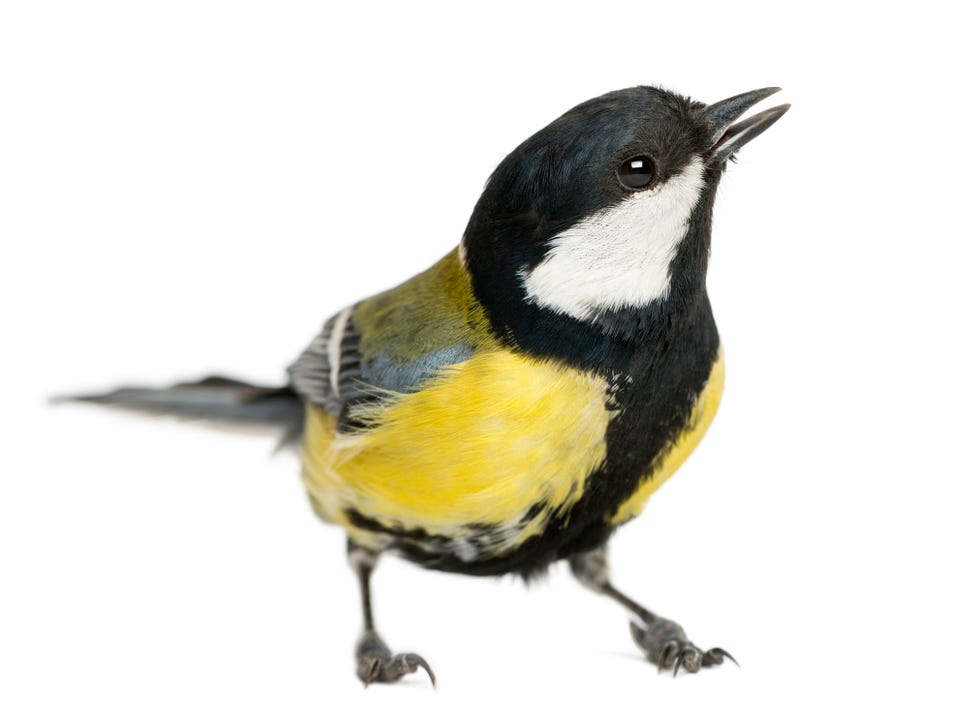
Great Tit
Yes, tee-hee, they’ve heard it before. The biggest tit in the family has a smart dark stripe down its greeny-yellow body and a simple two-note call that’s like a student shouting, ‘Teach-er! Teach-er!’
mauribo
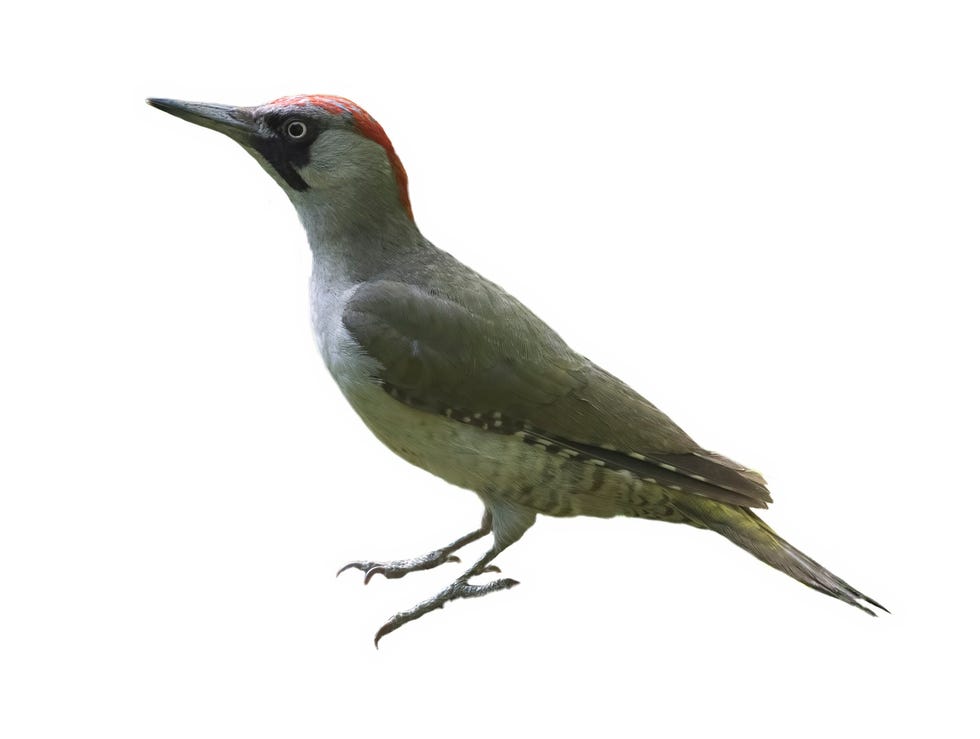
Green Woodpecker
The largest of the UK’s woodpeckers is more easily identified by the loud laughter of its call than a percussive tree drumming. It’s bright green with a red head, and if you’re very lucky, it might show up looking for insects on your lawn.
Andrew_Howe
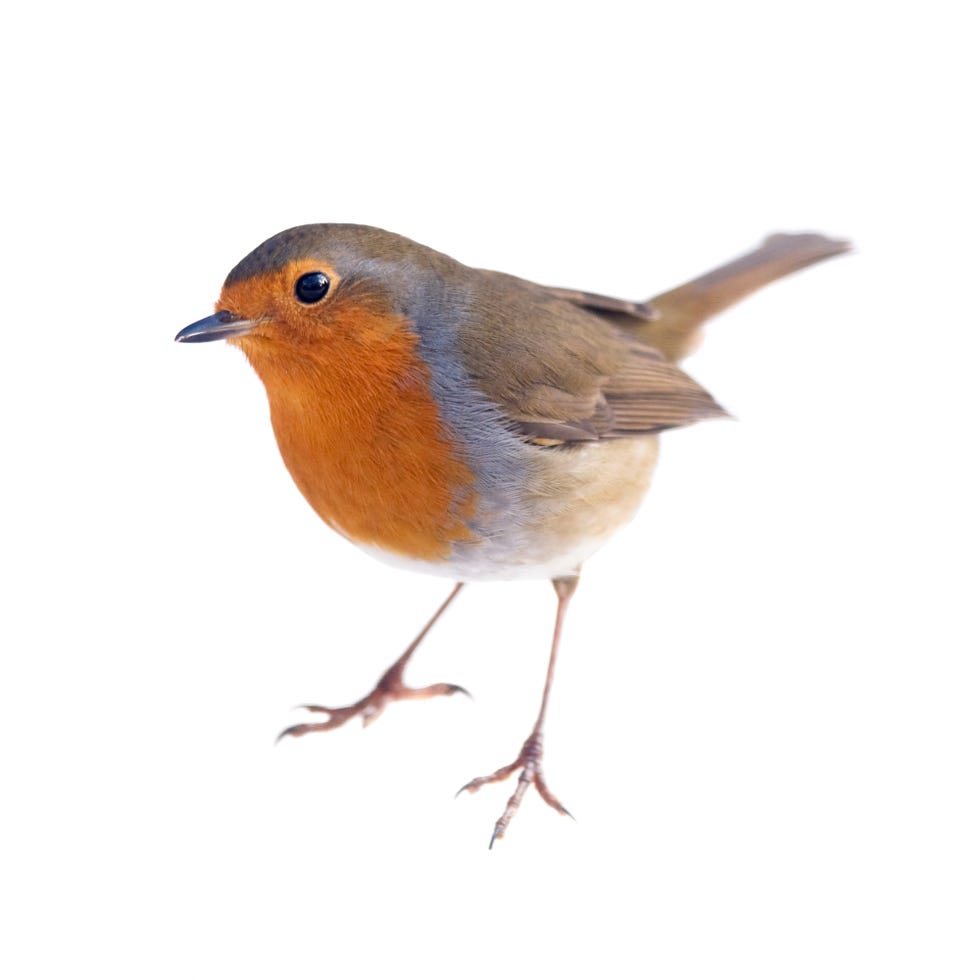
Robin
The robin is consistently voted the nation’s favourite bird and is a common sight, especially once you can distinguish the complex melodies of its singing. If you’re gardening, he’ll likely show up to check up on you.
Related Story