
India Sturgis was 31 and to friends and colleagues she appeared to have it all: a flourishing career, a happy ten-month-old baby, a loving husband and close family. She seemed — as she puts it — “a normal, functioning human being”. Yet beneath the surface, her life was drastically unravelling.
Gripped by insomnia, increasingly “angry and irritated and jumpy”, she began suffering terrifying panic attacks. Depression and paranoia followed, along with intrusive thoughts of suicide and self-harm. For as long as possible, she concealed her suffering. Eventually that became impossible.
Her husband, an insurance broker, had her admitted to the Priory psychiatric hospital in southwest London (her stay was funded by his private health insurance), where she was diagnosed with chronic insomnia, post-traumatic stress disorder and generalised anxiety disorder (GAD) so crippling she was deemed a risk to herself. Initially, nurses checked in on her every hour through the night.
Sturgis became one of the estimated one in ten British people affected with a disabling anxiety disorder. Yet as a confident, sociable person before her diagnosis, “anxious” wasn’t a label she had ever associated with herself.
“There’s an idea an anxious person is a timid mouse sitting in the corner, terrified about the smallest thing, but often anxious individuals are the most outgoing people in a room,” she says. “I’m not afraid of flying or spiders or jumping off tall things. Nothing in my life could explain how I was feeling.”
Yet warning signs had been there for years. In her mid-twenties, working as a journalist in London, Sturgis was plagued with insomnia, existing on just a few hours of sleep a night. “It was triggered by more and more stupid things, something minor I had to do the next day. It really irritated me.”
She kept it to herself. “I didn’t want pity. Talking about it was drawing attention to it and I just wanted to shut it down and get on with my life. I became very good at going about day to day doing everything I needed to get done, while falling apart at the seams behind closed doors.”
Sturgis became a freelance writer, hoping that would be less stressful. To her surprise, for a brief period after her daughter (an easy baby) was born, she slept better. Yet before long, the sleepless nights returned worse than ever. Soon she was going for days on only “measly scraps” of sleep. Then the panic attacks started.
“You can’t even articulate how awful they are: the most heightened experience I’ve had. You’re sweating, your heart feels like it’s jumping out of your body. You feel so sad and hopeless, you want to tear your skin off to stop it.” Yet more distressing was the way the attacks struck in the most mundane situations. “Often it was when I alone upstairs in a bedroom in the middle of the night with everything quiet — it made it even more infuriating.” Sturgis would scream into pillows so as not to wake her family.
Sturgis began “picturing weird things”. Her husband was patient and supportive throughout but she was sure he would leave her. She became convinced she had cancer. “My mind was imploding.”
At times, she contemplated suicide. “You’re constantly looking for a way to make the feelings stop. I’d see parts of the house and think, ‘That’s where I’ll do it!’ But within seconds I’d think, ‘It’s terrifying you’re thinking that way, you have a daughter!’ So then it was like, ‘I can’t even take that way out, I’m even more stuck.’”
Her nadir came one morning at about 6am. She had been awake two nights in a row and began talking to herself and hitting herself “to drown out the noise in my head. Time had stopped making sense to me. I was losing touch with reality”. She turned on the television news. “I couldn’t take in a word but I thought it would make me feel normal.” When her husband appeared, “he looked at me like I was a total stranger”.
He took her to a doctor, who had her hospitalised that night. Once reassured that her daughter wouldn’t be taken away, “I just felt massive relief. I had pushed and pushed things but I couldn’t manage this on my own. I was really grateful the professionals had got their hands on me”.
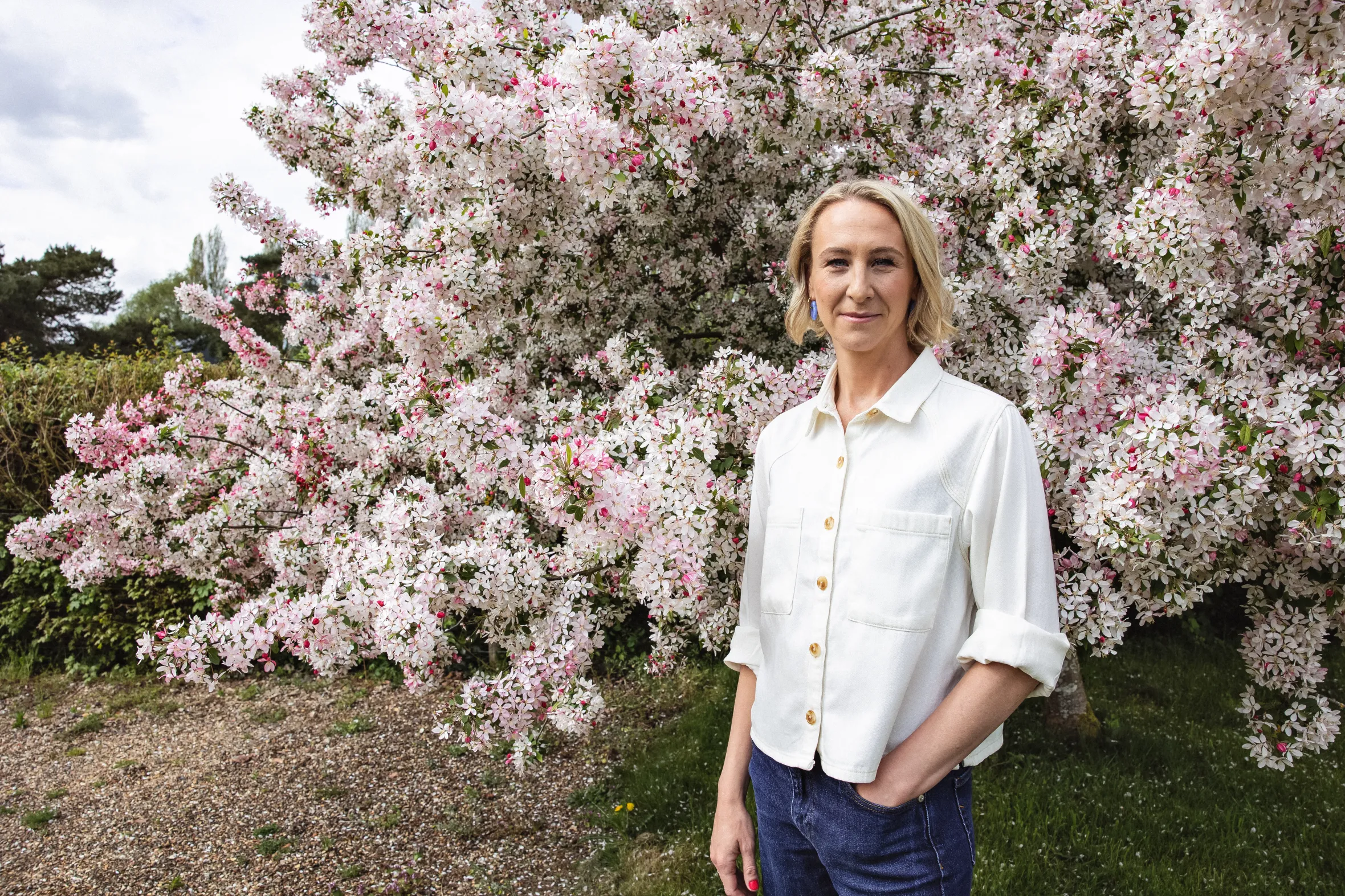 Sturgis is one of the estimated one in ten British people affected with a disabling anxiety disorderNatalie Martinez for the times; hair and make up alice theobald/Arlington using using SUQQU and PERS
Seven years on, Sturgis, 39, is in a completely different place. Sitting in a Suffolk pub, deep in enchanting Constable country, near the home she moved to during lockdown, she’s upbeat and lucid. She has a one-year-old son as well as her daughter and has just published her first book, How to Eat an Elephant, charting her experiences but also exploring numerous coping strategies for anxiety.
The book’s title comes from a phrase Sturgis saw on a psychotherapist’s wall: How to Eat an Elephant? One Bite at a Time. This ancient African proverb resonated hugely, making her realise even the most daunting problems could be tackled incrementally. “It was very helpful for me, in the middle of the fire, to be told recovery would take not weeks, not months but probably years.”
More than anything, recovery was boosted by understanding that she might not ever “beat” anxiety but could manage it. “It’s highly, highly treatable, you just have to find out what helps you and do those things when you need them.”
These included taking antidepressants, which she’d previously resisted (“I thought they were a sign of failure”). At the more holistic end of the scale, she embraced yoga. “I hated the Sweaty Betty stereotype but it really worked for me.”
Many of those tools came from her time at the Priory, where she stayed for a month, followed by three months as an outpatient. She received different forms of therapy, including group sessions alongside people from a wide range of backgrounds. “I couldn’t believe so many people were feeling what I was feeling, were going through something so life-wrecking. It was very reassuring.”
Today Sturgis employs various strategies to manage her condition in the same way a football manager might “try different manoeuvres, depending on the opponent you’re facing and how you’re playing at the time”. These aren’t whacky or revolutionary, mainly centring on eating well, prioritising sleep, exercising and making herself breathe deeply through the nose. “It’s such a cliché but it really helps,” she says.
Perhaps most important is acknowledging she has a condition she previously considered somehow shameful, despite the fact her friends — although surprised at her diagnosis — responded with nothing but kindness. “But for so long I thought anxiety was an annoying, weak emotion and tried to block it off. Now I know it’s not a moral failing, it’s an affliction like diabetes.”
The mindset was crucial when Sturgis had difficulties conceiving her second child and suffered two miscarriages. “When I did become pregnant and was very worried about losing the baby again, instead of pushing the fears away I listened to them in a way that was proportionate and reasonable.” She reduced her workload and “gave myself time to slow down. I was kind to myself”.
Sturgis was “quick to excite” but not anxious as a child, but isn’t particularly interested in pinpointing the origins of her condition. “Once you’re there, it doesn’t matter how you get there.” Still, she notes that over the past 20 years she has been involved in an extraordinary five car accidents, in all of which she was the front-seat passenger, ranging from “the world’s most gentle pile-up” to swerving to avoid a lorry on the motorway, sending the car spinning onto the central reservation barrier. No one was killed and she emerged from all virtually unscathed, although in one case her husband was hospitalised with a broken back and peritonitis, leading to an operation to remove two feet of his intestines. She wonders if these contributed “to anxiety shifting to a more permanent neurological message”.
Anxiety has become part of the zeitgeist. Since the pandemic, the number of children being referred to a practitioner for anxiety has more than doubled to 500 a day. Yet misunderstandings about the condition persist, with many not grasping the difference between everyday worrying and the clinical diagnosis.
“It’s frustrating we use the same word for the two states. Feeling anxious is a healthy, normal response. Clinical anxiety is a serious illness.” The distinction is vital — minimising the condition can make it harder for people to be taken seriously and seek appropriate help. “Anyone who’s had pronounced experience of clinical anxiety will tell you it’s not something they’d wish on their worst enemy. When I was really unwell I wished to God I could break all four limbs instead of having this condition. It would have been so much more socially acceptable and easier to recover from.”
Her book is aimed not only at people suffering from anxiety but at their loved ones. “They need to know they can’t be expected to fix this. You’re not a mental health expert. You wouldn’t expect yourself to solve someone’s fractured arm or broken leg. Often your physical presence is enough.”
Sturgis accepts anxiety is part of her life. “It’s my Achilles’ heel. I’m not bulletproof… but when the pinch point comes I have a good tool kit available.”
How to Eat an Elephant: The Life-changing Power of Managing Anxiety, One Bite at a Time by India Sturgis is published on May 7 (Thorsons, £16.99). To order a copy go to timesbookshop.co.uk. Free UK standard P&P on orders over £25. Special discount available for Times+ members