
At his inauguration, Mayor Daniel Lurie promised to dedicate his time in office to tackling the city’s drug use and mental health crisis, even in the face of the city’s looming budget deficit.
In practice, cuts to programs that help tackle that crisis are coming anyway. Among them: City College’s Community Mental Health Certificate Program, a one of a kind 18-month program, training frontline mental health workers to use their lived experience for peer counseling with a chance to be licensed by the state.
The city’s Department of Public Health recently announced that its funding will end after its current five-year $2.15-million contract comes to an end. If it can’t find funding elsewhere, its last class will graduate in June 2027.
For 16 years, the program has been relatively unusual for its low barriers to entry (Classes at City College have been free since 2017) and its focus on training people with a history of addiction and mental health issues to become frontline mental health workers.
Students intern at clinics around the city and, once they graduate, take a licensing exam to become workers in one of the city’s many clinics.
“We’re feeling concerned about the program going away because of not only what it offers the graduates, but also what the graduates offer the community,” said Edith Guillen-Nueve, the program’s associate director. “We’re afraid of … how not having this program will take away a pathway for continued education and a career pathway.”
Guillen-Nueve said the state has shifted its priorities away from the broad prevention and intervention across the mental health spectrum that it once supported, and towards, treating addiction and creating housing for people with severe addictions and mental health issues.
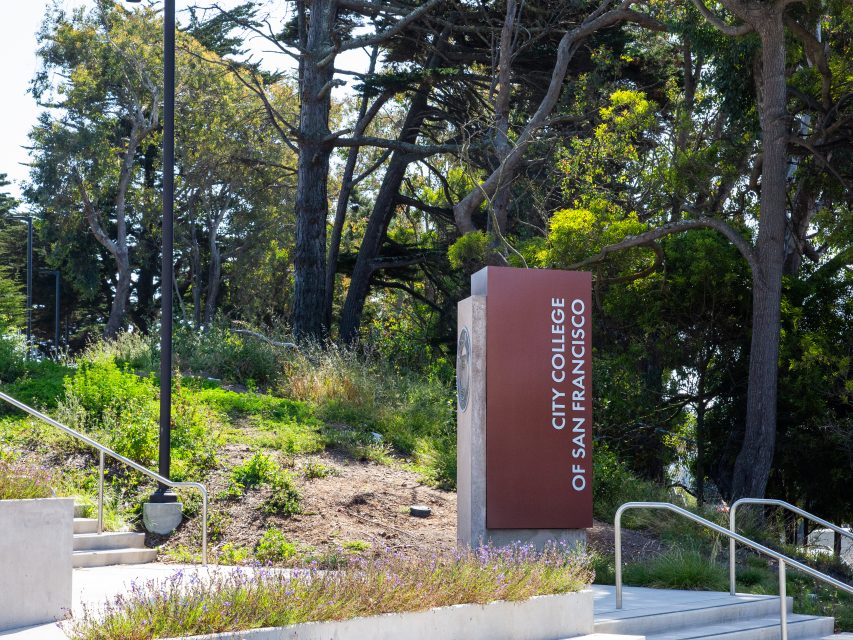 City College of San Francisco’s sign captured on a sunny day on April 28, 2026. Photo by Xueer Lu.
Graduates of the Community Mental Health Certificate Program work in a variety of jobs in the broader mental health field, including peer support counselor, community mental health worker, and family advocate. While the need for those roles still exists, the state funding that kept the certificate program running has been redirected toward addiction treatment and housing.
The Department of Public Health got funding for the certificate program through Proposition 63, a 2004 state ballot measure that levied a 1-percent tax on incomes over $1 million and directed proceeds to counties for mental health programs. In March 2024 California voters passed Proposition 1, which replaced Prop. 63’s Mental Health Services Act with the Behavioral Health Services Act, which specifically directs mental health resources toward substance abuse treatment and the facilities for those undergoing it.
While peer support counselors and community mental health workers can play a role in addiction recovery settings, the funding structure under Prop 1 does not cover the kind of community-based training and positions the city college program was designed to produce.
The San Francisco Department of Public Health confirmed that the city college program will end in 2027 “due to the end of state funding,” but did not answer any further questions.
Guillen-Nueve, who started the Community Mental Health Certificate Program with its director and her husband Sal Nueve, is worried: the end of this free program will mean a cut in supply of frontline mental health workers for San Francisco at a time when the need is especially high.
Peter Dale, now 64, was one of the program’s first graduates. Before he enrolled, he said, a triple diagnosis of HIV, Hepatitis B and Hepatitis C, had left him depressed and isolated. “I would tell myself how worthless and weak I was,” Dale said. “I was told during this time I would never work again.”
Dale graduated in spring 2012, and since then, he has worked as a peer counselor at the Richmond Area Multi-Services, Inc., a nonprofit mental health organization known as RAMS.
“When you’re a peer counselor, you are hired for your lived experience,” Dale said. “So everything that I’ve been through that I thought would destroy me and [would] make me a damaged individual that nobody wanted anything to do with, were all reasons why I’m working here today.”
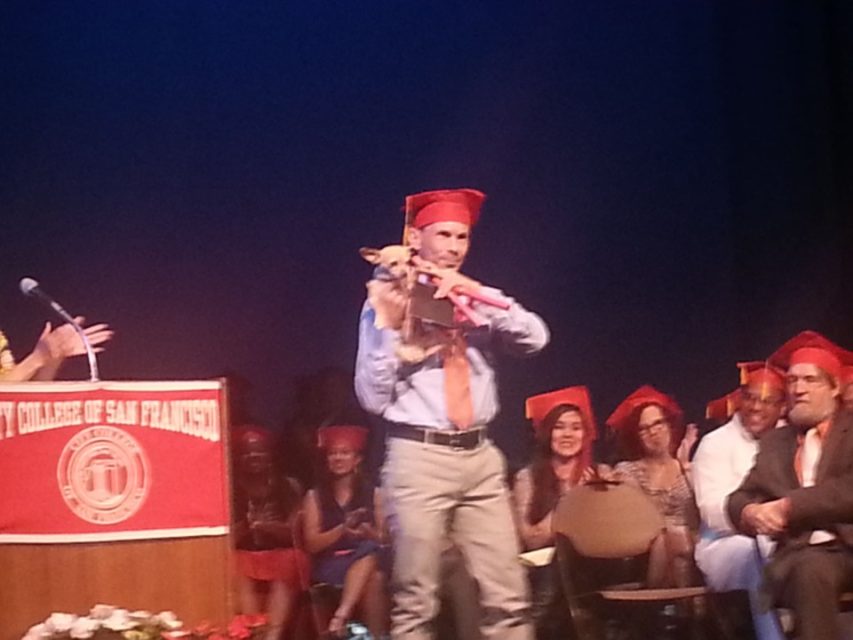 Peter Dale was a graduation speaker when he graduated from the City College’s Community Mental Health Certificate Program in May 2013. Dale was on stage with his dog Chica. Photo courtesy of Peter Dale.
Several graduates of the program described using their lived experience battling mental health crises to help those in need.
Amy Cai, who enrolled in 2020 during the Covid-19 pandemic, said that she was shocked to hear the program was ending. Born and raised in China, Cai now works as a senior bilingual family resource specialist and parent mentor coordinator at Support for Families of Children with Disabilities, a local nonprofit, where she draws on the program’s tools every day to interview families, build relationships with them, and help them navigate loneliness as monolingual immigrants.
“Not everyone has the time and money to pursue a university degree,” Cai said, on the verge of tears. “This program offers something reasonable, affordable and accessible.”
Melanie Brandt, a 56-year-old native San Franciscan who is three years into recovery after decades of struggling with addiction and homelessness, had worked as a peer counselor off and on since 2010, but described the city college program as more exhaustive and detailed than any other training she’s taken.
Enrique “Rick” Jimenez, U.S. Army combat veteran, enrolled in the program after years of dealing with his own PTSD and substance use disorder. Like other current and former students, Jimenez described what he learned there as something larger than just a certification program.
“Because of what I learned through this program, I was able to help save a person who was in a suicidal crisis,” Jimenez wrote to Mission Local. “That is not just classroom theory to me… That is a life.”