
CHICAGO — A city program that deploys social workers instead of law enforcement officers to non-violent mental health incidents is expanding to serve all of Chicago, Mayor Brandon Johnson announced Wednesday.
CARE, or the Crisis Assistance Response and Engagement program, dispatches teams of mental health professionals to certain mental health-related 911 calls. The program was launched in 2021 and has steadily expanded since.
When CARE began, police officers and Fire Department paramedics accompanied behavioral health clinicians on calls under a co-responder model. That changed in 2024, when the program was placed entirely under the Chicago Department of Public Health and police and fire personnel were removed from the response teams.
Expanding the initiative citywide has been a goal of its backers and the Johnson administration for years. A larger push for non-police mental health responses gained traction nationwide in 2020, following the police murder of George Floyd in Minneapolis and other high-profile incidents.
The program will now serve all 22 police districts, up from six, with coverage split between the North and South sides, Deputy Mayor for Health and Human Services Arturo Carrillo said after a Wednesday press conference announcing the expansion.
CARE teams provide on-site mental health assessments and basic medical care before connecting people to more permanent resources, but they do not deploy to 911 calls or other incidents if there is a report of a weapon or other violence present.
“CARE responses are limited to non-violent, non-medical situations where there is no active threat to the individual or others,” a press release said.
Callers to 911 can request a CARE team, or emergency dispatchers can determine when to send a team in specific situations, Carrillo said. People experiencing “socio-emotional distress” are also now available for services, the city said.
“CARE teams will screen for socio-emotional distress and facilitate the response to a more diverse range of crisis calls in neighborhoods across the city,” Johnson said Wednesday. “And this means that no matter what neighborhood you live in or what you’re going through, our CARE teams can respond in a dignified manner and connect you to a range of support throughout the city.”
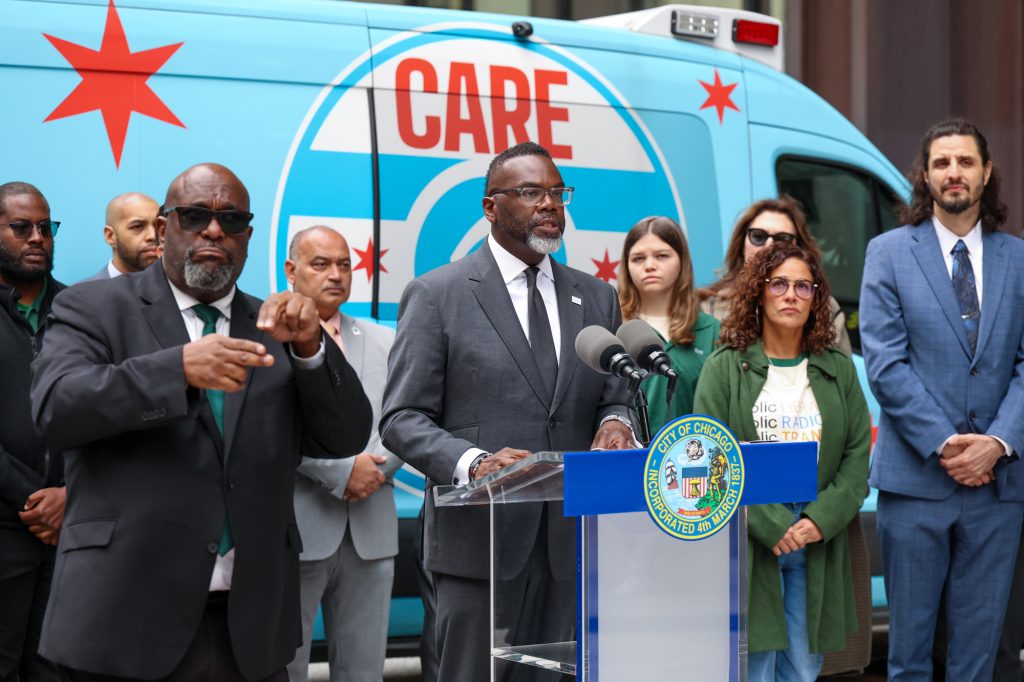 Mayor Brandon Johnson speaks to the crowd at Daley Plaza on Wednesday, May 13, 2026. Credit: Zoey Duchene/Block Club Chicago
The Johnson administration did not provide data on Wednesday to show how many calls CARE has responded to since it launched in 2021.
The program has faced hurdles with deployment, according to a report published last year by the nonprofit MindSite News. The analysis found that CARE teams still respond to only a small fraction of calls that 911 dispatchers categorized as “potentially mental health-related,” among other challenges.
But city workers and leaders touted the expansion of the program on Wednesday as a way to serve more Chicagoans. Gabrielle Mitchell, a CARE clinician who has worked with the program since 2021, said her work doesn’t always mean responding to an immediate, pressing incident.
Instead, it can include offering services for a wide range of mental health issues, including during the aftermath of traumatic events, she said at Wednesday’s press conference.
“Sometimes mental health is just helping someone get their LINK card back. Sometimes mental health is talking to a mother who feels overwhelmed and has no support, and sitting with her and helping her figure it out,” Mitchell said. “The great thing about the CARE team is that when you call 911, and you get this team, whatever your crisis is, we’re going to meet you there, because everybody’s worst day is their worst day. It don’t have to look like my worst day.”
For non-urgent mental health response calls, Chicagoans can also request a CARE visit within 72 hours by emailing CAREprogram@CityofChicago.org.
Support Freedom of the Press
Independent journalism like this only exists because of readers like you. This World Press Freedom Day, help Block Club raise $20,000 to fuel high-impact investigations that hold Chicago’s institutions and leaders accountable. Make your tax-deductible donation here.
Listen to the Block Club Chicago podcast: