
By Sadee Johnson
Flashes dart across the court, passing by with grace, precision and speed. The blur of a black and white ball travels between players while they turn sharply, flying past the stands, each player pushing it toward their own goal. It’s competitive, energetic and transfixing.
It’s power soccer.
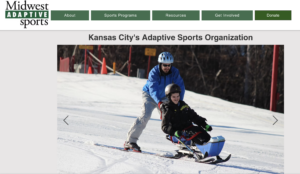 This is a screenshot of the Midwest Adaptive Sports website.
For many young people with disabilities, access to organized sports is little to none. But across the U.S., adaptive sports programs are beginning to change that. In doing so, they’re addressing something deeper than physical health. It addresses the growing mental health needs of youth with disabilities.
Lack of awareness, high costs
Before cost, transportation and equipment, there’s one particularly high hurdle: Too many people don’t know adaptive sports exist.
“I think the biggest barrier to access in any disabled sport is really just knowledge of their existence,” said William Schultz, head coach of the Wisconsin Whitetails, a power soccer program based in LaCrosse. “Most parents or young people with disabilities don’t know these things exist.”
Schultz has coached adaptive teams for years, from the nationally ranked Wisconsin Warriors power soccer team to newer, currently developing ones. What he’s seen is that families often discover these kinds of opportunities by accident, whether through a Facebook post, a passing comment or a random encounter.
This lack of awareness affects more than just the roster. The Centers for Disease Control and Prevention reports that children with disabilities are significantly less likely to meet recommended physical activity levels than their peers. At the same time, they are more likely to experience social isolation, anxiety and depression.
Adaptive sports is one possible solution.
Schultz and others are turning adaptive sports mainstream by prioritizing the demonstrations to rehabilitation centers, connecting with therapists and hosting open sessions where children can try adaptive sports without long-term commitment.
But even when families find these programs, access isn’t guaranteed.
“We play in chairs that cost $10,000… even just to be able to show up and play, you’ve got to have a chair that you can bang into people on,” said Schultz, referring to the special wheelchairs players use to compete in power soccer.
Adaptive sports like power soccer can often require specific equipment, and it’s not cheap. Some programs are able to provide shared gear or financial assistance, but many families are still responsible for a lot of the cost.
Two programs as one response
Luckily, the Disabled Athlete Sports Association (DASA) and Midwest Adaptive Sports are working to reduce that burden, along with other organizations. Their programs offer access to equipment, coaching and competition, with a focus on long-term development.
Those in adaptive sports often report improvements in confidence, independence, and social connection, according to DASA. Midwest Adaptive Sports similarly highlights the emotional and psychological benefits of participation, describing sports as a pathway to resilience and self-worth.
For athletes who may have spent much of their lives navigating what is seen as limitations, that shift can be immediate and life-changing.
“They get in a power soccer chair, and it flips that switch,” said Schultz.
That “switch” often facilitates a turning point. The National Institutes of Health show that adaptive sports participation is linked to the improvement of symptoms of depression and stronger peer relationships among youth with disabilities.
“A lot of that drive for independence comes from the social parts of the game… building community around sport,” said Schultz.
For many participants, adaptive sports provide an opportunity to connect with others who share similar experiences outside of a medical or educational setting but instead through something more fun and truly bonding.
“You’re meeting people like you, and you see that they are competitive and independent in other ways,” the Wisconsin Whitetails coach explained.
This reshapes how these young athletes see themselves and their futures. It also creates a support network that extends beyond practice, building friendships and shared understanding. In Madison, Arts for All dance teacher Sarah Jacobson is working toward a similar goal.
“It became more about having a place to belong than about the actual dance experience itself,” said Jacobson, describing her classes.
Jacobson started her program after noticing that children with disabilities, particularly those on the autism spectrum, had limited access to extracurriculars fit for their needs. In response, she designed a class where participation could look however it needed to.
For children with autism and other developmental differences, adaptive sports provide an opportunity for practicing social interaction in a relatively predictable environment.
“Sports are great because there are clear rules and expectations. They tell you exactly what you need to do,” said Dr. Lily Wagner, a clinical psychologist and researcher with UW–Madison’s Waisman Center.
The Centers for Disease Control and Prevention also notes that physical activity can improve mood, reduce stress and contribute overall to the emotional well-being of individuals with disabilities.
Jacobson remembered one student who particularly enjoyed this structure.
“There was this one day… she was laying on the ground… and I’m like, you know what? We’re all just going to lay on the ground,” she said.
Moments like that challenge traditional ideas of structure and success. Instead of forcing conformity, Jacobson adapts the environment to the dancers’ needs.
“It’s really about having a place to belong,” said Jacobson.
Adaptive programs like those offered by the Wisconsin Whitetails and Arts for All don’t just change experiences for participants, though. They also change assumptions or perceptions audiences may hold. A particular example can be seen at Jacobson’s dance recitals.
“They didn’t understand,” Jacobson said, referring to some audience members’ view of her dancers. “Just because she doesn’t have use of her legs, doesn’t mean she hasn’t got amazing upper body strength.”
Moments like these can challenge how many people frame disability as a limitation and replace that view with a more positive outlook.
Despite the clear benefits, access to adaptive sports remains inconsistent.
“I would love to see our K–12 systems do a better job connecting students and families to stuff like this,” Schultz said.