
For more than 20 years, Jessica Johnson lived on the streets of El Sobrante, Antioch and other cities in Contra Costa County. For a while, she slept behind a bank. Sometimes, she’d find respite in a park. But, for over half her life, she had no permanent home to speak of. As a teen, Johnson had become estranged from her family while she battled schizophrenia and substance use disorder.
Unhoused, Johnson, now 41, endured trauma and violence. There were times when she was found face down in the middle of a street or in some other disoriented state miles away in another county. She’d be detained by police or hospitalized. Under medical care, her condition stabilized, and over the years, she tried various housing options. But without adequate support services, Johnson’s mental health would inevitably deteriorate, and she’d return to the street where the dangerous cycle would begin again.
It’s a scenario that Bay Area mothers and mental health advocates Teresa Pasquini and Lauren Rettagliata have had a close seat to: With or without family support, people with the most severe mental illnesses often end up in the same place — living on the street, without health care, support or intervention. Both Pasquini and Rettagliata have adult sons with mental illnesses and have been stalwart National Alliance on Mental Illness (NAMI) activists as well as members of the former Contra Costa County Mental Health Commission.
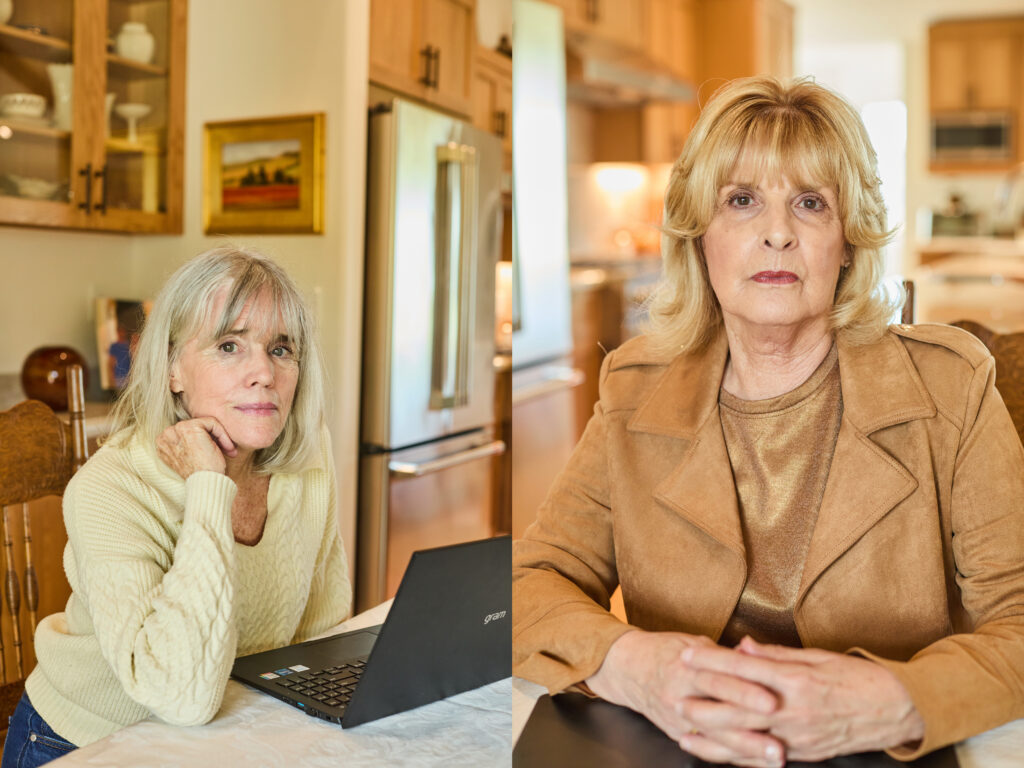 Lauren Rettagliata, left, and Teresa Pasquini were inspired to study supportive housing options across California after years of navigating the mental health system for their adult sons. Gabriela Hasbun for California Health Report/CatchLight
In 2019, though, they were acting on a mom impulse when a friend, who also has an adult child with a mental illness, was moving back to California and asked for a favor. The friend implored Pasquini and Rettagliata to check out Santa Ana’s John Henry Foundation, a long-term support home for adults living with schizophrenia. The women decided a road trip was in order. Pasquini and Rettagliata — as well as so many of the families they’ve connected with over the years — have lived through the terror of watching their adult kids stabilize and then repeatedly destabilize. Appropriate, supportive housing seemed elusive.
What they saw in Santa Ana, though, blew them away. “It was this protective oasis,” Pasquini said. The housing was not only pleasant, clean and comfortable, but there was 24-hour support, nutritious meals, assistance with medication compliance, therapy, skill building and social activities.
There are an estimated 11.5 million Americans (or nearly 5 percent of the population) living with a serious mental illness. Though many function well with medical treatment and help from family and friends, supportive housing offers options for those who need more care.
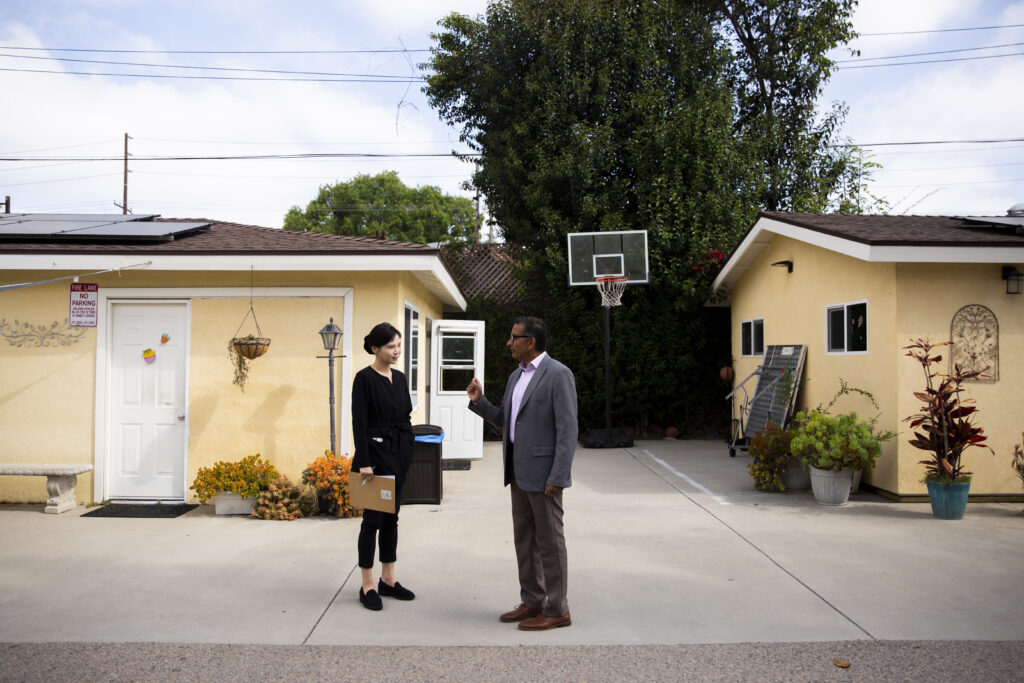 Dr. Rimal Bera, right, speaks with Dr. Elizabeth Kim at the John Henry Foundation in Santa Ana. Jenna Schoenefeld for California Health Report/CatchLight
Pasquini explained that the director of John Henry said he’d only had to implement a Section 5150 — part of the California legal code allowing an involuntary psychiatric hold because someone is dangerous to themselves or others — on a resident a few times. This alone was astounding. Starting from age 16, Pasquini said her son, now in his 40s, has been “5150’d no less than 40 times.” When not taking his medication, Danny, who allows his mother to share his story, suffers from anosognosia, a common schizophrenia symptom in which the person doesn’t believe they are ill and won’t comply with treatment. According to Pasquini, when unmedicated and in the throes of his illness, her son attempted “suicide by cop” — intentionally trying to provoke law enforcement to kill him — as well as other extremely dangerous acts.
For these two moms, and so many families like them who have loved ones with medically serious mental illnesses, life can be challenging.
“That day at John Henry, the tears just flowed,” Pasquini explained. The two moms were full of questions and hope — what if housing like this one had been available near them? Would their sons’ lives have been better? What if this were available for all people with serious mental illnesses — would we have less disparity as well as less of the suffering that exists on the streets of every major city?
“So, we came back, and I described myself as a dog coming out of the water — shaking, just so excited,” Pasquini said.
The women were experienced enough with mental health advocacy to know that while John Henry is a private pay facility — currently costing a hefty $4,250 a month — the model of care surprisingly made good economic sense even for those who rely on the state and county health care system.
“The real thing is that while, yes, this sounds expensive it’s not necessarily more expensive than what the state and counties are currently spending, all told, on seriously mentally ill people,” Rettagliata said.
The duo decided to go all in. They ended up identifying and visiting some 22 model supportive housing options statewide. Using the initials T&L of their first names — like the movie characters Thelma & Louise — the duo documented their road trips on Facebook with many in the mental health advocacy world following along. “We had a good time with the Thelma & Louise thing, but we don’t drive over the cliff at the end!” Pasquini joked. Instead, the two women hunkered down and wrote a heartfelt white paper they titled Housing That Heals.
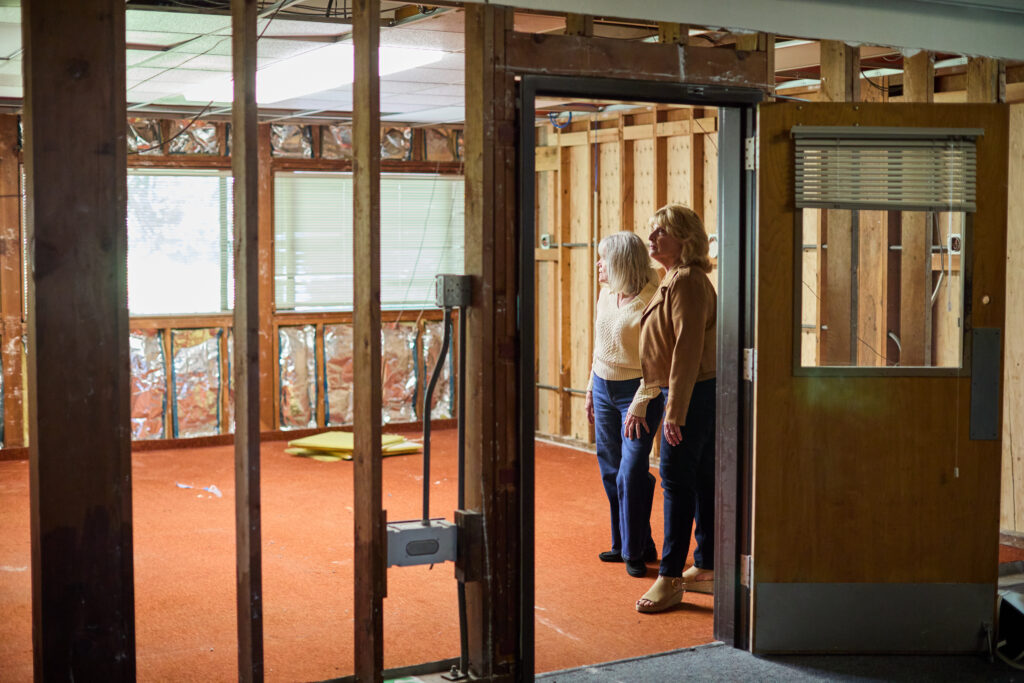 Lauren Rettagliata and Teresa Pasquini, right, visit the Richmond site of a mental health rehabilitation center they championed, expected to open in 2028. Gabriela Hasbun for California Health Report/CatchLight
The two pointed out that the lack of a housing continuum of care for those with the most serious mental illnesses is a “humanitarian crisis” and results in people “flooding medical emergency rooms, psychiatric emergency rooms, psychiatric inpatient units, homeless shelters, IMDs [Institutions for Mental Diseases], county jails and courtrooms.” Importantly, they also noted that there are equity issues involved, particularly for those with chronic brain disorders like schizophrenia, schizoaffective and bipolar disorders, all of which strike in late adolescence or early adulthood. Sometimes these conditions take years to find appropriate medication and lead sufferers to seek relief in street drugs.
These ideas weren’t exactly new; the US Department of Justice said that “America’s jails and prisons have become our new mental hospitals.” And many researchers have acknowledged the link between high ER use and mental illness.
The women, though, were intent on getting people to understand what families like them dealt with — an inhumane system that treats mental illness and the often-concomitant problem of substance use disorder as different than other disabilities. The system, they wrote, doesn’t spend money wisely to treat those who suffer from the illnesses, or adequately help their exhausted families — too often leading to isolation and homelessness for those that have serious mental illnesses.
“California law provides a right to shelter, a right to treatment, and a right to in-home supportive services to those with developmental disabilities. No equal entitlement exists for the SMI (seriously mentally ill) population,” they wrote. Rettagliata’s young granddaughter crayoned their logo — a person snugly situated in a little red house framed by a purple heart. On Mother’s Day 2020, the duo started sharing their white paper.
“It was great because with this paper Teresa and Lauren definitely sparked a conversation,” said Gigi Crowder, CEO of NAMI Contra Costa and a long-time Northern California mental health advocate.
‘They are living under the stars’
In 2016, then Gov. Jerry Brown signed Senate Bill 1380, which placed an emphasis on getting unhoused people into housing as top priority – called a “Housing First” model. That bill prompted more housing programs, but the moms had hit on a glaring problem. For those who have serious mental illnesses, it’s not just about getting them into housing. It’s about housing and a continuum of care to ensure that they stay housed.
Nearly half of people experiencing homelessness in California have what researchers at UC San Francisco’s Benioff Homelessness and Housing Initiative call “complex behavioral needs.” A 2023 study administered surveys to nearly 3,200 participants and found that 82 percent reported having had a serious mental health condition at some point, and 66 percent were experiencing symptoms at the time of the study. Of course, homelessness is complex and many people who experience it do not have preexisting mental health or substance use challenges. But researchers know there is a psychological toll of being unhoused — including chronic stress, lack of sleep and trauma from exposure to violence.
 Teresa Pasquini shares a selfie she took with her son Danny with friend Jessica Johnson. Gabriela Hasbun for California Health Report/CatchLight
For those who have preexisting or acquired mental health challenges, housing alone often will not be enough. For Jessica Johnson, it certainly wasn’t. During the two decades she cycled in and out of housing arrangements, she abused substances and often declined treatment or had the wrong treatment for her mental health condition. It’s now been five years since she started taking an effective medication for her condition and moved into an adult residential facility in Pleasant Hill that offers a full suite of supports, including medication management, meals, transportation to doctor’s appointments and therapies to promote healthy living. It was a combination of the right medication and the right placement at the right time. Now she’s stable, sober, enjoys spending time with friends and has even reconnected with her family.
“If I didn’t have a place like this, I’d definitely be on the streets drinking,” Johnson said. “I might be dead.”
Housing That Heals didn’t ignite change like this for all people with mental illness overnight, but it did get on the radar of advocates, families, lawmakers and the media. Even filmmaker Gail Freedman reached out. Freedman is the director and producer of No One Cares About Crazy People, a recent documentary that chronicles tragedy of Mark Rippee, a man with a serious mental illness who, despite his family’s fierce advocacy, remained unhoused, untreated and floridly psychotic (completely detached from reality due to mental illness) on the streets of Vacaville until his death at age 59. Pasquini and her son also appeared in the film.
Crowder says the problems of inadequate support, treatment and housing cut across socioeconomic and racial lines, weakening families and alienating those who struggle with mental illness, but the impact is even greater for those who also contend with race-based barriers to health care and other resources.
Community activist Desiree Rushing attends Contra Costa NAMI family meetings alongside the moms and others supporting loved ones with mental illness. Rushing conducts weekly rounds at homeless encampments in diverse areas like Antioch, Pittsburg and Richmond — bringing food, water and comfort to many of the afflicted and advocating on their behalf for housing and services. “They are living under the stars and most of them have no contact with their family and nobody able to advocate for them,” she said tearfully. “I do my work for them.”
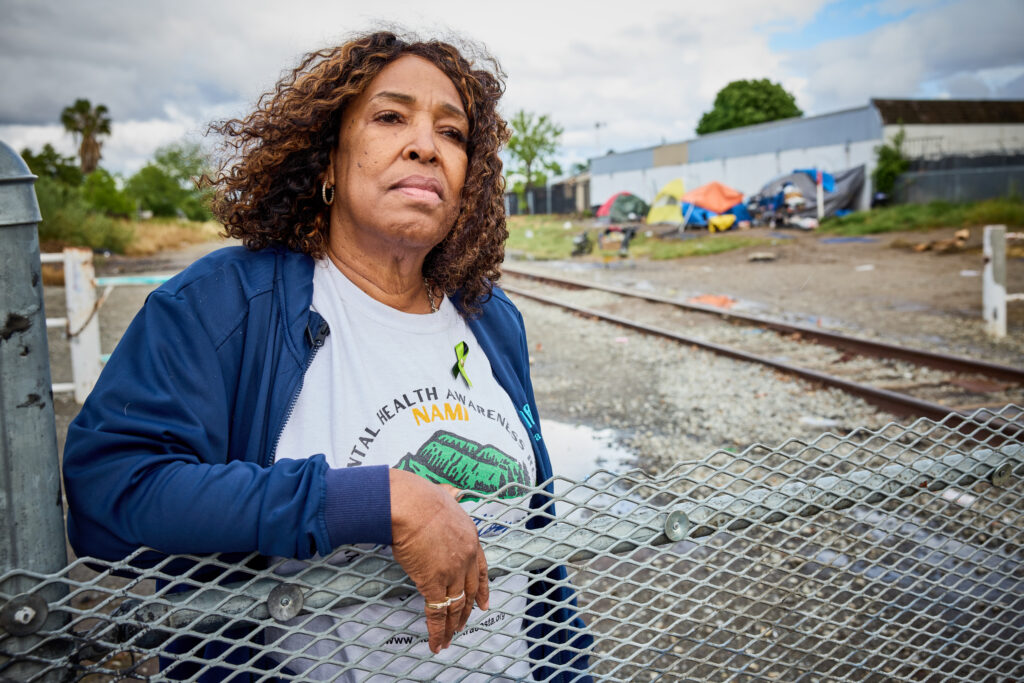 Desiree Rushing pauses for a portrait at an encampment in Antioch, where she leads weekly outreach bringing food, supplies, and resources to unhoused residents. Gabriela Hasbun for California Health Report/CatchLight
Sifting through a dark history for solutions
After their experiences advocating for their sons, and hearing about cases like Johnson’s, Rippee’s and the people Rushing helps, the moms have lately become passionate about advancing laws like SB 43, an update to the Lanterman-Petris-Short (LPS) Act, the legislation that allows for 5150 psychiatric holds. SB 43 went into full effect statewide in January and it now allows up to 72-hour holds in county-designated facilities or hospitals for people with a mental health disorder or severe substance use disorder who are unable to provide for their own basic needs — such as food, clothing or shelter.
Going one step further, the women are now a part of a group of advocates bringing attention to the somewhat archaic LPS code 5200, which they argue could be employed to enforce a more complete psychiatric evaluation — rather than just a hold. This, they say, is the best shot at housing and humane stabilization for those who need treatment but initially decline it themselves — often due to symptoms of their mental illness such as anosognosia or florid psychosis. The moms’ experiences make them realists.
“A lot of people think getting people who have serious mental illness help is just about building trust. I wish it were that easy, but it’s not,” Rettagliata said.
Involuntary holds and treatment are not without controversy, though. In the 19th and early-20th century U.S., people with mental illnesses — or those who were thought to have mental illnesses — were at times committed to asylums without consideration for their rights. Because of that legacy, there remain staunch opponents to involuntary treatment who argue that patients lose freedom, privacy and other civil rights. But advocates counter that not treating people, even if the initial treatment is involuntary, and then not providing the right housing with wrap around services is simply akin to giving up.
Rushing has thought long and hard about this issue. “If I were suffering like I see some of the people out there suffering, I’d want someone to intervene,” she said. “Mental health is a medical condition and it’s not right to just leave them like this.”
Letting people with a serious mental illness “die with their rights on” is definitely not the answer, Pasquini said, referencing a 1974 American Medical Association article by Dr. Darold Treffert that’s become well known in the mental health advocacy world. Treffert was one of the first to acknowledge the dilemma and the potential danger of not treating someone who clearly needs help for fear of infringing on the person’s civil rights.
 A person walks alongside an encampment near train tracks in Antioch. Gabriela Hasbun for California Health Report/CatchLight
The ideal scenario, though, is to deliver care before the situation is dire, said Karen Larsen, CEO of the Steinberg Institute, a mental health advocacy organization. “Our hope would be that our systems could intervene prior to hospitalization and definitely prior to court involvement.”
Le Ondra Clark Harvey, CEO of the California Behavioral Health Association (CBHA), agrees that too often laws have reinforced a crisis-driven approach, where people must reach the most acute level of suffering before qualifying for help. “We need a continuum that serves people with serious mental illness well before they reach that point because prevention, stability and recovery are far more humane and cost-effective than crisis response.”
There’s been a statewide cacophony of advocate voices leading to the passage of recent helpful legislation. In December 2024, The California Community Assistance, Recovery, and Empowerment (CARE) Act (SB 1338) went into effect. CARE creates a civil process to provide mental health treatment, housing and support services to people with untreated schizophrenia or other psychotic disorders. While many advocates say CARE hasn’t worked as well as they’d hoped, they still see it as a step in the right direction.
In addition, there’s Proposition 1 — the Behavioral Health Services Act (BHSA), which was passed by California voters in March 2024. BHSA is a ballot measure that authorized billions of dollars to fund treatment and supportive housing for people living on the streets and facing mental health challenges. CBHA released a policy white paper last year explaining how counties can now use the BHSA funds and other mechanisms to pay for housing that heals — that is, appropriate housing plus a continuum of services. The white paper uses a case study to show an example of how an intensive and comprehensive service model for the most challenging clients — costing $300 per client, per day — can be fully supported through Medi-Cal and BHSA funding.
At home, Rettagliata and Pasquini are proud to say they were major forces behind Contra Costa County successfully applying for some $100 million in BHSA funds, some of which will support a mental health rehabilitation center. Contra Costa is the only densely populated county without a mental health rehabilitation center, which is a safe facility where people in the throes of the most serious mental health issues can find housing and get treatment. The county has identified a building to repurpose as a center but has not announced when it will open its doors.
Today, both Rettagliata’s and Pasquini’s sons are stable and appropriately housed — something they don’t take for granted. As aging parents, they worry about the day their sons won’t have them. But every day there are plenty of reminders that their work isn’t done. “We still have just an overwhelming number of people with serious mental illness who are on our streets and in our jails who should not be,” Pasquini said. “We’re proud of our state. We’re proud of what we’ve done, but we’re still not there yet.”
Reporter Lauren DeLaunay Miller contributed to this story.
Visuals Editing by Alyssa Schukar at CatchLight.
California Health Report is part of the Mental Health Parity Collaborative, a group of newsrooms
that are covering stories on mental health care access and inequities in the U.S. The partners on the collaborative include The Carter Center and newsrooms in select states across the country.
This story was produced in partnership with CatchLight as part of their three-year Mental Health Visual Reporting Initiative.
Mental Health Support:
National Alliance on Mental Illness’ guide to shaping mental health discussions on schizophrenia and psychosis
National Alliance on Mental Illness’ advocacy page
Latinx Therapy directory
Immigrant Rising’s list of BIPOC and LGBTQ+ mental health directories and hotlines
Asian Mental Health Collective therapist directory
UndocuHealth mental health directory
National Suicide Prevention Lifeline: call or text 988. Multiple language services available
National Alliance on Mental Health: 1 (800) 950-6264 or text NAMI to 741741
BIPOC Blackline mental health hotline: 1 (800) 604-5841
Mental Health America’s transgender+ communities mental health resources
This article first appeared on California Health Report and is republished here under a Creative Commons Attribution-NoDerivatives 4.0 International License.