
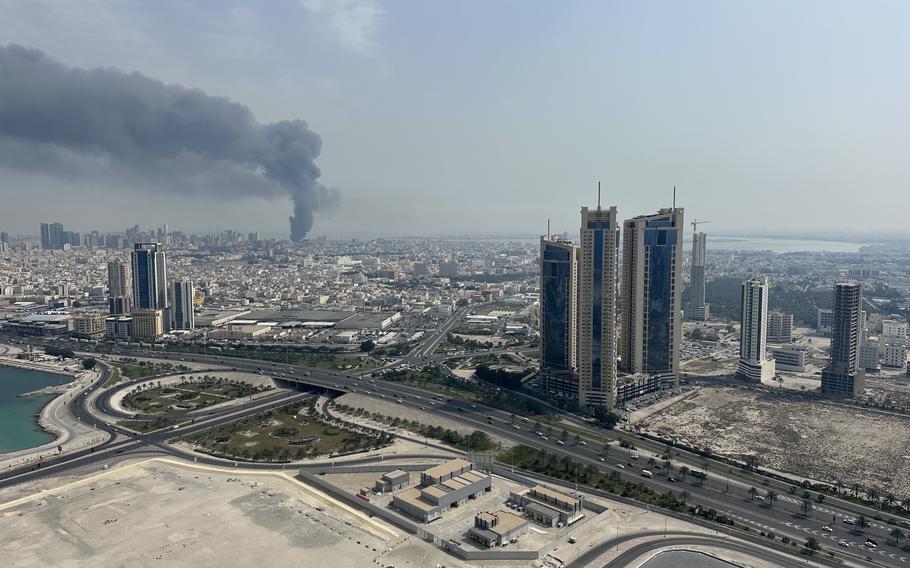
Manama, Bahrain, February 28, 2026. A column of black smoke rises over the skyline following the first strike on U.S. Naval Support Activity Bahrain, seen from across the city. (Shannon Renfroe/Stars and Stripes)
A car door slams outside, and the sailor flinches. His chest tightens. His breath catches. It’s what his body does now, against his will.
Two months ago, he was sheltering in Bahrain, listening to Iranian missiles and drones hit close enough to shake the walls. He never knew when the next attack was coming or where it would land.
A few days in, he woke to a string of nearby strikes and began shaking uncontrollably. It was the first panic attack of his life.
Now, almost every slamming door sounds like one of those impacts. When a plane passes overhead, the panic returns.
“It’s such a strange feeling that something like that can have that much control over me, elicit that much of a response from me,” he said.
He is among thousands of sailors, military family members and Defense Department civilians who evacuated from Naval Support Activity Bahrain after Iranian missile and drone strikes began hitting the island on Feb. 28, in retaliation for U.S. and Israeli attacks on Iran at the start of the war.
The evacuees were part of a forward-stationed community, with schools, a commissary and the everyday routines of American life overseas, suddenly inside the impact radius of a war.
The sailor and his family are now safe. But the effects have lingered in ways that are harder to see.
In the weeks after the Bahrain evacuation — one of the largest emergency movements of U.S. military-linked personnel in recent history — evacuees described panic, hypervigilance and delayed stress after experiencing wartime attacks without the support systems typical of combat deployments.
In previous interviews with Stars and Stripes, some who left Bahrain expressed frustration with what they described as insufficient planning and inconsistent communication from military leadership during the evacuation, and still are reluctant to speak openly about the matter.
In reporting this story, Stars and Stripes spoke to about a dozen sailors, government employees and family members. They were not identified because many feared professional repercussions for discussing their mental health struggles and experiences during the Bahrain evacuation.
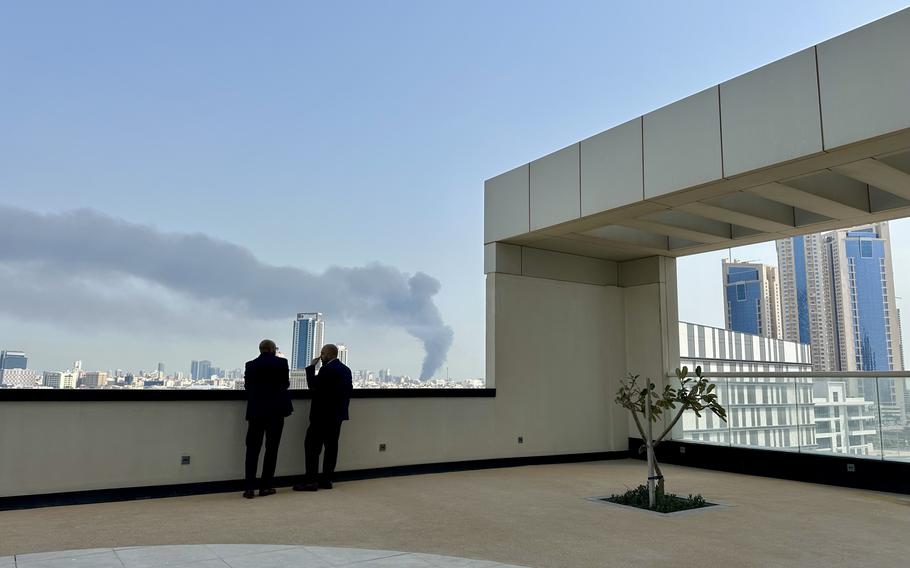
Manama, Bahrain, February 28, 2026. Two members of hotel security at the Hilton look out from a rooftop terrace toward the rising smoke plume in the distance after the first strike on U.S. Naval Support Activity Bahrain. (Shannon Renfroe/Stars and Stripes)
A first war
The Defense Department spent over two decades building mental health systems around the wars in Iraq and Afghanistan, including pre-deployment briefings, post-deployment screenings and Veterans Affairs pathways tied to PTSD from combat service. But the system does not neatly map onto the people who left Bahrain.
The evacuation is now forcing some of those structures to adapt to a population that falls somewhere between a combat deployment and a civilian disaster response.
U.S. Central Command, which oversees operations in the region, told Stars and Stripes on Monday that evacuees will be offered the same post-deployment screenings used for troops returning from combat theaters.
But the Bahrain evacuees are not returning from war in the traditional sense. Many were sailors living with spouses and children in what had felt, until days earlier, like an ordinary overseas posting.
For most younger sailors, the experience was far outside anything they had seen in uniform. The Navy’s combat exposure during the post-9/11 wars was narrower than that of the Army or Marine Corps, aside from special operations and programs such as Individual Augmentee, which sent thousands of sailors into ground combat billets in Iraq and Afghanistan.
Most junior enlisted sailors serving today entered the Navy after the August 2021 withdrawal from Afghanistan. Except for the Red Sea engagements against Houthi missile and drone attacks since late 2023, most have never been on the receiving end of enemy fire.
Under fire
One sailor was in her apartment in Juffair, the neighborhood surrounding NSA Bahrain, watching a rebroadcast of President Donald Trump’s speech announcing the Iran strikes, when the first missile-threat alert came over her phone. She didn’t know what to do.
She was outside during the initial impact. Her first thought was that a U.S. missile-defense system had launched; it never occurred to her that her apartment could come under attack. The shockwave hit before she understood what had happened, making her physically sick.
As she opened her door to seek refuge on a lower floor, the second strike came. She remembers the hallway windows blowing open, the shockwave moving through her chest like bass at a concert, and herself screaming.
In the hallway, she caught a glimpse of her tear-stained face in a mirror, and the thought arrived all at once — Is this just the base, or are they going to start bombing us here?
According to the VA’s National Center for PTSD, roughly one in five people exposed to traumatic events develops acute stress disorder within a month. Research has found that intentional trauma — combat, terror attacks and assaults — tends to produce more persistent PTSD symptoms than accidents or natural disasters.
For the female sailor, what’s left two months later is anger, directed less at Iran than at the comparison game that she feels has followed her out of Bahrain. People who deployed to Iraq or Afghanistan insist they understand. But those who go to combat zones, she points out, arrive prepared; they are armed and they know they may not return home for a while. Her situation was different. Bahrain was home, and she had to leave it on an hour’s notice.
At this point, she said, she feels closer to a refugee than to a sailor.
“I felt very cowardly for a week,” she said. “I couldn’t do anything to help myself.”
In the weeks since, she has realized she wasn’t processing any of it in Bahrain. She was in survival mode. From the outside, she looked calm, even annoyed with sailors who were visibly afraid. The processing came later.
After she started journaling and talking to other evacuees, she learned that no two are coming out of it the same way.
Four trajectories
What she’s describing has been studied for decades. Researchers have a term for the numbed, on-autopilot state she was in: peritraumatic dissociation, a common response in which processing comes later, once the person is safe.
A 2018 review of 54 trauma studies by Columbia University psychologist George Bonanno found that people process trauma differently: some recover quickly, some slowly, some develop lasting PTSD symptoms and others appear fine before symptoms emerge later.
Two months after they fled, Bahrain evacuees describe a wide range of reactions.
For the sailor who watched the strikes from her apartment in Juffair, life feels filled with questions. When will she be reunited with her possessions? When will she see her friends from Bahrain? She tries not to think about it constantly, she said. But the sadness comes in unpredictable waves, before passing.
Family burden
Spouses and children are in even stranger territory. They likely prepared only as much as their previous post’s family-readiness brief had asked of them.
Much of the research on military-family trauma focuses on deployment separation and reintegration afterward.
The Bahrain evacuees invert that experience: many of the service members were at home with family when the war arrived at their door.
One sailor remembers an evacuation drop-off point in Bahrain crowded almost entirely with spouses and children. He watched his wife leave without knowing whether he would see her again. That night, he smoked his first cigarette in years.
The psychological impacts likely extend beyond Bahrain. U.S. installations across the region – including Kuwait, Qatar, Saudi Arabia and the United Arab Emirates – also came under Iranian fire during the war. Fourteen U.S. service members have died during the broader conflict, including seven killed in attacks on regional bases.
Hundreds more were wounded, though most have since returned to duty, the Pentagon has said. No deaths were reported within the U.S. military community in Bahrain.
Remote recovery
According to support materials reviewed by Stars and Stripes, the Navy has set up counseling, chaplain support and mental health services for evacuees, largely by phone or video.
While research suggests virtual PTSD treatment can be effective, studies typically focus on patients in long-term, structured therapy rather than short-term crisis support.
Base chaplains, who are talking with evacuees remotely, were contacted for this story, but none agreed to be interviewed.
The Navy-Marine Corps Relief Society distributed roughly $1 million in emergency aid to about 2,000 sailors and families affected by the evacuation, said Dawn Cutler, a retired rear admiral and the society’s chief operations officer. The organization said assistance covered emergency expenses such as food, rent, transportation and pay problems.
U.S. Central Command said Monday it is coordinating follow-on care through military medical facilities and the Defense Health Agency, adding that medical and administrative personnel are working with service members and their families on a case-by-case basis.
The Navy has not told evacuees when, or whether, they’ll return to Bahrain, although CENTCOM commander Adm. Brad Cooper has said he intends to welcome back service members and families as soon as possible.
Not all evacuees are convinced that it will happen. The sailor who opened this story is now in transitional housing in Europe, with no clear idea whether he will return to the life he was building.
Whatever happens next in the Gulf, the effects are already moving through bedrooms at 3 a.m., pediatricians’ offices, school counselors’ calendars and through the reaction that still comes when a door slams far from Bahrain.
“Most of the time it feels normal,” one sailor shared, “until I remember where I am, and that I was never supposed to be here.”