
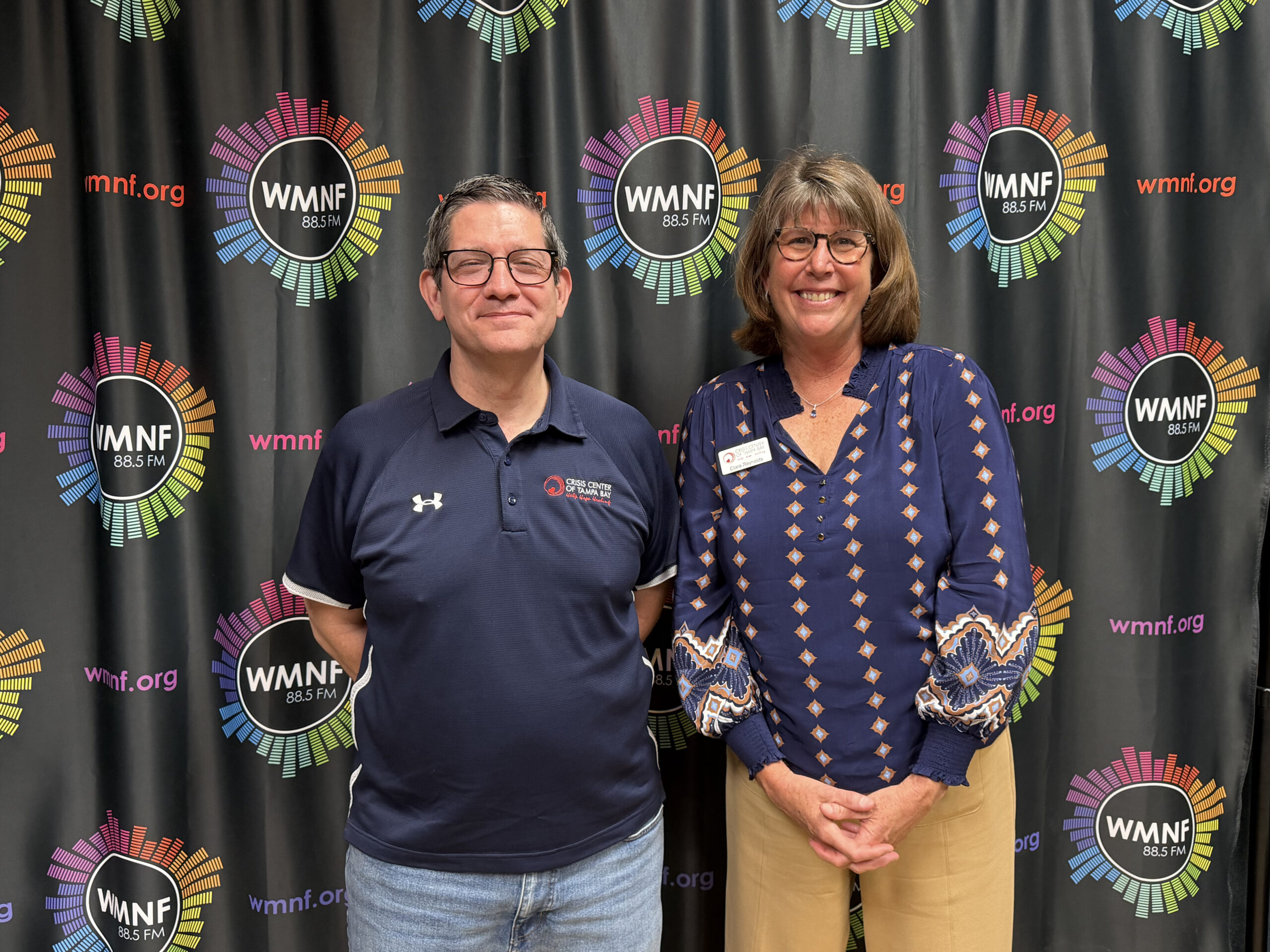
Ken Gibson (L)& Clara Reynolds on MidPoint. Photo by Daria Mironova/WMNF.
May is Mental Health Awareness month and more Tampa Bay residents are reaching out for mental health support than ever before. But leaders from the Crisis Center of Tampa Bay say significant gaps in emergency behavioral care still remain.
On May 20, Clara Reynolds, president and CEO of the Crisis Center of Tampa Bay, and Ken Gibson, senior director of marketing and PR, joined MidPoint to discuss the region’s growing mental health needs, how the community responds to crisis, and available resources.
“Our mission is to ensure that nobody in our community has to face a crisis alone,” Gibson said.
What is a mental health crisis?
The Crisis Center leaders define a crisis as “a challenge in life that needs a solution,” emphasizing that people do not need to wait until a situation becomes severe to seek help.
Clara Reynolds explained that behavioral changes are often the clearest indicators, including increased alcohol or substance use, disrupted sleep, social withdrawal, or noticeable shifts from someone’s normal routines. She encouraged loved ones to trust their instincts, start conversations with concern rather than judgment, and recognize that even if someone is “just struggling,” they still deserve support.
Youth are leading a behavioral health shift
One of the most notable changes since the COVID-19 pandemic has been the growing willingness of younger people to seek mental health help. Reynolds pointed out that younger generations have become more open about seeking therapy and are pushing employers to prioritize emotional well-being alongside physical health.
Gibson added that the pandemic accelerated what the organization had anticipated would be a behavioral health “tsunami.”
Veterans remain a priority population
The Crisis Center has also expanded services for veterans, a group Reynolds said often faces unique barriers when seeking help. She pointed to the creation of the Florida Veterans Support Line, a 24/7 resource staffed by veterans, regardless of discharge status, that connects callers with services both inside and outside the VA system.
“There’s nothing like that peer-to-peer connection,” Reynolds said.
Crisis response gaps
One of the biggest gaps Reynolds identified is greater access to mobile crisis response teams – licensed mental health professionals trained to respond to psychiatric emergencies. She explained that mental health emergencies are often better handled first by trained behavioral health professionals rather than traditional law enforcement responses. A behavioral health specialist may be able to quickly determine whether a person is a danger to themselves or others and whether safety concerns call for a law enforcement response.
“Law enforcement aren’t trained mental health professionals,” Reynolds said. “They are incredible individuals doing the very best with the skill sets they have, but mobile crisis response is the emergency response that should be available.”
The Crisis Center has already helped reshape crisis response in Tampa through a partnership with the Tampa Police Department, which trains behavioral health dispatch operators to quickly and accurately assess callers’ needs for mental health assistance.
Knowing when to call 911, 988, or 211
The MidPoint guests emphasized that knowing which number to call can make a critical difference.
Call 911 – if someone is in immediate danger or has access to lethal means, such as a firearm or another weapon.
Call 988 – for mental health crises, suicidal thoughts, emotional distress, or concern about a loved one.
Call 211 – for non-urgent support, including housing assistance, food resources, counseling referrals, and other community services.
Both 211 and 988 are answered locally by Crisis Center of Tampa Bay staff 24 hours a day, 365 days a year.
A message for those struggling
Reynolds concluded the MidPoint discussion with a message aimed directly at anyone facing emotional distress.
“It’s okay to not be okay,” she said.
Gibson urged people not to isolate. He encouraged anyone who is struggling with emotional distress to reach out to someone they trust, whether that’s a friend, colleague, faith leader, or mental health professional.
The Crisis Center of Tampa Bay, a nonprofit that has served the region for more than 50 years, provides a wide range of services that extend far beyond a traditional hotline. Those include operating the 988 Suicide & Crisis Lifeline locally, staffing the 211-community resource line, providing behavioral health ambulance transport, rape crisis services, trauma counseling, and youth and family behavioral health programs.
To learn more about the Crisis Center of Tampa Bay resources, please visit their website.
You can listen to this entire MidPoint show on demand from the archive here, on the WMNF app, or as a WMNF MidPoint podcast on Spotify or Apple Music.